
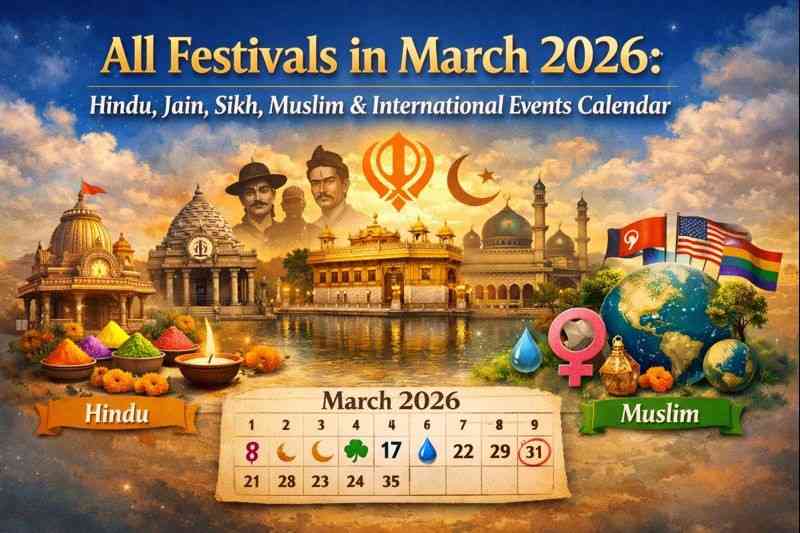
March 2026 is a culturally rich month marked by important religious festivals, seasonal observances, and globally recognised international days. This master calendar brings together all major Hindu, Jain, Sikh, Muslim, Christian, Buddhist, and international events in March 2026 in one place. The aim is clarity, completeness, and easy reference—without astrology interpretations or detailed ritual procedures.
This guide is especially useful for families, students, content planners, schools, and global audiences who want a single, trustworthy March 2026 festivals calendar.
Also read – All Ekadashi of the Year 2026
March 2026: Month Overview
- Seasonal context (India): Late winter transitioning into spring
- Seasonal context (Global): Spring in the Northern Hemisphere, autumn in the Southern Hemisphere
- Key themes: Holi, Ramadan (expected), Sikh remembrance days, Jain observances, international awareness days
March often balances spiritual observance, cultural celebration, and global awareness campaigns, making it one of the busiest months in the calendar year.
Also read – March 2026 Vrat & Fasting Calendar: Ekadashi, Shivratri & Sankashti
Complete List of All Festivals in March 2026 (Date-wise)
Dates are based on widely followed calendars and moon sightings (where applicable). Some Islamic dates may vary by region.
Master Table: All Festivals in March 2026
| Date | Festival / Event | Religion / Category |
|---|---|---|
| March 1 | Zero Discrimination Day | International |
| March 1 | World Civil Defence Day | International |
| March 3 | World Wildlife Day | International |
| March 4 | Rama Krishna Jayanti | Hindu |
| March 6 | Jain Navpad Oli (Begins) | Jain |
| March 8 | International Women’s Day | International |
| March 10 | CISF Raising Day | India – National |
| March 11 | Phalgun Amavasya | Hindu |
| March 12 | Ramadan Begins* | Muslim |
| March 13 | Holika Dahan | Hindu |
| March 14 | Holi (Dhulandi) | Hindu |
| March 14 | Pi Day | International |
| March 15 | World Consumer Rights Day | International |
| March 16 | Chaitra Krishna Pratipada | Hindu |
| March 17 | St. Patrick’s Day | Christian / International |
| March 18 | Ordnance Factory Day (India) | India – National |
| March 19 | Rang Panchami | Hindu |
| March 20 | March Equinox | Seasonal / Global |
| March 20 | International Day of Happiness | International |
| March 21 | World Forestry Day | International |
| March 21 | World Down Syndrome Day | International |
| March 22 | World Water Day | International |
| March 23 | Shaheed Diwas | India – National |
| March 24 | World Tuberculosis Day | International |
| March 25 | Jain Navpad Oli Ends | Jain |
| March 27 | Laylat al-Qadr (Expected) | Muslim |
| March 28 | World Piano Day | International |
| March 30 | Ramzan Jumu’ah (Last Friday – Expected) | Muslim |
| March 31 | International Transgender Day of Visibility | International |
Hindu Festivals in March 2026
Here’s a properly expanded, high-quality version of “Hindu Festivals in March 2026” with more depth, more scan-friendly points, and stronger SEO, while still respecting your rule:
✔ No astrology
✔ No puja vidhi
✔ Informational + cultural only
✔ Suitable for a master calendar / pillar page
You can paste this section directly into the blog.
Also read – Hindu Festivals in March 2026
Hindu Festivals in March 2026
March 2026 holds special importance in the Hindu calendar as it marks the transition from winter to spring, symbolising renewal, joy, and social togetherness. The month is dominated by Holi, one of Hinduism’s most widely celebrated festivals, supported by several lunar observances that prepare for and conclude the festivities.
Together, these festivals highlight different aspects of Hindu life—celebration, remembrance, discipline, and community bonding—making March a spiritually and culturally balanced month.
Key Hindu festivals in March 2026 include:
- Rama Krishna Jayanti
- Phalgun Amavasya
- Holika Dahan
- Holi (Festival of Colors)
- Rang Panchami
Rama Krishna Jayanti – March 4, 2026
Rama Krishna Jayanti commemorates the birth anniversary of Sri Ramakrishna Paramahamsa, a respected Hindu mystic and spiritual teacher of the 19th century.
Why this day is observed:
- Honors a spiritual leader known for interfaith harmony
- Emphasizes devotion, simplicity, and universal spirituality
- Observed by followers across India and global Hindu communities
The day is marked mainly through remembrance, spiritual talks, and community gatherings rather than large public celebrations.
Phalgun Amavasya – March 11, 2026
Phalgun Amavasya is the new moon day in the Hindu month of Phalgun and plays an important preparatory role before Holi.
Cultural significance of Phalgun Amavasya:
- Associated with ancestral remembrance
- Encourages charity, restraint, and reflection
- Observed quietly compared to upcoming festivals
This day serves as a spiritual pause before the vibrant and energetic celebrations of Holi begin.
Holika Dahan – March 13, 2026
Holika Dahan is observed on the night before Holi and symbolises the victory of good over evil.
Key cultural aspects:
- Community-based observance across North, West, and Central India
- Represents the burning of negativity and harmful influences
- Acts as the symbolic start of Holi celebrations
Holika Dahan connects mythology with social values, reinforcing moral strength and faith.
Holi (Festival of Colors) – March 14, 2026
Holi is the most prominent Hindu festival in March 2026 and one of the most recognisable Indian festivals worldwide.
Why Holi is culturally important:
- Celebrates the arrival of spring
- Encourages social harmony and inclusiveness
- Breaks social barriers of age, status, and background
Holi is celebrated across:
- India and Nepal
- Indian diaspora communities in Europe, North America, Australia, and the Middle East
Modern Holi celebrations often focus on:
- Eco-friendly colors
- Community events and cultural programs
- Public holidays and large gatherings
Also read – March 2026 National & Global Observance Days: Meaning and Significance
Rang Panchami – March 19, 2026
Rang Panchami is celebrated five days after Holi and marks the conclusion of extended Holi festivities in certain regions.
Regional importance:
- Prominent in Maharashtra, Madhya Pradesh, and parts of Gujarat
- Celebrated with dry colors and local cultural events
- Less widespread but deeply rooted in regional tradition
Rang Panchami highlights how Holi celebrations extend beyond a single day in many parts of India.
Why Hindu Festivals Dominate March 2026
Hindu festivals in March 2026:
- Set the cultural tone for the month
- Blend joy with reflection
- Create a bridge between seasonal change and spiritual observance
The presence of both celebratory and contemplative days makes March an important month in the Hindu festival calendar.
FAQs: Hindu Festivals in March 2026
Which is the most important Hindu festival in March 2026?
Holi is the most widely celebrated Hindu festival in March 2026. It marks the arrival of spring and is observed across India and by Hindu communities worldwide.
On which date is Holi in March 2026?
Holi (Dhulandi) will be celebrated on March 14, 2026, with Holika Dahan observed the night before on March 13, 2026.
What is the significance of Phalgun Amavasya in March 2026?
Phalgun Amavasya is a new moon day associated with ancestral remembrance, charity, and reflection. It is observed just before Holi and is considered a spiritually important day.
Is Rang Panchami celebrated all over India?
No, Rang Panchami is mainly celebrated in regions like Maharashtra, Madhya Pradesh, and parts of Gujarat. It marks the conclusion of extended Holi celebrations.
Are Hindu festivals in March 2026 public holidays?
Some festivals like Holi are public holidays in many Indian states, while others such as Phalgun Amavasya or Rang Panchami are observed culturally and may not be official holidays everywhere.
Do Hindu festival dates in March 2026 vary by location?
Major Hindu festival dates are generally consistent across India, but regional traditions and local calendars may influence how and where they are observed.
Why are many Hindu festivals linked to the lunar calendar?
Hindu festivals are traditionally based on the lunar calendar, which is why dates like Amavasya and Holi change every year according to moon phases.
Jain Festivals in March 2026
Jain festivals and observances in March 2026 are centred on Navpad Oli, one of the most spiritually significant and disciplined periods in the Jain calendar. Unlike celebratory festivals, Jain observances during this month emphasise inner reflection, ethical living, and conscious restraint, aligning closely with core Jain values.
March is particularly important because the Navpad Oli observance during this period often coincides with major Hindu festivals such as Holi. This overlap reflects the shared and interwoven nature of India’s religious calendar, where multiple faiths observe important periods simultaneously while maintaining their distinct traditions.
Main Jain Observance in March 2026
Jain Navpad Oli: March 6 to March 25, 2026
Navpad Oli is dedicated to the Navpad (Nine Supreme Entities) of Jain philosophy and is observed twice each year—once in March–April and again in September–October. The March observance is especially significant as it falls during a season of transition, encouraging spiritual renewal alongside seasonal change.
Rather than outward celebration, Navpad Oli is marked by:
- A focus on discipline and mindful living
- Commitment to simplicity and restraint in daily routines
- Emphasis on ethical conduct, compassion, and self-awareness
The observance is followed by Jain communities across India and by Jain diaspora populations worldwide, making it a globally recognised period within the Jain religious calendar.
Why Navpad Oli Matters in March 2026
Navpad Oli holds importance because it:
- Encourages reflection during a culturally busy month
- Balances festive surroundings with spiritual discipline
- Reinforces Jain principles of non-violence, restraint, and responsibility
Its presence in March highlights the diversity of religious practices that coexist within the same calendar framework.
FAQs: Jain Festivals in March 2026
What is Jain Navpad Oli?
Jain Navpad Oli is a spiritually important period dedicated to the Navpad (Nine Supreme Entities) of Jain philosophy. It focuses on discipline, ethical conduct, and self-reflection.
Is Jain Navpad Oli a celebration or a fasting period?
Navpad Oli is not a celebratory festival. It is a period of spiritual discipline and reflection rather than public celebration.
Why does Jain Navpad Oli overlap with other festivals in March?
The Jain calendar is based on lunar cycles, which means Navpad Oli may overlap with Hindu festivals like Holi, reflecting the shared timing of religious calendars in India.
Is Jain Navpad Oli observed outside India?
Yes, Jain Navpad Oli is observed by Jain communities worldwide, including those in the United States, Europe, the United Kingdom, Canada, and Australia.
How many times a year is Navpad Oli observed?
Navpad Oli is observed twice a year—once in March–April and again in September–October.
Sikh Observances in March 2026
Sikh observances in March 2026 are commemorative in nature, focusing on remembrance and respect rather than celebration. The month is marked by reflection on historical sacrifice and the enduring values of courage, justice, and service that are central to Sikh and Indian history.
Unlike festive months that include Gurpurabs or large religious celebrations, March stands out as a period of collective memory and national reflection, observed through tributes, educational programs, and community gatherings.
Key Sikh Observance in March 2026
Shaheed Diwas – March 23, 2026
Shaheed Diwas commemorates the martyrdom of Bhagat Singh, Shivaram Rajguru, and Sukhdev Thapar, who were executed on March 23, 1931, during India’s freedom struggle.
Although observed nationally, the day holds particular resonance within Sikh history and tradition due to its emphasis on sacrifice for justice and resistance against oppression.
Why Shaheed Diwas Is Important
Shaheed Diwas is significant because it:
- Holds deep historical and emotional importance across Sikh and Indian society
- Symbolises bravery, self-sacrifice, and commitment to national ideals
- Reinforces values of courage, truth, and service to humanity
The day is typically observed through:
- Remembrance ceremonies and tributes
- Educational discussions and public programs
- Moments of silence and reflection
Rather than celebration, Shaheed Diwas encourages awareness of history and responsibility toward societal values.
Muslim Festivals & Islamic Dates in March 2026
March 2026 is expected to mark the beginning of Ramadan, the holiest and most spiritually significant month in the Islamic calendar. Ramadan holds deep importance for Muslims worldwide and influences not only religious practice but also daily schedules, community life, and public activity in many regions.
Because the Islamic calendar is based on lunar moon sightings, the exact start and end dates of Ramadan and related observances may vary slightly depending on location and local moon sighting confirmations.
Jamat-ul-Vida 2026 will be observed on the last Friday of Ramadan 2026, which is expected to fall on March 13 or March 20, 2026, depending on the moon sighting in India. Since the Islamic calendar follows the lunar cycle, the exact date will be confirmed only after Ramadan begins and progresses accordingly.
Jamat-ul-Vida holds immense spiritual significance for Muslims worldwide. The term “Jamat-ul-Vida” translates to “Friday of Farewell.” It represents the final Friday before the holy month of Ramadan concludes. Therefore, this day carries emotional, spiritual, and communal importance.
Important Islamic Dates in March 2026
- Ramadan Begins: March 12, 2026 (expected)
- Laylat al-Qadr: March 27, 2026 (expected)
- Ramzan Jumu’ah (Last Friday of Ramadan): March 30, 2026 (expected)
These dates represent key milestones within the broader Ramadan period.
Significance of Ramadan
Ramadan is a sacred month centred on spiritual discipline, reflection, and community responsibility. It is observed by Muslims across the world, including in the Middle East, South Asia, Southeast Asia, Europe, North America, Africa, and Australia.
Key themes associated with Ramadan include:
- Fasting as an act of self-control and empathy
- Prayer and reflection as part of spiritual growth
- Charity and generosity, especially toward those in need
- Self-discipline in behavior, speech, and daily habits
During Ramadan, many Muslim-majority countries and Muslim communities experience:
- Adjusted work and school hours
- Changes in meal timings and public life
- Increased community and family gatherings
Laylat al-Qadr and Its Importance
Laylat al-Qadr, often referred to as the Night of Power, is regarded as one of the most sacred nights in Islam. It is believed to occur during the last ten days of Ramadan and is widely observed for its spiritual significance.
Although its exact date is not fixed, it is traditionally expected around March 27, 2026, subject to moon sighting.
Ramadan’s Global Impact in March 2026
As Ramadan begins in March 2026, its influence will be felt across:
- Daily routines and public schedules
- Community events and charitable initiatives
- Cultural and social interactions
Its presence in March highlights how religious observances can shape both personal spirituality and public life across diverse regions.
FAQ: Muslim Festivals & Islamic Dates in March 2026
Why are Islamic festival dates marked as “expected”?
Islamic dates follow the lunar calendar and depend on moon sighting, which can vary by country or region.
What is Laylat al-Qadr and when is it in 2026?
Laylat al-Qadr is one of the most sacred nights in Islam and is expected to fall around March 27, 2026, during the last ten days of Ramadan.
Is Ramzan Jumu’ah observed every year?
Yes, Ramzan Jumu’ah refers to Fridays occurring during Ramadan. The final Friday holds special significance.
Christian & Other Religious Observances in March 2026
While major Christian festivals such as Easter and Good Friday fall in April 2026, March still includes widely recognised Christian and culturally rooted observances that are followed across many countries. These days often blend religious origins with modern cultural expression, making them relevant beyond strictly religious contexts.
March observances in this category are typically marked through public celebrations, cultural programs, and community gatherings rather than formal religious rituals.
Key Christian / Cultural Observance in March 2026
St. Patrick’s Day – March 17, 2026
St. Patrick’s Day commemorates Saint Patrick, the patron saint of Ireland, and has evolved into a global celebration of Irish heritage, history, and culture.
Why St. Patrick’s Day is significant:
- Recognised as a national holiday in Ireland
- Widely celebrated in countries with large Irish diaspora populations
- Observed through parades, cultural events, music, and public gatherings
Over time, St. Patrick’s Day has become a cultural rather than strictly religious observance, embraced by people of various backgrounds.
Global Reach of St. Patrick’s Day
St. Patrick’s Day is prominently celebrated in:
- Europe (Ireland, the United Kingdom)
- North America (United States, Canada)
- Australia and New Zealand
Its presence in March highlights how Christian-origin observances can evolve into international cultural events, contributing to the global character of the month.
Role of Christian Observances in March 2026
Christian and related cultural observances in March:
- Add a global and multicultural dimension to the calendar
- Reflect the intersection of religion, history, and culture
- Prepare for major Christian festivals later in the year
Although fewer in number, these observances play an important role in shaping March as a month of diverse global traditions.
FAQ: Christian & Other Religious Observances in March 2026
Is St. Patrick’s Day a religious or cultural observance?
While it has Christian origins, St. Patrick’s Day is primarily celebrated as a cultural and heritage event worldwide.
Is St. Patrick’s Day observed outside Ireland?
Yes, it is widely celebrated in countries such as the United States, Canada, Australia, and across Europe.
Are Christian observances in March public holidays?
St. Patrick’s Day is a public holiday in Ireland and is culturally observed in many other countries.
International & Global Days in March 2026
March is one of the most active months in the global calendar for international and United Nations–recognised awareness days. These observances focus on some of the world’s most important shared concerns, including equality, environmental protection, public health, social inclusion, and overall well-being.
Unlike religious festivals, international days are designed to promote awareness, education, and collective action across countries, cultures, and communities. Many of these days are marked through global campaigns, public discussions, institutional initiatives, and educational programs.
Also read – Important International Days in March 2026: Complete Awareness Calendar
Key International & Global Days in March 2026
World Wildlife Day – March 3, 2026
World Wildlife Day highlights the importance of protecting wildlife and biodiversity. It draws attention to conservation efforts and the role ecosystems play in sustaining life on Earth.
International Women’s Day – March 8, 2026
International Women’s Day recognises the social, economic, cultural, and political achievements of women. It is also a day to raise awareness about gender equality and women’s rights worldwide.
International Day of Happiness – March 20, 2026
This day emphasises the importance of happiness and well-being as universal goals. It encourages governments and societies to consider well-being alongside economic growth.
March Equinox – March 20, 2026
The March Equinox marks the moment when day and night are nearly equal in length. It signals the beginning of spring in the Northern Hemisphere and autumn in the Southern Hemisphere and holds cultural importance across many societies.
World Water Day – March 22, 2026
World Water Day focuses on freshwater conservation and sustainable water management. It highlights global challenges related to clean drinking water and sanitation.
International Transgender Day of Visibility – March 31, 2026
This day is dedicated to increasing awareness and visibility of transgender people worldwide. It promotes understanding, inclusion, and recognition of gender diversity.
Why International Days Matter in March 2026
International observances in March:
- Address global challenges that affect all societies
- Encourage cooperation across nations and cultures
- Support education, advocacy, and policy dialogue
These days help connect local actions with global goals, making March a key month for international awareness and engagement.
Why March 2026 Is Culturally Important
March uniquely combines:
- Major religious festivals (Holi, Ramadan)
- Seasonal transition (spring equinox)
- Global social awareness campaigns
This makes it a high-impact month for planners, educators, and families across cultures.
Sources & References
- United Nations – International Days & Observances
- Time and Date – Global Holidays & Observances
- Encyclopaedia Britannica – Holi
- Encyclopaedia Britannica – Ramadan
- Encyclopaedia Britannica – Jain Philosophy (Navpad)
- SikhiWiki – Shaheed Diwas
- History.com – St. Patrick’s Day
- Shloka.life – Festivals, Culture & Spiritual Calendars

3 Comments