Introduction: Why Understanding an Astrology Chart Matters
Many people feel curious about astrology but also feel overwhelmed when they see a detailed chart filled with symbols and lines. Horoscope columns often spark interest, yet they rarely explain how astrology truly works. This gap leads beginners to ask an important question: astrology chart explained in simple terms, what does it actually reveal?
An astrology chart offers far more than daily predictions. It works as a personal map that reflects your personality, emotional patterns, life direction, and inner potential. Once you understand how it functions, astrology becomes logical, structured, and deeply insightful rather than mysterious or random.
Also Read :- Science vs Astrology: What Astrology Actually Claims
What Is an Astrology Chart?
To begin with, an astrology chart, also known as a birth chart or natal chart, represents the position of celestial bodies at the exact moment and place of your birth. Astrologers calculate it using your date of birth, precise birth time, and birthplace.
Because planetary positions change every few minutes, no two charts remain identical. This uniqueness explains why astrology treats individuals differently even when they share the same zodiac sign. When people search for astrology chart explained, they usually want clarity on how this cosmic snapshot connects directly to real life.
Why an Astrology Chart Is More Than a Zodiac Sign
Many beginners assume astrology begins and ends with Sun signs. However, Sun signs show only one layer of your personality. An astrology chart includes the Moon, Ascendant, planets, houses, and aspects, all working together as a system.
While the Sun reflects your core identity, the Moon governs emotions and instincts. Meanwhile, the Ascendant influences first impressions and outward behavior. Because of this multi-layered structure, astrology charts offer depth and accuracy that zodiac signs alone cannot provide.
The Foundation of an Astrology Chart Explained Clearly
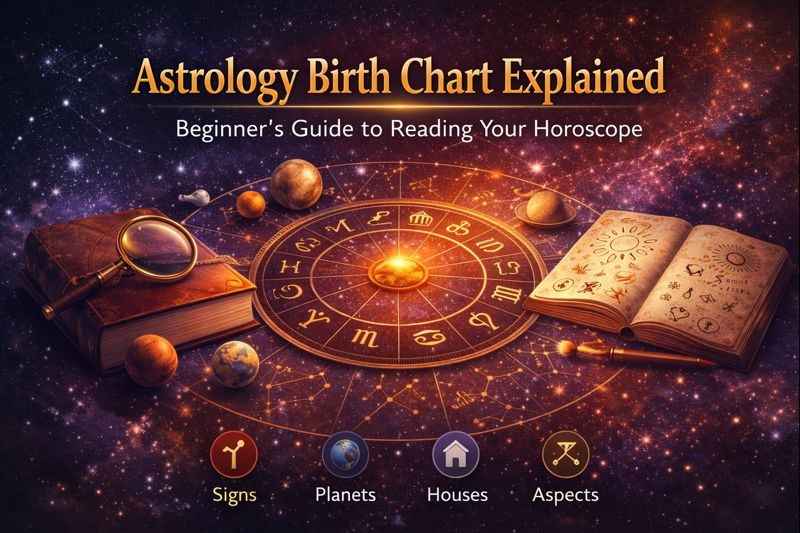
Understanding astrology becomes easier when you break the chart into its core building blocks. Each component answers a different question about your life.
Planets describe what energy operates within you. Zodiac signs explain how that energy expresses itself. Houses reveal where these energies play out in everyday life. Aspects show how different energies interact.
Together, these elements create a living framework rather than a fixed fate.
The Role of Planets in an Astrology Chart
Planets act as the main drivers in your chart. Each planet governs a specific life function.
The Sun reflects identity, confidence, and purpose. The Moon shapes emotions, instincts, and emotional security. Mercury controls thinking, communication, and learning style. Venus influences love, values, beauty, and relationships. Mars directs ambition, action, and courage.
Jupiter expands growth, beliefs, and opportunities. Saturn structures discipline, responsibility, and life lessons. Uranus introduces change, innovation, and independence. Neptune inspires dreams, spirituality, and imagination. Pluto transforms power, healing, and deep psychological shifts.
When astrology chart explained thoroughly, planets become personality traits rather than distant objects.
Zodiac Signs and Their Expression
Each planet operates through a zodiac sign. Signs describe how planetary energy behaves.
Fire signs act with passion and enthusiasm. Earth signs seek stability and practicality. Air signs communicate, analyze, and connect ideas. Water signs feel deeply and respond emotionally.
For example, Mars in Aries acts boldly and directly, whereas Mars in Pisces moves intuitively and gently. This combination approach explains why astrology charts feel personal rather than generic.
Understanding the Twelve Houses
Houses represent different life areas. They answer where planetary energies manifest.
The first house governs self-image and identity. The second house relates to money and values. The third house influences communication and learning. The fourth house focuses on home and emotional roots.
The fifth house expresses creativity and romance. The sixth house handles health and daily routines. The seventh house rules partnerships. The eighth house covers transformation and shared resources.
The ninth house explores beliefs and higher learning. The tenth house defines career and public image. The eleventh house highlights goals and social circles. The twelfth house reveals subconscious patterns and spiritual growth.
When astrology chart explained properly, houses connect cosmic symbolism to daily life experiences.
The Ascendant: Your Entry Point into the World
The Ascendant, also known as the rising sign, marks the zodiac sign on the eastern horizon at birth. It influences how others perceive you and how you approach new situations.
Unlike the Sun sign, the Ascendant changes approximately every two hours. This precision explains why accurate birth time matters so much.
People often resonate strongly with their rising sign once they understand its role, because it shapes behavior, appearance, and first impressions.
Planetary Aspects and Their Meaning
Aspects describe the angles planets form with each other. These angles show how different parts of your personality interact.
Harmonious aspects encourage ease and natural talent. Challenging aspects push growth through tension and learning.
For example, a smooth connection between Mercury and Jupiter supports optimistic thinking, while a tense link between Mars and Saturn demands patience and discipline.
Aspects ensure astrology charts remain dynamic rather than simplistic.
Why Birth Time Accuracy Matters
A few minutes can change house placements and even the Ascendant. Because houses govern life areas, incorrect timing can distort interpretations.
This fact explains why professional astrologers always request exact birth details. When astrology chart explained without accuracy, interpretations lose reliability.
Therefore, beginners should always verify birth records when exploring their charts.
How an Astrology Chart Explains Personality
An astrology chart reveals personality through patterns rather than labels.
Strong fire energy indicates confidence and leadership. Dominant water placements suggest emotional depth and empathy. A chart filled with earth signs values practicality and security.
Instead of boxing people into stereotypes, astrology charts show balance, contrast, and complexity.
Astrology Chart and Emotional Patterns
The Moon and water houses reveal emotional responses. They explain why certain situations feel comforting or stressful.
For instance, a Moon in Cancer seeks nurturing environments, while a Moon in Aquarius values emotional independence.
Understanding these patterns improves self-awareness and emotional intelligence.
Astrology Chart and Career Direction
The tenth house, Saturn, and planetary strengths highlight career inclinations.
Creative charts thrive in artistic fields. Analytical charts excel in research and strategy. Leadership-oriented charts succeed in management roles.
Rather than predicting job titles, astrology charts highlight work environments where individuals feel fulfilled.
Astrology Chart in Relationships
Relationship dynamics depend heavily on Venus, the Moon, and the seventh house.
Charts explain attachment styles, love languages, and partnership expectations.
When astrology chart explained in this context, it helps people navigate conflicts, improve communication, and choose compatible partners wisely.
Predictive Use of Astrology Charts
Astrologers use transits, progressions, and dashas to forecast timing. These techniques activate the birth chart rather than replace it.
This approach explains why predictions remain personal rather than generalized.
Without a natal chart, accurate forecasting becomes impossible.
Common Misconceptions About Astrology Charts
Many beginners believe charts predict fixed destiny. In reality, charts describe tendencies, not unavoidable outcomes.
Others assume astrology lacks logic. However, astrology follows structured rules refined over centuries.
Some fear negative placements. Yet challenging placements often produce resilience and strength.
How Beginners Can Start Reading Their Chart
Start by identifying your Sun, Moon, and Ascendant. Next, observe dominant elements and repeating themes.
Then, study one house or planet at a time. Gradual learning builds confidence and clarity.
Avoid information overload by focusing on patterns rather than isolated details.
Astrology Chart Explained as a Tool for Growth
Astrology does not remove free will. Instead, it offers awareness.
Once people understand their strengths and challenges, they make conscious choices.
This awareness transforms astrology into a guide rather than a prediction system.
Digital Tools and Astrology Charts
Modern platforms generate charts instantly. However, interpretation still requires understanding.
Automated reports help beginners, yet human insight adds depth and nuance.
Using both together creates balanced learning.
Why Astrology Charts Feel Accurate
Accuracy comes from personalization. Charts consider time, place, and planetary movement.
This precision explains emotional resonance and life relevance.
As a result, people feel seen rather than generalized.
Frequently Asked Questions (FAQs)
Frequently Asked Questions (FAQs)
What is an astrology birth chart?
An astrology birth chart is a map of the sky at the exact time and place of your birth. It shows the positions of planets, zodiac signs, and houses, forming your unique astrological blueprint.
Why is the birth time important in astrology?
The exact birth time determines your rising sign (Ascendant) and house placements, which significantly affect personality traits, life themes, and timing interpretations.
What do planets represent in an astrology chart?
Planets represent different aspects of life and personality. For example, the Sun reflects core identity, the Moon represents emotions, and Mercury governs communication.
What are houses in an astrology chart?
Astrological houses represent areas of life such as career, relationships, family, finances, and health. Each planet expresses itself through the house it occupies.
Is astrology chart reading difficult for beginners?
Astrology may seem complex at first, but beginners can start by understanding the basics—planets, signs, and houses—before moving into deeper chart analysis.
Can two people with the same zodiac sign have different charts?
Yes. Even if two people share the same Sun sign, their Moon sign, rising sign, and planetary placements will differ, making every birth chart unique.
An astrology birth chart is a map of the sky at the exact time, date, and place of your birth. It shows the positions of planets, zodiac signs, and houses that form your personal astrological blueprint.
To create an accurate birth chart, you need your date of birth, time of birth, and place of birth. Even a few minutes’ difference in birth time can change house placements.
A birth chart is made up of zodiac signs, planets, twelve houses, and aspects. Together, these elements describe personality traits, life areas, and recurring patterns.
Planets represent different energies and functions of life. For example, the Sun shows core identity, the Moon reflects emotions, and Mercury governs communication and thinking style.
Astrological houses represent specific areas of life such as career, relationships, family, health, and finances. The sign and planet in each house explain how those life areas are experienced.
A birth chart is personalized and remains the same throughout life, while daily horoscopes are general predictions based only on your Sun sign.
No. Beginners can start by understanding the Sun, Moon, and Rising sign, then gradually learn planets and houses step by step.
Astrology charts do not predict exact events. They indicate tendencies, timing cycles, and potential influences that help in self-understanding and decision-making.
The Rising sign is the zodiac sign rising on the eastern horizon at birth. It shapes first impressions, physical appearance, and how you approach life.
Many people find astrology useful for self-reflection and pattern recognition. However, it should be viewed as a symbolic tool rather than a fixed or scientific measure.
Final Thoughts: Astrology Chart Explained as a Lifelong Map
An astrology chart does not define who you must become. Instead, it describes the raw material you work with.
Through awareness, effort, and choice, individuals shape how chart energies express themselves.
Once astrology chart explained fully, it shifts from mystery to meaningful self-knowledge.
By understanding your chart step by step, you gain insight, confidence, and a deeper connection to your life journey.