
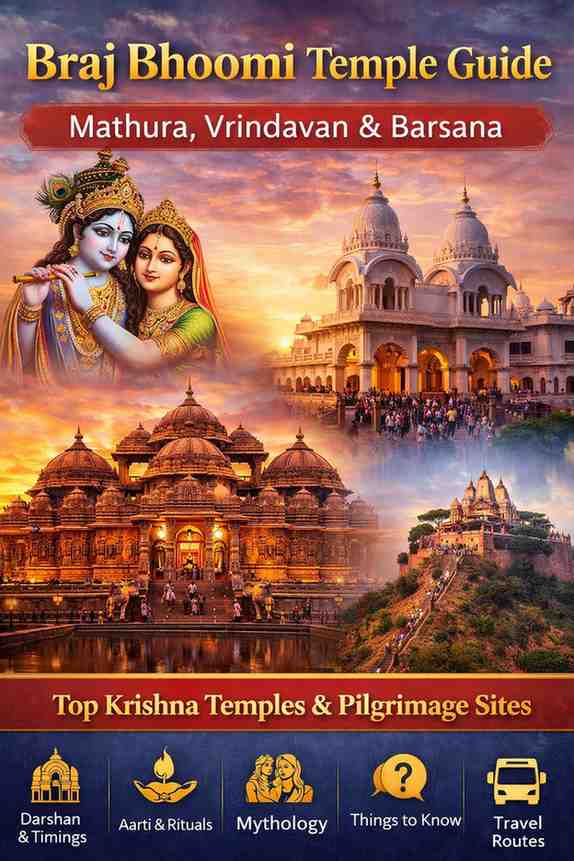
1. Introduction to the Sacred Land of Braj Bhoomi
If you’re looking for a Braj Bhoomi Temple Guide, you’ve come to the right place. Braj Bhoomi is the divine land of Lord Krishna’s birth and leelas.
Every corner of this region radiates spiritual energy and devotion.
The land includes Mathura, Vrindavan, Barsana, Nandgaon, and Govardhan.
Each place tells a story from Krishna’s divine childhood and youth.
Pilgrims from across the world come to seek blessings here.
The region’s name, “Braj,” comes from “Vraj,” meaning pasture or land of cows.
This divine land holds timeless legends and traditions of Lord Krishna.
The sacred Yamuna River flows gently through Braj, purifying souls.
Braj Bhoomi’s atmosphere is filled with bhajans, bells, and incense aroma.
Every visitor feels a deep connection with divine love and peace.
Braj Bhoomi is not just a religious place; it’s a spiritual experience.
The temples, ghats, and forests here hold centuries-old devotion.
The main towns of this sacred circuit are Mathura, Vrindavan, and Barsana.
These three centers preserve the divine pastimes of Krishna and Radha.
Pilgrimage to Braj is considered one of Hinduism’s most sacred journeys.
Travelers walk through lanes filled with chants of “Radhe Radhe.”
The vibe of Braj Bhoomi instantly transforms your heart and soul.
This land continues to inspire saints, poets, and devotees for centuries.
Let’s begin exploring this mystical region’s most important temples and stories.
Also Read :-Golden Temple Amritsar 2026: Sikh Heritage & Daily Rituals
2. Mathura: The Birthplace of Lord Krishna
Mathura stands on the banks of the holy Yamuna River.
It is the birthplace of Lord Krishna, the eighth avatar of Vishnu.
The city is mentioned in ancient scriptures like the Bhagavata Purana.
Mathura’s divine history goes back thousands of years.
It was once a major center of trade and spirituality in ancient India.
The most important temple here is the Krishna Janmabhoomi Temple.
It marks the exact spot where Lord Krishna was born.
Devotees can visit the underground prison cell where he appeared.
The temple complex includes shrines dedicated to several deities.
The air is filled with chants, prayers, and the scent of flowers.
Another famous temple is Dwarkadhish Temple, dedicated to Krishna as the King.
Built in the 19th century, it features intricate architecture and marble work.
The temple becomes especially vibrant during Janmashtami celebrations.
Devotees throng Mathura in millions during Krishna Janmashtami each year.
The Vishram Ghat on the Yamuna River is another sacred site.
It is believed Krishna rested here after killing Kansa, his evil uncle.
Pilgrims take holy dips in the Yamuna before visiting nearby temples.
Evenings at Vishram Ghat are magical with aarti and floating diyas.
The rhythmic chants echo across the river, creating divine vibrations.
Mathura also houses temples like Gita Mandir, Jama Masjid, and Bhuteshwar Mahadev Temple.
Each of them reflects the city’s deep religious and cultural harmony.
Walking through Mathura’s narrow lanes feels like traveling back in time.
Sweets like peda, sold near temples, are a sacred offering here.
Mathura’s energy captures the heart of every pilgrim and tourist alike.
Also Read :- Bhimashankar Jyotirlinga: History, Significance & Travel Tips
3. Vrindavan: The City of Divine Love
Vrindavan lies only 15 kilometers from Mathura.
It is known as the land where Lord Krishna spent his childhood.
Every street here whispers stories of Krishna and Radha’s divine love.
Temples in Vrindavan are countless, each with unique spiritual charm.
The Banke Bihari Temple is one of the most famous shrines.
Here, Krishna is worshipped in his playful, enchanting form.
Devotees believe the idol was revealed to Swami Haridas.
Darshan of Banke Bihari is done in a special manner with curtains.
The priests open and close the curtain repeatedly to protect devotees from his divine intensity.
Another iconic temple is the ISKCON Temple (Sri Krishna Balaram Mandir).
It attracts thousands of international devotees each year.
The temple features white marble architecture and constant kirtans.
Bhakti yoga and Krishna consciousness teachings are shared daily here.
The ISKCON movement began its worldwide expansion from this sacred site.
Prem Mandir, built by Jagadguru Kripaluji Maharaj, is a modern wonder.
Its marble carvings depict scenes from Krishna and Radha’s life.
The temple glows beautifully during evening light shows and aarti.
Visitors experience divine peace and mesmerizing architectural beauty.
Vrindavan also houses Radha Raman Temple, Madan Mohan Temple, and Rangaji Temple.
Each holds a unique legend tied to Krishna’s divine pastimes.
Pilgrims can also visit Seva Kunj, the sacred garden of divine Ras Leela.
It is said Radha and Krishna still dance here every night.
Vrindavan’s streets echo with bhajans and the fragrance of sandalwood.
Devotees chant “Radhe Shyam” as they walk barefoot through the town.
Vrindavan is a place where divine love becomes a living experience.
Also Read :- Akshardham Temple Delhi 2026: Architecture, Light Show & Darshan Guide
4. Barsana: The Land of Radha Rani
Barsana is known as the birthplace of Goddess Radha, Lord Krishna’s eternal consort.
This village lies about 45 kilometers from Mathura.
The town is built around four hills symbolizing Lord Brahma’s heads.
Barsana’s main attraction is the Shri Radha Rani Temple, also known as Ladli Ji Mandir.
The temple stands on Brahmachal Hill and offers panoramic views of the town.
Devotees climb stairs to reach the shrine chanting “Jai Radhe.”
The temple’s architecture blends beauty and devotion seamlessly.
Inside, Radha Rani’s idol is adorned with gold ornaments and silk clothes.
The serene atmosphere fills hearts with love and reverence.
Barsana is famous for its Lathmar Holi Festival.
During this unique event, women playfully beat men with sticks.
It represents Radha and Krishna’s playful love and eternal bond.
Thousands of tourists visit Barsana during Holi to witness this divine celebration.
Other important temples include Maan Mandir, Kirti Mandir, and Mor Kutir.
Each holds stories of Radha’s divine moods and devotion.
The narrow lanes of Barsana carry the essence of eternal love.
The local villagers still sing Radha-Krishna songs in traditional style.
Barsana’s peaceful environment and divine aura make it a must-visit.
The sunset view from Radha Rani Temple is breathtaking.
One can feel Radha’s divine presence everywhere in this sacred village.
5. Govardhan: The Sacred Hill of Devotion
Govardhan Hill is another major site of Braj Bhoomi.
It is believed that Lord Krishna lifted this hill to protect villagers from Indra’s wrath.
This divine act is celebrated as Govardhan Puja after Diwali.
The Govardhan Parikrama is an important ritual for devotees.
It is a 21-kilometer walk around the hill done barefoot.
During the parikrama, devotees chant bhajans and sing praises of Krishna.
Along the route, one finds several holy spots and kunds.
Radha Kund and Shyam Kund are considered the most sacred ponds.
Bathing here is believed to grant liberation and divine love.
Pilgrims also visit Mukharvind Temple to worship the face of Govardhan.
The temple rituals preserve traditions from ancient times.
Govardhan town is full of ashrams, cowsheds, and small temples.
Devotees offer “Annakut,” a mountain of food, as thanksgiving to Krishna.
Govardhan Hill is symbolic of faith, humility, and divine protection.
The region’s calmness brings peace to every pilgrim’s mind.
Also Read :- Mohan Nagar Maa Durga Mandir, Ghaziabad
6. Nandgaon: The Home of Krishna’s Childhood
Nandgaon is the village where Krishna spent his early years.
It lies close to Barsana and holds immense spiritual significance.
The Nand Bhavan Temple stands atop Nandishwar Hill.
According to legend, Krishna lived here with Nanda and Yashoda.
The temple offers stunning views of the Braj landscape.
Inside the shrine, one finds idols of Nanda, Yashoda, Krishna, and Balarama.
The divine family’s love is beautifully depicted through ancient sculptures.
Nandgaon also celebrates Holi with great enthusiasm.
The colors of Nandgaon and Barsana symbolize divine unity.
Pilgrims often visit both villages together as part of the Braj Yatra.
The air here carries stories of Krishna’s innocent childhood.
7. Festivals of Braj Bhoomi
Braj Bhoomi celebrates festivals throughout the year with great devotion.
Each event reflects Krishna’s playful, loving, and divine nature.
Janmashtami is the most important festival of Mathura and Vrindavan.
Temples stay open all night for prayers, bhajans, and drama performances.
Devotees reenact Krishna’s birth and cradle ceremonies.
Holi in Barsana and Nandgaon is world-famous.
The festival is celebrated with colors, music, and laughter.
The Lathmar Holi attracts thousands of domestic and foreign visitors.
Govardhan Puja, Radhashtami, and Jhulan Yatra are other major celebrations.
During Radhashtami, Vrindavan glows with decorations and flower showers.
Jhulan Yatra marks the monsoon swing festival of Radha and Krishna.
Every celebration in Braj Bhoomi has deep emotional and spiritual meaning.
The festivals unite devotees in joy, love, and divine remembrance.
8. Architecture and Heritage of Braj Temples
Braj temples display stunning architectural diversity and spiritual symbolism.
The older temples feature Rajasthani, Mughal, and Bundeli styles.
Newer temples like Prem Mandir show modern artistry and marble craftsmanship.
The Madan Mohan Temple is one of the oldest in Vrindavan.
Its red sandstone design reflects medieval charm and simplicity.
The Govind Dev Temple, built by Raja Man Singh, once had seven stories.
Even in ruins, it showcases the grandeur of ancient devotion.
Dwarkadhish Temple in Mathura displays intricate carvings and royal elegance.
Radha Raman Temple holds original Saligrama deity of Krishna.
Each structure reflects devotion, history, and artistic excellence.
The carvings often depict episodes from Krishna’s life.
From cowherd scenes to divine dances, every wall tells a story.
Even the temple bells and corridors carry centuries of bhakti.
9. Spiritual Experience and Modern Tourism
Today, Braj Bhoomi attracts millions of pilgrims and tourists every year.
The government and local trusts are improving facilities for visitors.
There are dharamshalas, hotels, and ISKCON guest houses for pilgrims.
Guided temple tours and parikrama routes are also available.
International devotees visit Vrindavan to learn about bhakti yoga.
Many foreigners have settled here to live a spiritual lifestyle.
The town has become a global center for Krishna consciousness.
Modern travelers find a mix of culture, faith, and peace here.
Photography, local cuisine, and devotional shopping enrich the experience.
Visitors can buy sacred tulsi malas, Krishna idols, and sweets.
Despite modernization, Braj Bhoomi retains its divine simplicity.
Every visit becomes a journey of the heart, not just sightseeing.
10. Travel Tips for Braj Bhoomi Pilgrims
The best time to visit Braj Bhoomi is from October to March.
Weather remains pleasant for darshan and parikrama.
During Janmashtami and Holi, expect large crowds and long queues.
Always wear modest and comfortable clothes while visiting temples.
Remove footwear before entering temple premises.
Respect local customs and avoid loud behavior near shrines.
Try local sweets like Mathura peda and Vrindavan laddoo.
Stay hydrated, as temple visits involve long walks.
Hire authorized guides for better understanding of legends and rituals.
Train and road connections from Delhi to Mathura are excellent.
Local auto rickshaws and e-rickshaws make travel easy between towns.
Carry cash for donations, as digital payments may not work everywhere.
11. FAQs: Braj Bhoomi Temple Guide
Q1. What is Braj Bhoomi famous for?
Braj Bhoomi is famous as the land of Lord Krishna’s birth and divine leelas.
Q2. Which are the main towns of Braj Bhoomi?
The main towns are Mathura, Vrindavan, Barsana, Govardhan, and Nandgaon.
Q3. When is the best time to visit Braj Bhoomi?
October to March is ideal for pleasant weather and comfortable travel.
Q4. What are must-visit temples in Mathura and Vrindavan?
Visit Krishna Janmabhoomi, Dwarkadhish, Banke Bihari, and ISKCON Temples.
Q5. What is Barsana’s Lathmar Holi?
It is a joyful Holi celebration where women playfully hit men with sticks.
Q6. How long does the Govardhan Parikrama take?
It takes around 5–7 hours depending on the devotee’s pace.
Q7. Is photography allowed inside temples?
Most temples restrict photography; check signs or ask the priests before clicking.
Q8. Are there accommodation options for pilgrims?
Yes, many dharamshalas, guesthouses, and hotels are available in all towns.
Q9. Can foreigners visit Braj Bhoomi?
Yes, many international devotees visit each year to experience Krishna’s land.
Q10. What makes Braj Bhoomi special?
Its temples, legends, and divine love of Radha-Krishna make it spiritually unmatched.
12. Conclusion: The Eternal Spirit of Braj Bhoomi
Braj Bhoomi is not just a destination—it is a spiritual awakening.
Every temple, ghat, and forest holds divine vibrations of Krishna and Radha.
The faith and simplicity of local devotees inspire visitors deeply.
One cannot leave Braj without feeling inner peace and devotion.
Mathura reveals Krishna’s birth; Vrindavan shows his love; Barsana displays Radha’s grace.
Together, they complete the story of divine love and faith.
Pilgrims experience both joy and humility in this sacred circuit.
The journey through Braj Bhoomi purifies mind, heart, and soul.
Visiting these holy towns is truly a lifetime blessing.
1 Comment