
Introduction: Why Astrology Myths Still Exist
Astrology continues to attract curiosity, devotion, and debate across cultures and generations. At the same time, astrology also attracts skepticism because many people misunderstand how it actually works. These misunderstandings give rise to astrology myths that repeat themselves year after year.
Although modern astrology has evolved with research, calculations, and psychological insights, outdated assumptions still shape public opinion. Therefore, understanding these astrology myths becomes essential before forming any conclusion about the subject.
Astrology Myth 1: Astrology Is Only About Zodiac Signs
One of the most common astrology myths suggests that astrology begins and ends with zodiac signs. Many people assume that their Sun sign defines their entire personality.
In reality, astrology involves an entire birth chart that includes planets, houses, aspects, and degrees. While zodiac signs play an important role, they represent only one layer of interpretation.
Because people ignore the rest of the chart, they often feel astrology sounds generic. As a result, this myth continues to circulate despite being incomplete.
Also Read :- Gurdwaras in Mississauga: Spiritual Anchors of the GTA
Astrology Myth 2: People With the Same Zodiac Sign Are the Same
Another widespread astrology myth claims that everyone born under the same zodiac sign behaves in identical ways. This assumption creates unrealistic expectations and unnecessary comparisons.
Astrology never states that two individuals with the same Sun sign will share identical lives or personalities. Different Moon signs, Ascendants, planetary placements, and life environments shape people differently.
Therefore, astrology values uniqueness rather than uniformity, which directly contradicts this myth.
Astrology Myth 3: Astrology Predicts Fixed and Unchangeable Fate
Many critics believe astrology promotes a rigid and unavoidable destiny. This belief stands among the most damaging astrology myths.
Astrology does not eliminate free will. Instead, it highlights tendencies, strengths, and challenges. Much like a weather forecast, astrology suggests possibilities rather than certainties.
When people understand this distinction, astrology becomes a guide rather than a limitation.
Astrology Myth 4: Horoscopes and Astrology Are the Same
People often confuse newspaper horoscopes with astrology itself. This confusion fuels several astrology myths related to accuracy and credibility.
Horoscopes usually rely on Sun signs alone, which forces astrologers to keep predictions broad. Astrology, however, uses detailed calculations and personalized charts.
Because mass horoscopes lack personalization, readers wrongly assume astrology lacks depth.
Astrology Myth 5: Astrology Has No Logic or Structure
Another persistent astrology myth claims astrology works without any system or calculation. Critics often dismiss astrology as random guesswork.
In truth, astrology follows mathematical astronomy, planetary cycles, time-based calculations, and consistent symbolic frameworks. Ancient astrologers tracked celestial movements with precision long before modern tools existed.
Although astrology differs from experimental science, it follows its own internal logic consistently.
Astrology Myth 6: Astrology Is a Religion
Many people wrongly categorize astrology as a religious belief system. This misunderstanding strengthens negative astrology myths across cultures.
Astrology does not require worship, rituals, or belief in a specific god. Instead, it studies planetary influences and symbolic correlations.
People from different religions often practice astrology without conflict because astrology functions as a philosophical and analytical system rather than a faith.
Also Read :- Why Life Feels Stuck According to Astrology
Astrology Myth 7: Astrology Always Predicts Negative Events
Some individuals fear astrology because they associate it with bad news. This fear-based astrology myth discourages exploration.
Astrology focuses on balance rather than doom. While charts highlight challenges, they also reveal strengths, opportunities, and periods of growth.
Astrologers aim to prepare individuals for conscious decisions, not frighten them with negativity.
Astrology Myth 8: A Bad Planet Ruins Your Life
This astrology myth often appears during discussions about Saturn, Mars, or Rahu. People assume these planets bring only suffering.
In astrology, no planet functions as purely good or bad. Each planet represents certain lessons and energies.
Saturn teaches discipline, Mars builds courage, and Rahu pushes ambition. Outcomes depend on placement, timing, and personal effort.
Astrology Myth 9: Astrology Works the Same for Everyone
Another popular astrology myth suggests planetary transits affect everyone equally. People expect identical results during eclipses, retrogrades, or major conjunctions.
Astrology interprets transits through individual charts. The same planetary movement triggers different areas of life for different people.
Because charts differ, experiences differ as well, which disproves this assumption.
Astrology Myth 10: Astrology Is Only for Predictions
Many believe astrology exists solely to predict the future. This narrow view creates incomplete astrology myths around its purpose.
Astrology also helps with self-awareness, emotional understanding, relationship dynamics, career planning, and spiritual growth.
Prediction represents only one branch of astrology, not its entire scope.
Astrology Myth 11: Modern Life Makes Astrology Irrelevant
Some argue that technology and science have replaced astrology. This belief forms another outdated astrology myth.
Despite advancements, people still seek meaning, patterns, and personal insight. Astrology addresses psychological and emotional questions that technology cannot answer alone.
As a result, astrology continues to adapt rather than disappear.
Also Read :- Astrology Chart Explained for Beginners: A Complete Guide to Understanding Your Birth Blueprint
Astrology Myth 12: Astrology Encourages Escapism
Critics sometimes accuse astrology of encouraging people to avoid responsibility. This claim strengthens negative astrology myths.
Responsible astrology emphasizes awareness and accountability. Charts highlight potential responses rather than excuses.
When practiced correctly, astrology encourages reflection instead of avoidance.
Why Astrology Myths Continue to Spread
Astrology myths persist because simplified content spreads faster than nuanced explanations. Social media often amplifies surface-level interpretations without context.
Additionally, misinformation thrives when people rely solely on Sun signs or viral posts. Without deeper learning, myths feel easier to accept.
Education and experience remain the strongest solutions to this issue.
How to Identify Authentic Astrology Information
To avoid falling into astrology myths, look for astrologers who explain reasoning instead of offering dramatic claims.
Authentic astrology emphasizes patterns, cycles, and probabilities. It avoids fear-based language and guaranteed outcomes.
When explanations feel balanced and detailed, accuracy improves significantly.
The Psychological Side of Astrology Myths
Astrology myths also connect to human psychology. People seek certainty during uncertainty, which makes exaggerated claims attractive.
However, astrology works best when it encourages awareness rather than dependency.
Understanding this balance helps separate truth from myth.
Also Read :-Is Astrology Real or Psychological? A Clear Explanation
Astrology Myths vs Personal Experience
Many skeptics change their views after experiencing a detailed birth chart reading. Personal relevance challenges long-held astrology myths.
When insights resonate deeply, people realize astrology operates beyond stereotypes.
Experience often teaches more than argument.
The Role of Free Will in Astrology
Astrology myths frequently ignore personal choice. While charts show tendencies, actions shape outcomes.
Astrology respects personal responsibility while acknowledging cosmic timing.
This balance keeps astrology practical rather than deterministic.
How Astrology Has Evolved Over Time
Ancient astrology focused on agriculture, seasons, and survival. Modern astrology incorporates psychology, counseling, and personal development.
Despite evolution, astrology myths freeze the subject in outdated forms.
Understanding this evolution helps modern readers see astrology more clearly.
Why Debunking Astrology Myths Matters
Astrology myths prevent people from accessing a valuable self-awareness tool. They also encourage dismissal without understanding.
Debunking myths allows honest evaluation rather than blind belief or rejection.
Informed curiosity always benefits personal growth.
Also Read :- Why Career Growth Feels Slow Despite Hard Work (Astrology View)
Astrology Myths and Cultural Differences
Different cultures interpret astrology differently. Western, Vedic, and Chinese systems follow distinct frameworks.
Astrology myths often arise when people mix systems without understanding context.
Learning system-specific rules reduces confusion significantly.
The Difference Between Skepticism and Dismissal
Healthy skepticism asks questions and seeks evidence. Astrology myths thrive when dismissal replaces inquiry.
Astrology welcomes thoughtful questioning because it strengthens understanding.
Open-minded exploration benefits both believers and critics.
Also Read :- Science vs Astrology: What Astrology Actually Claims
Can Astrology and Science Coexist
Another astrology myth claims astrology opposes science. In reality, astrology developed alongside astronomy historically.
While astrology does not follow scientific testing methods, it explores symbolic meaning rather than physical causation.
Recognizing this distinction allows respectful coexistence.
How to Approach Astrology Without Falling for Myths
Begin with learning rather than believing. Study charts, concepts, and real examples.
Avoid sensational predictions and fear-driven content.
Let understanding grow gradually through experience.
Frequently Asked Questions
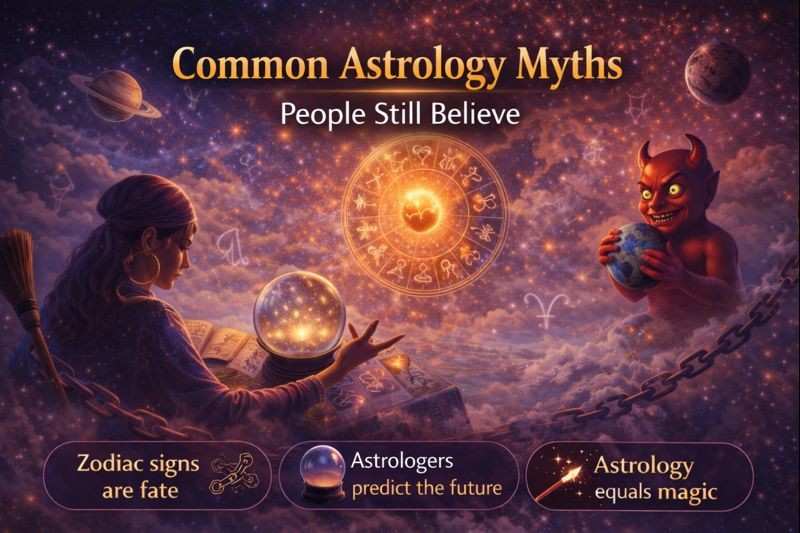
Some common myths include thinking zodiac signs control fate, astrologers predict exact future events, and astrology works like magic rather than a symbolic system.
No. Astrology does not claim to predict fixed future events. It focuses on tendencies, timing, and patterns rather than guaranteed outcomes.
No. A zodiac sign is only one part of a full birth chart. Planets, houses, and aspects together shape personality and life themes.
Astrology is not magic or superstition in its traditional form. It is a symbolic framework developed over centuries to observe cycles and correlations.
General horoscopes, confirmation bias, and selective attention often make astrology seem more precise than it actually claims to be.
No. Daily horoscopes are simplified and generic. Real astrology involves detailed birth chart analysis using exact time and place of birth.
Astrology myths persist due to pop culture, oversimplified media content, and lack of awareness about how astrology is traditionally practiced.
Conclusion:-
Astrology myths persist because simplification feels comfortable. However, true astrology demands depth, patience, and curiosity.
When people move beyond stereotypes, astrology reveals itself as a reflective and insightful system.
Understanding astrology myths empowers individuals to explore astrology with clarity rather than confusion.
Please have a look at other related blogs:Read More

2 Comments