
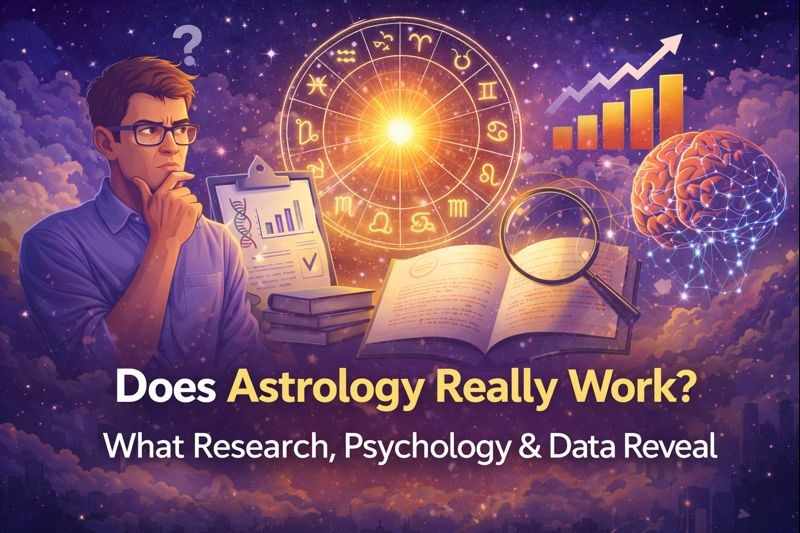
Introduction: Why This Question Refuses to Go Away
Few topics divide opinions as sharply as astrology. Some people trust birth charts more than personality tests. Others dismiss astrology as coincidence or belief-driven illusion. As a result, one question keeps resurfacing across cultures, platforms, and generations: does astrology really work?
To answer this honestly, we must look beyond blind belief and outright rejection. We need to explore research, psychology, historical data, and real-world usage patterns. Only then can we understand why astrology continues to thrive in a data-driven world.
Also read – Why Astrology Feels Surprisingly Accurate (Even to Skeptics)
Understanding Astrology Beyond Daily Horoscopes
Before evaluating accuracy, we must first define astrology properly. Astrology does not simply mean daily newspaper horoscopes. Instead, it refers to a complex symbolic system that maps planetary positions to human behavior and life events.
Traditional astrology relies on precise birth data. Astrologers analyze planetary placements, house positions, aspects, and timing cycles. Because of this layered structure, astrology functions more like a language than a prediction machine.
When people ask, does astrology really work, they often judge the entire system through oversimplified Sun-sign content. This mismatch creates confusion and skepticism.
Why Astrology Exists in Every Civilization
Astrology did not emerge randomly. Ancient civilizations across India, Mesopotamia, Greece, China, and Egypt independently developed astrological systems. These cultures observed recurring links between celestial cycles and earthly patterns.
Farmers tracked seasons through planetary movements. Kings consulted astrologers before wars and treaties. Physicians timed treatments using lunar phases. Such widespread adoption suggests long-term observation rather than sudden imagination.
Therefore, astrology survived because it offered a functional framework for understanding time, rhythm, and cause-effect relationships.
What Modern Scientific Research Says
Science approaches astrology cautiously. Controlled laboratory studies often fail to prove astrology through repeatable experiments. Scientists argue that astrology lacks falsifiability, which limits traditional validation.
However, science also acknowledges complexity limits. Human behavior depends on multiple variables. Psychology, genetics, environment, and timing all interact simultaneously. Astrology attempts to model this complexity symbolically rather than mechanically.
Interestingly, some studies reveal correlations between planetary cycles and collective trends, such as economic shifts and seasonal mood patterns. While correlation does not equal causation, it raises important questions instead of ending the discussion.
Also read – Is Astrology a Science or Pseudoscience? A Clear, Neutral Breakdown
The Role of Psychology in Astrology’s Effectiveness
Psychology plays a crucial role when evaluating whether astrology really works. Critics often cite the Barnum Effect, where people accept vague statements as personally accurate. This effect certainly explains generic horoscope popularity.
However, detailed birth chart readings operate differently. Specific chart interpretations often highlight uncomfortable truths rather than flattering traits. Many individuals report resistance before later recognition.
Additionally, confirmation bias does not fully explain predictive timing techniques. Accurate event windows often surprise clients before they occur. Psychology alone cannot account for this recurring pattern.
Astrology as a Pattern Recognition System
Human brains excel at pattern recognition. Astrology formalizes pattern recognition across time rather than space. Astrologers study repeating planetary cycles and compare them with historical data.
For example, Saturn cycles consistently link with responsibility, pressure, and structural changes. Jupiter cycles often coincide with expansion, learning, and opportunity. These associations persist across centuries of records.
Thus, astrology works more like weather forecasting than fate declaration. It highlights probability trends rather than fixed outcomes.
Data, Case Studies, and Long-Term Records
Indian Vedic astrology preserves thousands of years of documented charts. Astrologers compare birth charts with real-life events across generations. Western astrology maintains extensive archives as well.
Modern astrologers now analyze large datasets using software. Pattern consistency continues to emerge, especially in predictive techniques like transits and dashas. While skeptics demand laboratory proof, astrology relies on longitudinal evidence.
Medicine also advanced through observation before controlled trials existed. Astrology follows a similar empirical tradition.
Why Astrology Appears Inaccurate to Some People
Astrology fails when applied incorrectly. Inaccurate birth times lead to incorrect house systems and predictions. Oversimplified interpretations distort complex charts. Inexperienced astrologers reduce nuanced symbolism into absolute statements.
Moreover, free will always interacts with planetary influence. Astrology indicates timing and tendencies, not forced outcomes. When people expect rigid predictions, disappointment follows.
Therefore, misunderstanding the system often fuels skepticism rather than actual failure.
Also read- Is Astrology Real or Psychological? A Clear Explanation
Astrology vs Hard Determinism
Astrology does not claim planets control humans like remote devices. Instead, it suggests resonance between cosmic cycles and human consciousness.
Think of astrology as a clock rather than a command. When a clock shows midnight, people may choose sleep or activity. The clock does not force behavior. Similarly, planetary transits indicate moments of heightened probability.
This perspective aligns astrology with psychology and decision-making rather than superstition.
What Neuroscience Can and Cannot Explain
Neuroscience explains how beliefs influence perception. It also explains emotional validation and expectancy effects. However, neuroscience does not explain accurate life-event timing across individuals who share no belief in astrology.
Many clients consult astrologers only after predictions manifest. In such cases, belief did not create the outcome. This observation challenges purely psychological explanations.
Science currently lacks tools to measure symbolic timing systems. That limitation does not automatically negate their existence.
Also read – Why Career Growth Feels Slow Despite Hard Work (Astrology View)
Astrology in the Modern Data Era
Astrology continues to evolve with technology. Machine learning now assists astrologers in identifying recurring patterns. Apps process thousands of charts simultaneously. Data visualization strengthens comparative analysis.
Despite this evolution, astrology still requires human interpretation. Symbolic systems do not function like algorithms alone. Meaning emerges through context and synthesis.
This blend of data and intuition explains astrology’s resilience in the digital age.
Why Astrology Feels Personally Accurate
People often report feeling deeply understood during astrological readings. Birth charts reflect internal contradictions, fears, strengths, and growth points.
Astrology provides language for experiences people struggle to articulate. This clarity creates relief rather than blind faith. Self-awareness improves decision-making, relationships, and emotional regulation.
When astrology works at this level, accuracy feels lived rather than theoretical.
Common Misconceptions That Distort the Debate
Many assume astrology predicts exact events like lottery wins. Astrology does not function that way. Others think astrology replaces personal responsibility. In reality, astrology emphasizes choice during specific time windows.
Another misconception equates astrology with superstition. Traditional astrology follows rigorous rules, calculations, and interpretive frameworks.
Clearing these misunderstandings significantly improves the quality of the discussion.
Also read – Free Marriage Astrology: What Your Birth Chart Reveals
So, Does Astrology Really Work?
The answer depends on how one defines “work.” Astrology does not function as experimental physics. Astrology also does not operate as random belief.
Astrology works as a symbolic timing system rooted in long-term observation. It provides psychological insight, life-cycle awareness, and probabilistic forecasting.
For millions worldwide, astrology consistently delivers practical value, self-knowledge, and meaningful guidance.
Also read – Most Common Astrology Myths People Still Believe
Astrology and Personal Responsibility
Astrology does not remove accountability. Instead, it enhances conscious choice. Knowing a challenging phase approaches allows preparation rather than fear. Knowing supportive periods encourages initiative.
In this sense, astrology empowers rather than limits. Awareness always precedes growth.
The Middle Ground Between Faith and Skepticism
Blind belief weakens astrology. Blind rejection also weakens inquiry. The most productive approach lies in critical openness.
When evaluated thoughtfully, astrology occupies a space similar to psychology, economics, and climate modeling. These fields also deal with probabilities rather than certainties.
Astrology survives because it continues to help people navigate uncertainty.
Frequently Asked Questions
Does astrology really work?
Astrology does not work in the same way as experimental science. Instead, it operates as a symbolic and observational system that identifies personality patterns, emotional cycles, and timing themes. Many people find it meaningful because it aligns closely with psychological self-reflection and lived experience.
Is there scientific research supporting astrology?
Scientific studies have not proven astrology as a predictive science. However, research in psychology explains why astrological descriptions feel accurate through mechanisms such as pattern recognition, self-perception, and narrative meaning. This helps explain astrology’s continued popularity without validating it as a physical science.
Why do so many people feel astrology is accurate?
Astrology often reflects universal human experiences such as emotional change, relationship dynamics, ambition, and uncertainty. When people recognize their inner experiences in these descriptions, the interpretation feels accurate even without literal belief in planetary influence.
Is astrology just confirmation bias?
Confirmation bias does play a role, as people tend to remember information that resonates with them. However, astrology also relies on structured systems such as birth charts, timing cycles, and symbolic language, which many users find consistently reflective across different life stages.
How is astrology different from psychology?
Psychology studies behavior using empirical methods, while astrology uses symbolic models and archetypes. Both explore personality and emotional patterns, but astrology focuses more on timing and symbolic meaning rather than diagnosis or treatment.
Do personalized birth charts make astrology more accurate?
Personalized birth charts include multiple planetary positions, houses, and aspects, making interpretations more specific than general Sun-sign horoscopes. Many people report greater relevance and consistency when using full chart readings.
Can astrology predict the future?
Astrology does not predict exact events. Instead, it outlines themes, emotional trends, and timing cycles. These insights are often used for reflection and planning rather than deterministic forecasting.
Why do skeptics still read astrology?
Skeptics often engage with astrology as a reflective or psychological tool. It offers language for understanding emotions and life changes without requiring belief in fate or destiny. This flexibility allows astrology to appeal even to analytical minds.
Is astrology harmful or misleading?
Astrology becomes harmful only when treated as absolute truth or used to replace critical thinking. When approached as a reflective framework rather than a fixed belief system, it can support self-awareness without limiting personal responsibility.
Why does astrology remain popular worldwide?
Astrology persists because it offers meaning during uncertainty. Across cultures and generations, people use astrology to understand transitions, relationships, and personal growth in a way that feels emotionally grounding.
Conclusion: A System That Endures Because It Adapts
Astrology persists not because everyone believes in it, but because enough people find it useful. History, psychology, and data all reveal layers of legitimacy within the system.
While astrology may never satisfy strict laboratory criteria, it continues to offer insight into timing, behavior, and meaning.
So when people ask, does astrology really work, the most accurate answer becomes clear. Astrology works not by controlling life, but by helping humans understand it.
Sources & References
- Psychology Today – Confirmation Bias and Human Perception
- Stanford Encyclopedia of Philosophy – Science vs Pseudoscience
- Pew Research Center – Public Beliefs About Astrology
- Encyclopaedia Britannica – Astrology Overview
- Jung, C. G. – Archetypes and the Collective Unconscious, Princeton University Press
- Tarnas, R. – Cosmos and Psyche: Intimations of a New World View
- Google Trends – Astrology Search Interest Over Time
- Gurucool.life – Astrology, Birth Charts & Spiritual Insights
- Shloka.life – Astrology, Rituals & Festival Knowledge Base
- Campion, N. – Astrology and Popular Religion in the Modern West

9 Comments