
Introduction
India is a land steeped in spiritual heritage. From the snow-capped peaks of the Himalayas to the lush backwaters of the south, from desert plains to coastal shores—across these varied landscapes, one finds innumerable temples dedicated to Lord Vishnu, the preserver in the Hindu Trimurti. Each Vishnu temple has its own history, architecture, rituals, legends and an unbroken tradition of devotion.
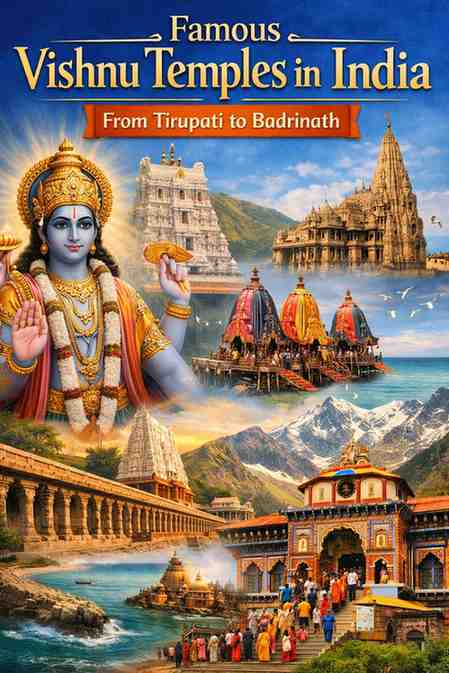
In this post, we will explore some of the most famous Vishnu temples in India, with special focus on two of the greatest: Tirupati (Sri Venkateswara Temple) in Andhra Pradesh and Badrinath Temple in Uttarakhand. Along the way, we will also visit other major abodes of Lord Vishnu—temples known for their divine sanctity, historical importance, architectural beauty, and spiritual draws.
This guide is aimed at devotees, heritage lovers, tourists, and anyone interested in the deep spiritual and cultural roots of India. We will cover:
- What makes a temple a “Vishnu temple” and why such sites are special
- Detailed histories, legends, and architecture of Tirupati and Badrinath
- A tour of other famous Vishnu temples across India
- Practical guide: how to visit, timings, festivals, rituals
- Spiritual significance and what devotees experience
Let’s begin.
Also Read :- Navagraha Temples in India: Planet Remedies & Worship Routes
Who is Lord Vishnu & Why Vishnu Temples are Significant
Before diving into individual temples, understanding Lord Vishnu’s role helps appreciate the devotion and symbolism:
- In Hindu belief, Vishnu is the Preserver or Sustainer—one who maintains cosmic order (dharma)
- Vishnu incarnates in various avatars (e.g. Krishna, Rama) to restore righteousness whenever there is adharma
- Devotees worship Vishnu in various forms: standing, reclining (Ananta Shayana), as avatars, etc.
Thus, the temples dedicated to Lord Vishnu (Vaishnava temples) become not just places of worship, but hubs of:
- Myth & legend
- Scripture & philosophy (especially Vaishnavism)
- Rituals & festivals tied to Vishnu’s avatars or cosmic functions
- Artistic expression: sculpture, iconography, temple architecture
With that setting, let’s explore two of the most renowned.
Also Read :- Bhairabi Mandir Assam – History, Significance, Timings & Complete Information
1. Tirupati – Sri Venkateswara Temple
Location & Setting
- The Tirumala Venkateswara Temple (often called Tirupati Balaji) is located in the Seshachalam Hills, in the hill town of Tirumala near Tirupati city, in Chittoor district, Andhra Pradesh. tirupati.ap.gov.in+2Incredible India+2
- It sits at an elevation, surrounded by green hills, sacred rivers and forests, adding to its spiritual ambiance. Culture and Heritage+2Culture and Heritage+2
History & Legends
- The temple is ancient; its current form has developed over centuries, shaped by various South Indian dynasties such as the Cholas, Pandyas, and the Vijayanagara Empire. tirupati.ap.gov.in+2Culture and Heritage+2
- One legend says that the idol of Lord Venkateswara is Swayambhu (self-manifested). The Times of India+1
- Another narrative involves Sage Bhrigu testing the Trimurti (Brahma, Vishnu, Shiva) to see who is greatest; Lord Vishnu humbly accepts the test, which is said to have earned him the worship and devotion offered at Tirumala. The Times of India
Architecture and Layout
- Dravidian style architecture; the temple has towering gopurams, mandapams (pillared halls), richly carved stone panels, and ornate gateways. Culture and Heritage+2tirupati.ap.gov.in+2
- The sanctum sanctorum (Ananda Nilaya) houses the main deity, Lord Venkateswara (also called Balaji, Srinivasa). The idol holds Shankha (conch) and Chakra (discus), typical of Vishnu iconography, and is richly ornamented. The Times of India+1
Rituals & Festivals
- Daily rituals: Suprabhata Seva (waking up the lord), Thomala Seva (flower offerings), Kalyanotsavam (ceremonial wedding), Archana, Sahasranama (chanting thousand names), etc. The Times of India+1
- Major festivals: Brahmotsavam (nine days), Vaikunta Ekadasi, and others. Devotees from all over India come in large numbers during those times. Incredible India+1
Significance & Pilgrimage
- Tirupati is often considered one of the wealthiest and most visited temples in the world in terms of donations and pilgrim inflow. tirupati.ap.gov.in+1
- Devotees believe that visiting Tirupati, doing penance, offering one’s hair (tonsure), fulfilling vows, brings relief from life’s troubles, blessings of prosperity, etc.
How to Visit & Practical Info
- Access: Via air (nearest airport Renigunta), road, and train. The Tirumala hills are accessed from Tirupati city. Culture and Heritage+1
- Accommodation: Many guest houses, dharmashalas, lodging arranged by Tirumala Tirupati Devasthanams (TTD) for pilgrims.
- Best times: Festival seasons (especially Brahmotsavam) though they are crowded. Vaikunta Ekadasi is another special day.
2. Badrinath Temple
Location & Setting
- Located in Chamoli district of Uttarakhand, in the Garhwal Himalayan region, by the banks of the Alaknanda River. Altitude approx 3,133 m above sea level. Wikipedia+1
- It is often snow-bound in winters; opens only in favorable months due to harsh mountain weather. Pilgrimage journey itself includes travel through high altitudes.
History & Legends
- The temple as a pilgrimage center was re-established by Adi Shankaracharya in the 8th or early 9th century. He is said to have discovered the idol of Badrinarayana in a hot spring (or somewhere in Narad Kund) and installed it in the present shrine. Wikipedia+1
- The deity is Vishnu in meditative posture, with two hands holding shankha and chakra, and the other two hands resting in a yogic pose. Wikipedia
Architecture & Layout
- Typical North Indian Himalayan temple style: stone construction, pitched roofs (to deal with snow), carved pillars, mandapas. The sanctum (garbhagriha), darshan mandapa, sabha mandapa form its basic structure. Wikipedia+1
- The idol is made of black stone / shaligram. There are also smaller shrines around for Lakshmi, Narada, Kubera etc. Wikipedia
- Near the temple is Tapt Kund, hot sulphur springs; many devotees bathe there before darshan, believing the water to have both purification and healing properties. Wikipedia
Festivals & Pilgrimage
- Similar to Tirupati, daily aartis, rituals tied to sunrise, etc. The priest is traditionally a Nambudiri Brahmin from Kerala—showing pan-Indian connections. Wikipedia
- The temple is a key place in Char Dham Yatra (Puri, Rameswaram, Dwarka, Badrinath). Also part of Uttarakhand’s Chota Char Dham (Yamunotri, Gangotri, Kedarnath, Badrinath). Culture and Heritage
Significance & Devotion
- For many devotees, Badrinath is the place of ultimate surrender and spiritual ascent: high altitude, harsh climate, rigorous journey—symbolic of inner spiritual journey.
- Many pilgrims endure tough terrain, weather, travel; this elevates the felt value of the darshan and devotion.
Visiting & Practical Info
- Season: The temple typically opens around late April / early May and closes by October / November, depending on snow and road access. Outside that it is closed. Wikipedia
- Access: Routes via Rishikesh, Haridwar etc. One stops, treks, or uses motor roads up to certain points. Pilgrim base camps in nearby towns.
- Accommodations: Inns, guest houses, basic & somewhat rustic in mountains; plan ahead for weather, oxygen (for altitude), proper gear.
3. Other Famous Vishnu Temples Across India
Besides Tirupati and Badrinath, there are many other Vishnu temples that are must-visits. Here are several, organized by region, with a brief on each.
| Temple | Location | Unique Features / Highlights |
|---|---|---|
| Sree Padmanabhaswamy Temple | Thiruvananthapuram, Kerala | Lord Vishnu reclining on Adi Shesha (Anantha Shayana), highly rich, mysterious vaults, blend of Kerala & Dravidian architecture, very important in Vaishnavism. Encyclopedia Britannica+2www.ndtv.com+2 |
| Ranganathaswamy Temple, Srirangapatna | Karnataka | One of Pancharanga Kshetrams, rituals of Sri Vaishnavism, beautiful temple set along river, historic Mysore period influences. Wikipedia |
| Ranganathaswamy Temple, Shivanasamudra | Karnataka | Located on islands in river Kaveri, scenic, less crowded, important in southern Vaishnava tradition. Wikipedia |
| Govindarajaswamy Temple, Tirupati (City-down hill) | Andhra Pradesh | Ancient Vaishnava temple in the city; often visited in conjunction with Tirumala pilgrimage. tirupati.ap.gov.in |
| Vedanarayana (Matsya) Temple, Nagalapuram | Andhra Pradesh | Dedicated to Vishnu’s Matsya (fish) avatar; one of few temples for that avatar. Wikipedia |
| Other Divya Desams, Pancharama Kshetras, etc. | Tamil Nadu, Andhra, Karnataka, etc. | Temples of the 108 Divya Desams (Vaishnava’s holy 108 abodes), each with its own legend, hymn, architecture (e.g. Kanchipuram, Srirangam, etc.). Some examples: Adikesava Perumal Temple, Sarangapani Temple, etc. tirumalatirupatiyatra.in |
You could make a pilgrimage circuit combining several of these, depending on region.
4. Comparative Themes: What Unites These Temples
When you study major Vishnu temples, you see several recurring themes, despite geographical, cultural, architectural differences.
- Avatar Legends & Mythology
- Each temple often is tied to a legend involving one of Vishnu’s avatars (Matsya, Kurma, Rama, Krishna, etc.) or an event in mythology.
- Example: Vedanarayana Temple (Matsya avatar); Tirupati linked with Venkateswara avatar; Badrinath associated with the deity Narayana manifesting in the Himalayas.
- Pilgrimage, Sacrifice & Spiritual Journey
- Many temples are located in remote, difficult terrain (Badrinath, Himalayan sites, hill-temples). The difficulties of the journey amplify the spiritual meaning.
- Rituals like penance, fasting, vows, offerings feature heavily.
- Architecture & Art
- Dravidian in south, Nagara in north, Himalayan adaptations for the cold, stone roofs, etc.
- Rich iconography: how Vishnu is depicted (standing, reclining, with Shankha & Chakra, consorts, Vaishnava symbols).
- Festivals & Rituals
- Shared festivals: Vaikunta Ekadasi, Janmashtami, etc.
- Local variations: Onam in Kerala, Brahmotsavam in Tirupati, etc.
- Management & Devotional Economy
- Temples often supported by royal patronage historically; now, trusts or temple boards.
- Offerings, donations, lands, etc., used to upkeep temple, support social services.
- Spiritual and Cultural Significance beyond Religion
- These temples are not just places of worship, but carriers of culture: music, dance, literature, architecture, social cohesion.
- They attract tourists, scholars as well as devotees, enhancing local economies.
5. Deep Dive: Padmanabhaswamy Temple
Since this temple is among the very famous, with stories that captured global attention, it deserves a more detailed look.
Legends & Origin
- The name “Padmanabha” means “lotus-navel” — Vishnu resting on the serpent Ananta, with a lotus emerging from his navel upon which Brahma is born. Encyclopedia Britannica+1
- Thiruvananthapuram (“sacred city of Ananta Padmanabha”) is named after this deity. www.ndtv.com+1
- Many legends: that sage Divakara discovered the deity; old texts (such as Alvar hymns) refer to the temple. trivandrum.nic.in+1
Architecture & Features
- Fusion of Kerala and Dravidian styles. The gopuram (entrance tower) shows Tamil/Pandyan influences; the sloped roofs and woodwork reflect Kerala tradition. https://www.oneindia.com/+1
- The deity is in the Anantha Shayana posture, reclining on the serpent Adi Shesha. The murti is made of rare herbal/mineral mix (Katusarkara Yogam). TempleWalks+2Encyclopedia Britannica+2
- There are several doors through which one sees different parts of the deity. The idols are huge; there is a sacred tank (Padma Theertham), halls, flagstaff etc. TempleWalks
Treasures, Vaults & Mysteries
- The temple became globally famous after vaults (kallaras) were opened, revealing enormous treasures: gold, jewels, ancient coins and artefacts. www.ndtv.com+1
- Some vaults are still sealed; there are myths and legends about curses, divine protection, etc. These things feed both curiosity and reverence.
Festivals, Rituals & Visiting
- Major festivals: Aipasi, Panguni, Lakshadeepam (lighting thousands of oil lamps), etc. Encyclopedia Britannica+2www.ndtv.com+2
- Strict dress code; rituals by priests of specific traditions (Nambies / Tantris). https://www.oneindia.com/+1
6. Suggested Temple Trail & Itinerary Ideas
If you’re a pilgrim or tourist wanting to see major Vishnu temples, here are suggested itineraries:
Southern Circuit
- Thiruvananthapuram (Padmanabhaswamy)
- Kanchipuram / Tamil Nadu – Kanchi has several famous Vishnu temples (Vaikuntha Perumal, Devarajaswami etc.)
- Srirangam (Ranganathaswamy)
- Tirupati
Central & Northern Circuit
- Dwarkadhish Temple, Gujarat
- Jagannath Temple, Puri
- Badrinath (Uttarakhand)
- Ranganathaswamy Temples in Karnataka
- Possibly smaller but significant Divya Desams (depending where you are)
7. Ten More Famous Vishnu Temples in India You Must Visit
India has countless temples dedicated to Lord Vishnu, but certain shrines hold unparalleled significance because of their mythology, architecture, and centuries-old rituals. Here’s an expanded list of 10 more famous Vishnu temples that every devotee and traveler should know about.
1. Dwarkadhish Temple – Gujarat
- Location: Dwarka, Gujarat
- Deity: Lord Krishna (an incarnation of Vishnu) as “King of Dwarka”
- Highlights: One of the Char Dham shrines; located near the Arabian Sea. The five-storied temple is built on 72 pillars.
- Legend: Believed to be built by Lord Krishna’s great-grandson Vajranabh. Dwarka was submerged under the sea several times according to scriptures.
2. Jagannath Temple – Puri, Odisha
- Deity: Lord Jagannath (form of Vishnu), with siblings Balabhadra and Subhadra.
- Highlights: Known for the Rath Yatra festival, where the deities are taken out in giant chariots.
- Unique Feature: Wooden idols replaced every 12 years in the sacred Nabakalebara ritual.
3. Ranganathaswamy Temple – Srirangam, Tamil Nadu
- Deity: Ranganatha (reclining Vishnu).
- Significance: Largest functioning Hindu temple complex in the world; first of the 108 Divya Desams.
- Architecture: 21 gopurams, intricate carvings, and the famous Raja Gopuram that dominates the skyline.
4. Varadaraja Perumal Temple – Kanchipuram, Tamil Nadu
- Deity: Lord Varadaraja (form of Vishnu).
- Highlights: The temple has a golden lizard carving said to remove sins when touched.
- Festivals: Vaikasi Brahmotsavam is the biggest festival.
5. Vittala Temple – Hampi, Karnataka
- Deity: Lord Vittala (form of Vishnu).
- Fame: Iconic stone chariot symbol of Hampi; musical pillars that produce tones when tapped.
- Architecture: Vijayanagara style, a UNESCO World Heritage site.
6. Narayan Sarovar Temple – Kutch, Gujarat
- Significance: Associated with holy lakes mentioned in the Puranas; one of the most remote Vishnu shrines.
- Features: Built in white marble; serene location near desert landscape.
7. Adikesava Perumal Temple – Kanyakumari, Tamil Nadu
- Location: Near Thiruvattar; between the rivers Tamirabarani and Kothai.
- Speciality: Ancient Kerala-style temple with mural paintings; said to be older than Padmanabhaswamy temple.
8. Lakshmi Narayan Temple – Delhi
- Popular Name: Birla Mandir.
- Built by: Industrialist B. R. Birla, inaugurated by Mahatma Gandhi.
- Architecture: Modern North Indian temple style with marble carvings and open courtyards.
9. Thirunelli Temple – Wayanad, Kerala
- Deity: Lord Vishnu as Chaturbhuja.
- Special Feature: Located in the Brahmagiri hills; known for performing ancestral rites.
10. Simhachalam Temple – Visakhapatnam, Andhra Pradesh
- Deity: Varaha Narasimha (Vishnu’s combined boar and man-lion forms).
- Legend: Prahlada’s prayers brought Narasimha to save him here.
- Architecture: Orissan-Dravidian blend with stone carvings.
8. Vishnu Avatars and Their Temples in India
Lord Vishnu is said to have descended to earth in Dashavatara—ten primary incarnations—to restore balance. Each avatar has temples that commemorate its deeds.
| Avatar | Key Temples | Location |
|---|---|---|
| Matsya (Fish) | Vedanarayana Temple | Nagalapuram, Andhra Pradesh |
| Kurma (Tortoise) | Srikurmam Temple | Srikakulam, Andhra Pradesh |
| Varaha (Boar) | Simhachalam Temple | Andhra Pradesh |
| Narasimha (Man-Lion) | Ahobilam Temple | Kurnool, Andhra Pradesh |
| Vamana (Dwarf) | Thrikkakara Temple | Kerala |
| Parashurama (Warrior Sage) | Parashuram Temple | Maharashtra |
| Rama (Prince of Ayodhya) | Ramaswamy Temple, Rameswaram | Tamil Nadu |
| Krishna | Dwarkadhish, Mathura, Guruvayur | Gujarat, UP, Kerala |
| Buddha | Mahabodhi Temple (as an avatar reference) | Bihar |
| Kalki (Future Avatar) | Worshipped symbolically at Tirupati | Andhra Pradesh |
9. Architecture & Art of Vishnu Temples
The architecture of Vishnu temples varies across India but follows sacred geometry (Vastu Shastra).
Dravidian Style (South India)
- Examples: Tirupati, Srirangam, Padmanabhaswamy
- Features: Towering gopurams, pillared mandapas, massive prakaras (enclosures), intricate sculptures of deities and scenes from Ramayana and Mahabharata.
- Often use granite, with beautifully ornamented vimanas.
Nagara Style (North India)
- Examples: Badrinath, Dwarkadhish, Birla Mandir Delhi.
- Features: Curvilinear shikhara (spire), sanctum with circumambulatory path, elaborate carvings, less horizontal spread than Dravidian style.
Kalinga Style (Eastern India)
- Seen in Jagannath Temple, Odisha.
- Features: Vertical elevation, pyramid-like towers, and stone carvings with Vaishnavite motifs.
Kerala Style
- Seen in Padmanabhaswamy and Adikesava temples.
- Features: Wooden structures, copper roofs, murals, and water tanks nearby for ritual purification.
10. Festivals Celebrated in Vishnu Temples
Festivals are the soul of Indian temple tradition. Every Vishnu temple has its own celebrations, combining devotion, color, and community.
Major Vishnu Festivals Across India
- Vaikuntha Ekadashi: Marks opening of heaven’s gates; celebrated grandly at Tirupati and Srirangam.
- Janmashtami: Krishna’s birthday; Mathura, Dwarka, and Guruvayur become centers of celebration.
- Rath Yatra: Annual chariot festival at Puri Jagannath Temple; millions participate.
- Brahmotsavam: The grand nine-day festival at Tirumala where Lord Venkateswara is taken in processions.
- Onam: Celebrated in Kerala, honoring Vamana avatar of Vishnu and King Mahabali’s return.
- Mukkoti Dwadashi: Celebrated the day after Vaikuntha Ekadashi; believed to bring spiritual liberation.
11. Pilgrimage & Travel Tips for Devotees
Planning a pilgrimage to Vishnu temples? Here are detailed tips:
1. Choose the Right Season
- South Indian temples: Best from October to February (pleasant weather).
- Himalayan temples (like Badrinath): Best from May to October before snowfall.
2. Dress Code
- Most Vishnu temples require traditional attire:
- Men: Dhoti or pants with upper cloth.
- Women: Saree or salwar; avoid western wear.
- Example: Padmanabhaswamy enforces strict traditional dress.
3. Ritual Etiquette
- Always walk clockwise around the temple (pradakshina).
- Avoid taking photos inside sanctums.
- Donations are optional but encouraged for maintenance.
4. Accommodation
- Major temples like Tirupati and Badrinath offer guesthouses run by trusts.
- Book online via official temple boards or government tourism portals.
5. Food & Prasadam
- Don’t miss temple-served prasadam:
- Tirupati laddu (world-famous)
- Jagannath’s Mahaprasad
- Srirangam’s sweet pongal
- Badrinath’s Khichdi prasadam
12. Cultural & Economic Importance of Vishnu Temples
Beyond faith, Vishnu temples are cultural and economic powerhouses that sustain entire communities.
Heritage & Culture
- These temples preserve ancient art forms: Bharatanatyam, Carnatic music, mural painting.
- Scripts and Vedic chanting traditions have been passed down through temple priests.
Economy
- Temples like Tirupati and Padmanabhaswamy manage vast trusts, hospitals, and educational institutions.
- Tourism creates jobs, supports artisans, vendors, guides, and transport operators.
Social Service
- Many temples run annadanam (free meal) programs feeding thousands daily.
- They fund schools, hospitals, and dharmashalas for pilgrims.
13. Spiritual Symbolism of Vishnu Worship
Each Vishnu temple represents a cosmic idea — a harmony of material life and spiritual evolution.
- Vishnu’s four symbols — Shankha (conch), Chakra (discus), Gada (mace), Padma (lotus) — symbolize purity, time, strength, and liberation.
- Tirupati Balaji teaches surrender and humility.
- Badrinath embodies meditation and self-discipline.
- Jagannath represents universality — all are equal in His eyes.
- Padmanabhaswamy symbolizes eternity (Ananta Shayana).
Visiting these temples isn’t just sightseeing; it’s inner pilgrimage — from ego to enlightenment.
14. Bonus: List of 108 Divya Desam Vishnu Temples (Overview)
The 108 Divya Desams are sacred Vishnu shrines sung by the Alvars (Tamil Vaishnava saints).
Key highlights include:
- Srirangam, Kanchipuram, Tirupati, Srivilliputhur, Thiruvananthapuram
- Spread across Tamil Nadu, Andhra, Kerala, Karnataka, North India, and even Nepal (Muktinath).
- Each temple praises Vishnu’s different divine quality — compassion, strength, mercy, etc.
11.The Dashavatara of Vishnu and Their Temples
Lord Vishnu is worshipped in ten primary forms known as the Dashavatara, each representing a divine mission. Visiting temples dedicated to these avatars is like tracing the spiritual map of India.
| Avatar | Famous Temples | Location |
|---|---|---|
| Matsya (Fish) | Vedanarayana Temple | Nagalapuram, Andhra Pradesh |
| Kurma (Tortoise) | Srikurmam Temple | Srikakulam, Andhra Pradesh |
| Varaha (Boar) | Simhachalam Temple | Andhra Pradesh |
| Narasimha (Man-Lion) | Ahobilam Temple | Andhra Pradesh |
| Vamana (Dwarf) | Thrikkakara Temple | Kerala |
| Parashurama (Warrior Sage) | Parashuram Temple | Konkan, Maharashtra |
| Rama (Prince of Ayodhya) | Ramaswamy Temple | Rameswaram, Tamil Nadu |
| Krishna | Dwarkadhish Temple, Guruvayur Temple | Gujarat, Kerala |
| Buddha (Incarnation) | Mahabodhi Temple (as symbolic Vishnu avatar) | Bihar |
| Kalki (Future) | Worshipped symbolically at Tirupati and other major Vishnu temples | Across India |
12. Lesser-Known But Significant Vishnu Temples
Apart from the famous ones like Tirupati and Badrinath, India is dotted with hidden gems that are rich in spirituality and history:
- Thirunelli Temple (Kerala) – A mountain-top temple in Wayanad, believed to absolve ancestral sins.
- Narayana Sarovar (Gujarat) – Located near the Rann of Kutch, this temple sits beside sacred lakes mentioned in the Puranas.
- Adikesava Perumal Temple (Tamil Nadu) – Ancient Kerala-style architecture, with serene riverside surroundings.
- Simhachalam Temple (Andhra Pradesh) – Known for the Varaha Narasimha idol, which devotees believe protects them from evil forces.
- Udupi Sri Krishna Temple (Karnataka) – Famous for daily Panchamruta Seva and the unique practice of worshipping the deity through a small window (Kanakana Kindi).
13. Festivals Celebrated Across Vishnu Temples
Festivals bring Vishnu temples alive. They are not just religious events but also cultural celebrations that reflect India’s diverse heritage.
Major Vishnu Festivals
- Vaikuntha Ekadashi: Celebrated in Srirangam, Tirupati, and other major Vishnu temples. Devotees believe passing through the “Vaikunta Dwaram” grants moksha (liberation).
- Janmashtami: Krishna’s birthday, celebrated in Mathura, Dwarka, and Guruvayur with fasting, dance, and enactments of Krishna’s childhood leelas.
- Rath Yatra: Puri’s famous chariot festival, attracting millions of devotees from across India and abroad.
- Brahmotsavam: A grand festival at Tirupati where Lord Venkateswara is taken out in a procession for nine days.
- Onam: Celebrated in Kerala, marks the Vamana avatar and the return of King Mahabali.
Rituals and Sevas
- Archana and Abhishekam: Daily rituals involving chanting of Vishnu mantras and sacred bathing of the deity.
- Prasadam Distribution: Temples like Tirupati, Puri, and Guruvayur distribute prasadam to thousands of devotees.
- Alankaram (Decoration): Seasonal flower and jewel decorations symbolize the cosmic energy of Vishnu in different avatars.
14. Architecture and Art of Vishnu Temples
Vishnu temples are known for their intricate architecture, reflecting local culture and devotion.
- Dravidian Style (South India): Towering gopurams, pillared halls, and massive temple complexes like Srirangam, Padmanabhaswamy, and Tirupati.
- Nagara Style (North India): Curvilinear shikharas, smaller mandapas, as seen in Badrinath and Dwarka.
- Kalinga Style (Eastern India): Jagannath Temple in Puri, Odisha; vertical towers with elaborate carvings depicting Vishnu’s avatars.
- Kerala Style: Wooden structures, sloping copper roofs, and murals; temples like Padmanabhaswamy and Adikesava.
Artworks in these temples often depict scenes from:
- Ramayana and Mahabharata
- Bhagavata Purana
- Local legends and folk tales
15. Pilgrimage Circuits: From South to North
For devotees wanting a complete Vishnu yatra, planning is key. Some famous pilgrimage circuits include:
- Southern Circuit: Tirupati → Srirangam → Padmanabhaswamy → Guruvayur → Udupi
- Western Circuit: Dwarkadhish (Gujarat) → Somnath → Narayan Sarovar
- Northern Circuit: Badrinath → Kedarnath (combined Vaishnavite-Shiva) → Govindghat
- Eastern Circuit: Jagannath Puri → Konark → Bhubaneswar
Tips for pilgrims:
- Carry traditional attire as many temples enforce dress codes.
- Start early in the morning for darshan to avoid crowds.
- Book accommodations in advance, especially in Tirupati, Badrinath, and Puri during festivals.
Frequently Asked Questions (FAQs) – Famous Vishnu Temples in India
1. Which is the most famous Vishnu temple in India?
The Tirupati Balaji Temple (Tirumala Venkateswara Temple) in Andhra Pradesh is considered the most famous Vishnu temple in India and attracts millions of devotees every year.
2. What are the Char Dham temples associated with Lord Vishnu?
The Char Dham temples associated with Lord Vishnu include Badrinath in Uttarakhand, Dwarka in Gujarat, Rameswaram in Tamil Nadu, and Jagannath Puri in Odisha.
3. Where is the Badrinath Temple located?
Badrinath Temple is located in the Chamoli district of Uttarakhand in the Himalayan region and is one of the holiest pilgrimage sites dedicated to Lord Vishnu.
4. What is special about the Tirupati Balaji Temple?
Tirupati Balaji Temple is famous for its rich traditions, massive daily footfall of devotees, and the belief that Lord Venkateswara fulfills the wishes of sincere devotees.
5. Which Vishnu temple is known for the Jagannath Rath Yatra?
The Jagannath Temple in Puri, Odisha is famous for the annual Rath Yatra festival where the deities Jagannath, Balabhadra, and Subhadra are taken out in grand chariots.
6. What are the 108 Divya Desams?
The 108 Divya Desams are sacred Vishnu temples mentioned in the hymns of the Alvars (Tamil Vaishnavite saints). These temples are considered highly sacred in the Sri Vaishnavism tradition.
7. Which Vishnu temple is located in the Himalayas?
Badrinath Temple in Uttarakhand is the most prominent Vishnu temple located in the Himalayan mountains.
8. Which state has the most Vishnu temples?
Tamil Nadu has the highest number of Vishnu temples, especially among the 108 Divya Desams revered in the Vaishnavite tradition.
9. When is the best time to visit Badrinath Temple?
The best time to visit Badrinath Temple is between May and October when the temple is open to devotees. It remains closed during winter due to heavy snowfall.
10. Why do devotees visit Vishnu temples?
Devotees visit Vishnu temples to seek blessings for peace, prosperity, protection, and spiritual growth. Lord Vishnu is considered the preserver of the universe in Hindu tradition.
16. Conclusion
From Tirupati to Badrinath, the Vishnu temples of India are more than just places of worship. They are living monuments of faith, culture, art, history and spiritual aspiration. Each temple’s legends teach us something: humility, devotion, perseverance. The rituals bind communities and generations. The architectural styles reflect geographical realities and local cultures. For a pilgrim, visiting these temples is not only about darshan, but an inner journey—through hardship, through reflection, through surrender.
If you are planning a pilgrimage, consider both the physical preparation (travel, accommodation, weather) and the spiritual preparation (mindset, faith, purpose). And when you stand before the sanctum of a temple like Tirupati or Badrinath, feel how centuries of devotion resonate in stone, chant, flame, and believer.
3 Comments