
Introduction
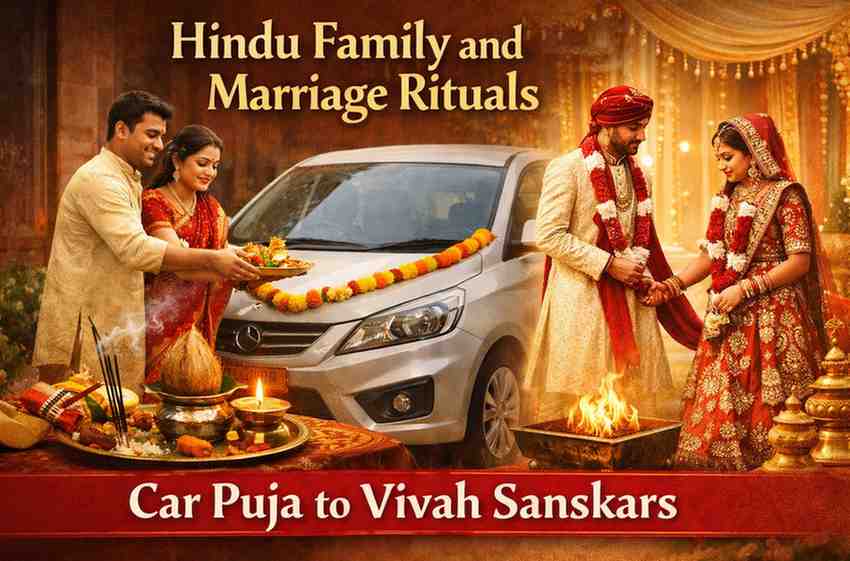
Hindu family and marriage rituals are a cornerstone of Sanatana Dharma, guiding individuals through life from birth to marriage and beyond. Ceremonies such as Car Puja, Griha Pravesh, and Vivah Sanskars not only sanctify important life events but also strengthen family bonds, preserve cultural heritage, and nurture spiritual growth. These rituals help families remain connected across generations while instilling devotion, respect, and a sense of community.
Also read – PRADOSH VRAT FEBRUARY 2026: DATE, PUJA VIDHI & BENEFITS
Understanding Hindu Family and Marriage Rituals
The concept of “sanskar” refers to a rite of passage or spiritual refinement, and Hindu family rituals and marriage traditions are among the most important of these ceremonies. They provide moral, social, and spiritual guidance while celebrating critical life milestones. From the naming ceremony of a newborn to sacred thread rituals, each observance imparts values, strengthens relationships, and marks life transitions.
Marriage, or Vivah Sanskar, holds a central place in Hindu family rituals. It symbolises the union of two individuals, the merging of families, and the continuation of lineage. These rituals also reinforce ethical behaviour, teach responsibility, and preserve cultural identity, ensuring that traditions are passed to future generations.
Also read – कजरी तीज 2026: तिथि, महत्व, पूजा विधि और क्षेत्रीय परंपराएं
Daily Practices in Hindu Family Rituals
Hindu family rituals extend beyond large ceremonies into everyday life. Car Puja, for example, is performed when buying a new vehicle, seeking blessings for safety and prosperity. Griha Pravesh, or housewarming rituals, cleanse a new home and invite positive energies.
Childhood ceremonies, such as naming and Mundan (first haircut), mark purification and the child’s introduction to family and society. Festivals like Raksha Bandhan celebrate sibling bonds and reinforce familial love, respect, and duty. Through these daily practices, families maintain a connection to tradition while nurturing spiritual awareness and emotional bonds.
Vivah Sanskar: Central Ceremony in Hindu Marriage Traditions
Marriage is the most celebrated rite in Hindu family rituals, combining spiritual, social, and emotional dimensions. Pre-wedding ceremonies like Roka, Haldi, and Mehendi prepare the couple physically, mentally, and spiritually, while bringing families together in celebration.
The wedding day itself is rich in symbolism. Kanyadaan, where the bride is given away, represents parental blessing and the joining of families. Mangal Phera, or circumambulation of the sacred fire, signifies shared responsibilities and spiritual union. During Saptapadi, the couple takes seven steps symbolising love, respect, and lifelong commitment. Symbols like Sindoor and Mangalsutra further highlight marital unity.
Regional variations add depth to Hindu marriage traditions. North Indian weddings include Sangeet and Baraat ceremonies, while South Indian weddings focus on Varmala and Mangalsutra rituals. Bengali weddings feature Shubho Drishti and Saat Paak, and Maharashtrian weddings often begin with a ring ceremony and Satyanarayan Puja. Despite these differences, the spiritual and social essence of marriage remains central in all Hindu family rituals.
Also read – Hindu Wealth and Prosperity Rituals for Abundance
Spiritual Significance of Hindu Marriage and Family Rituals
Hindu family rituals and marriage ceremonies are not merely social events—they are spiritual journeys. Marriage, in particular, integrates Dharma (duty), Artha (stability), Kama (desires), and Moksha (spiritual growth). Participating in these rituals helps individuals honour family responsibilities, nurture emotional support, and seek spiritual advancement. Astrology often guides wedding dates and compatibility, ensuring harmony within the couple and their families. Hindu family and marriage rituals offer a sacred framework for a balanced and fulfilling life.
Modern Adaptations
Even today, Hindu family rituals have adapted while maintaining their spiritual essence. Eco-friendly weddings, online pujas for distant relatives, and simplified ceremonies focus on the meaning and symbolism rather than extravagance. Interfaith marriages often blend customs while respecting Hindu traditions. These adaptations ensure Hindu marriage and family rituals continue to strengthen family bonds, nurture spirituality, and preserve cultural heritage in modern life.
FAQ – Hindu Family & Marriage Rituals
1. What are Hindu family rituals (Sanskar)?
Hindu family rituals, known as Sanskar, are cultural and spiritual ceremonies performed from birth to marriage. They shape values, purify the body and mind, and prepare an individual for different life stages.
2. Why is Car Puja performed in Hindu tradition?
Car Puja is performed to invoke blessings for safety, prosperity and protection from accidents or obstacles. It marks the vehicle as auspicious before it is used.
3. What items are required for Car Puja?
Common items include coconut, flowers, incense sticks, kumkum, turmeric, lemon, kalawa (holy thread), and sweets. Some regions also use lemons under the wheels as a symbolic protection ritual.
4. What does Vivah Sanskar mean?
Vivah Sanskar refers to the Hindu marriage ceremony that sanctifies the union of two individuals through Vedic mantras, fire rituals, vows, and symbolic offerings.
5. What rituals are included in a Hindu marriage?
A Hindu marriage includes rituals such as Ganesh Puja, Jaimala, Kanyadaan, Mangal Phera, Saptapadi, and Sindoor-Daan. Each ritual represents commitment, responsibility, and sacred vows.
6. Why is fire (Agni) important in Hindu weddings?
Agni, or sacred fire, is considered a divine witness to the marriage. Couples take vows around the fire, symbolizing purity, commitment, and the presence of divine energy.
7. Are Hindu wedding rituals the same across India?
Core rituals remain the same, but customs vary between regions, languages, and communities. North Indian, South Indian, Maharashtrian, Bengali, and Gujarati weddings have distinct traditions.
8. What is the purpose of Sanskar in Hindu life?
The purpose of Sanskar is to purify, guide, and uplift an individual at important life milestones. They reinforce culture, morality, family values, and spiritual responsibility.
9. Are Car Puja and Vivah Sanskar religious or cultural?
Both have religious roots in Hindu scriptures but also hold strong cultural significance in modern society, blending devotion with social tradition.
10. Are Hindu rituals still relevant today?
Yes. Many families continue these rituals to honor tradition, seek blessings, and maintain cultural continuity. Modern adaptations have made them more accessible and meaningful for younger generations.
Conclusion
Hindu family and marriage rituals reflect a rich blend of culture, devotion, and spirituality. From Car Puja to Vivah Sanskars, each ceremony strengthens familial bonds, preserves traditions, and provides spiritual guidance. Modern adaptations make these practices accessible while maintaining their essence. Observing these rituals allows families to celebrate milestones meaningfully, honour heritage, and foster unity, love, and devotion across generations. Hindu family rituals and marriage ceremonies remain a timeless bridge connecting the past, present, and future.
References
- IGNCA – Ancient Indian Culture and Hindu Rituals — https://ignca.gov.in/
- Hinduism Today – Shodasha Sanskar — https://www.hinduismtoday.com/
- Grhya Sutras and Vedic Scriptures — Grhya Sutras Archive
- Cultural India – Hindu Wedding Rituals — https://www.culturalindia.net/weddings/
- Times of India – Modern Hindu Practices — Modern Hindu Practices
2 Comments