
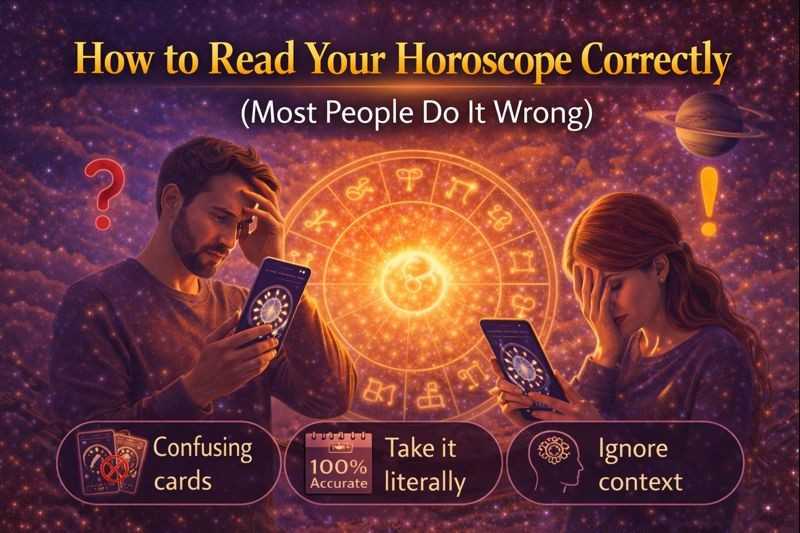
Introduction: Why Most People Misread Their Horoscope
Many people read horoscopes daily, yet very few truly understand them. Most readers scan a few lines, relate one sentence to their mood, and then move on. As a result, they either overtrust vague predictions or completely dismiss astrology as inaccurate.
To change this experience, you must first learn how to read horoscope content correctly. Once you understand the structure, purpose, and limits of horoscopes, they begin to offer guidance rather than confusion.
Also Read :- Why Millions of People Check Their Horoscope Every Day
Understanding What a Horoscope Really Is
Before learning how to read horoscope interpretations, you need clarity about what a horoscope represents. A horoscope is not a fixed prediction of future events. Instead, it reflects planetary movements and how those energies may influence general trends in life.
Astrologers write horoscopes by analyzing transits, planetary aspects, and zodiac sign influences. These insights describe possibilities rather than certainties. When readers expect guarantees, disappointment naturally follows.
The Biggest Mistake People Make While Reading Horoscopes
Most readers treat horoscopes as literal forecasts. They expect exact outcomes, dates, and names. However, astrology does not work like a weather report.
Another common mistake involves emotional bias. People remember predictions that match their experiences and ignore the rest. Because of this selective attention, horoscopes appear either magically accurate or completely wrong.
Additionally, many readers forget that zodiac-based horoscopes apply to millions of people. Without personalization, interpretations must remain general.
Sun Sign Horoscopes vs Personalized Astrology
To understand how to read horoscope content properly, you must know the difference between Sun sign astrology and personalized charts.
Sun sign horoscopes use only your birth date. As a result, they describe broad personality traits and trends. On the other hand, a birth chart considers the exact time and place of birth. This chart includes the Moon sign, Ascendant, houses, and planetary aspects.
Because Sun sign horoscopes rely on limited data, they offer guidance rather than detailed prediction. When readers expect birth-chart-level accuracy from daily horoscopes, confusion arises.
How to Read Horoscope Text the Right Way
Start by reading horoscopes with awareness rather than expectation. Treat them as symbolic guidance instead of fixed truth.
Next, focus on themes rather than events. For example, if a horoscope mentions financial caution, observe spending habits rather than expecting loss. This approach allows practical application without fear.
Furthermore, read horoscopes consistently over time. Patterns matter more than single-day predictions. When you observe repeated themes, astrology becomes clearer and more useful.
Also Read :- Why Relationships Fail Repeatedly According to Astrology
The Importance of Timing in Horoscope Reading
Many people overlook timing while learning how to read horoscope predictions. Daily horoscopes reflect short-term planetary movements, while weekly and monthly forecasts show broader trends.
Because planets move at different speeds, their influence unfolds gradually. Slow-moving planets like Saturn and Jupiter indicate long-term lessons, while faster planets like the Moon affect daily emotions.
Understanding this timing prevents unrealistic expectations and improves interpretation accuracy.
Why Emotional State Affects Horoscope Accuracy
Your mindset plays a major role in horoscope interpretation. When emotions dominate, readers project fears or hopes onto vague statements.
Instead of reacting emotionally, observe objectively. Ask how the message applies to habits, decisions, or attitudes. This shift transforms horoscopes into tools for self-reflection rather than sources of anxiety.
The Role of Free Will in Astrology
Another reason people misread horoscopes involves misunderstanding free will. Astrology highlights tendencies, not compulsions.
Planets may indicate challenges, yet human choice determines response. When readers assume fate controls outcomes, they miss astrology’s true purpose.
Correct interpretation encourages conscious decision-making rather than passive acceptance.
Keywords and Language in Horoscope Writing
Astrologers use symbolic language intentionally. Words like “may,” “could,” and “tend to” signal possibilities rather than promises.
Learning how to read horoscope language means respecting these nuances. When readers ignore conditional phrasing, misunderstandings follow.
Additionally, metaphors often appear in horoscope writing. These metaphors describe energy patterns, not literal events.
Why One Horoscope Cannot Fit Everyone Perfectly
Zodiac signs cover thirty-degree segments of the sky. Thousands of people share identical Sun sign placements.
Because of this reality, astrologers write generalized guidance. When readers expect personalized advice, disappointment feels inevitable.
Understanding this limitation allows realistic expectations and better interpretation.
Also Read :- Science vs Astrology: What Astrology Actually Claims
How to Use Horoscopes for Personal Growth
Instead of seeking predictions, use horoscopes as mirrors. Reflect on habits, choices, and emotional reactions.
For instance, relationship-focused horoscopes encourage communication awareness rather than conflict prediction. Career-related messages highlight effort and timing instead of promotion guarantees.
This mindset transforms astrology into a growth-oriented practice.
Daily vs Weekly vs Monthly Horoscopes
Different horoscope types serve different purposes. Daily horoscopes highlight emotional tone and short-term focus. Weekly forecasts guide planning and priorities. Monthly horoscopes outline broader lessons and opportunities.
Knowing which horoscope to read reduces confusion and improves relevance. Mixing expectations often leads to misunderstanding.
The Influence of Transits and Retrogrades
Planetary transits drive horoscope themes. Retrogrades, especially Mercury retrograde, receive heavy attention.
However, retrogrades do not cause chaos automatically. They encourage review, reflection, and revision.
Learning how to read horoscope discussions of retrogrades removes fear and adds clarity.
Why Online Horoscopes Feel Inconsistent
Many websites publish generic or automated horoscopes. Quality varies significantly.
Reliable horoscopes focus on planetary logic rather than sensational language. Choosing trusted sources improves interpretation accuracy.
Cross-reading multiple sources also helps identify consistent themes rather than isolated predictions.
How Birth Charts Enhance Horoscope Understanding
Although daily horoscopes use Sun signs, birth charts add precision.
When you know your Moon sign and Ascendant, horoscope interpretation improves dramatically.
For example, emotional predictions align more accurately with Moon sign placements. Career themes connect more clearly through house analysis.
Combining Sun sign horoscopes with birth chart awareness creates balanced understanding.
Common Myths About Horoscope Accuracy
Many believe horoscopes should predict exact events. This belief creates unrealistic expectations.
Others think wrong predictions disprove astrology entirely. However, misuse of information does not invalidate the system.
Clarifying these myths supports healthier astrology engagement.
How to Read Horoscope Without Fear
Fear-based reading blocks insight. Some readers panic after seeing challenging predictions.
Instead of reacting emotionally, interpret advice constructively. Challenges often signal preparation opportunities rather than disasters.
This approach builds confidence and emotional balance.
Practical Steps to Read Your Horoscope Correctly
Begin by noting the date, zodiac sign, and planetary context.
Then identify the main theme rather than individual sentences.
Next, reflect on how the theme applies to behavior, not outcomes.
Finally, observe results over time instead of judging instantly.
Why Astrology Feels Accurate Sometimes
Astrology works through symbolism, timing, and psychology. When people feel understood, they recognize patterns more clearly.
This recognition does not rely on magic. Instead, it reflects self-awareness and behavioral alignment.
Understanding this process removes skepticism without blind belief.
When Horoscopes Fail to Resonate
Not every horoscope will resonate every day. Life circumstances vary widely among individuals.
Rather than dismiss astrology, recognize the limits of generalized content.
For deeper insight, personalized astrology remains the most effective approach.
Ethical Horoscope Reading
Responsible astrology avoids fear, manipulation, and dependency.
Healthy horoscope reading encourages empowerment rather than helplessness.
Readers should use astrology as guidance, not authority.
Also read- WHY PEOPLE RELATE TO MORE THAN ONE ZODIAC SIGN
FAQs About How to Read Horoscope Correctly
Frequently Asked Questions
Why do most people read horoscopes incorrectly?
Most people read horoscopes as fixed predictions instead of general themes. Horoscopes are meant to highlight tendencies and timing, not guarantee outcomes.
Should horoscopes be taken literally?
No. Horoscopes use symbolic language and should be interpreted reflectively rather than taken as exact instructions or predictions.
Is reading your Sun sign horoscope enough?
Sun sign horoscopes are very general. For better understanding, Moon sign and rising sign interpretations provide more accurate context.
How often should you read your horoscope?
Reading horoscopes occasionally—daily or weekly—is fine, but constantly checking them can create unnecessary dependency or anxiety.
Do horoscopes work the same for everyone?
No. Horoscopes are broad interpretations. Personal birth charts influence how planetary movements affect each individual differently.
What is the correct way to use horoscopes?
The healthiest way to read horoscopes is as a tool for reflection and awareness, not as a substitute for personal judgment or decision-making.
Can horoscopes be wrong?
Horoscopes can feel inaccurate when interpreted literally or without considering personal circumstances and free will.
Most people rely only on their Sun sign and expect exact predictions, while astrology actually focuses on patterns, tendencies, and timing rather than fixed outcomes.
Rising sign horoscopes are usually more accurate because they are based on house placements. Sun sign horoscopes are more general and broad.
No. Horoscopes highlight themes and energies for a period of time, not guaranteed events or outcomes.
Weekly or monthly horoscopes are generally more useful than daily ones, as they focus on broader planetary movements rather than short-term moods.
Astrology involves interpretation. Different astrologers may emphasize different planets, transits, or chart factors, leading to variations.
Yes. Many people use horoscopes as tools for reflection and self-awareness rather than strict belief systems.
The best approach is to read horoscopes with awareness—using them as guidance and insight, not as absolute truth or life commands.
Conclusion: Learning the Right Way Changes Everything
Once you understand how to read horoscope content correctly, astrology stops feeling random. Instead, it becomes thoughtful, reflective, and practical.
Most people misunderstand horoscopes because they expect certainty instead of insight.
When you approach astrology with awareness, patience, and self-responsibility, horoscopes guide rather than mislead.
Ultimately, correct horoscope reading does not predict your life. It helps you understand how to live it better.
Sources & References
- Shloka.life – Astrology, Horoscopes & Spiritual Insights
- Gurucool.life – Ancient Wisdom, Psychology & Conscious Living
- Psychology Today – Confirmation Bias & Decision-Making Behaviour
- Encyclopaedia Britannica – Astrology: History & Interpretations
- Stanford Encyclopedia of Philosophy – Free Will & Human Choice
4 Comments