
Introduction: Why This Question Still Matters
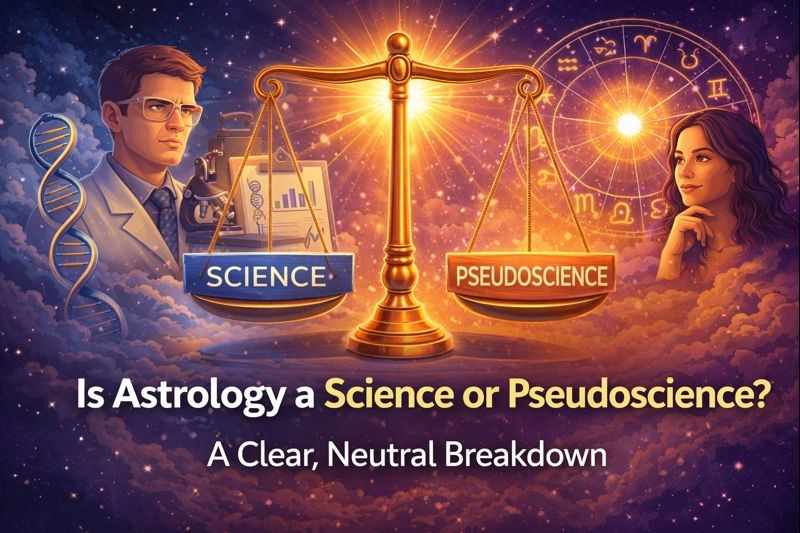
People have debated astrology for centuries, yet the question remains unresolved for many modern readers. Some trust astrology deeply and use it for guidance in relationships, careers, and life decisions. Others dismiss it outright and label it as superstition. Because of this divide, one question continues to surface across search engines, classrooms, and discussions: is astrology a science or does it belong to the category of pseudoscience?
To answer this honestly, we must move beyond belief and disbelief. We also need to examine definitions, historical context, scientific standards, and human psychology. Only then can we reach a clear and neutral understanding.
Also read – Why Astrology Feels Surprisingly Accurate (Even to Skeptics)
Understanding the Core Question: Is Astrology a Science
Before forming conclusions, we must first define what science actually means. Science relies on systematic observation, testable hypotheses, repeatable experiments, and measurable outcomes. Scientists expect theories to change when new evidence appears.
Astrology, on the other hand, studies the correlation between celestial movements and human life. Astrologers analyze planetary positions, zodiac signs, and birth charts to interpret personality traits and life events. This fundamental difference sets the stage for the debate over whether astrology meets scientific criteria.
Also read – Does Astrology Really Work? What Research, Psychology & Data Reveal
What Science Requires to Be Called Science
To understand why people ask is astrology a science, we must examine the rules science follows. Scientific disciplines require controlled experimentation, statistical validation, peer review, and predictive accuracy that exceeds chance.
Physics, biology, and chemistry meet these standards because researchers can reproduce results under similar conditions. When findings fail, scientists revise or discard theories. Therefore, scientific credibility depends on adaptability and evidence, not tradition or belief.
What Astrology Claims to Do
Astrology claims that planetary positions influence human behavior, emotions, and life events. Birth charts attempt to map an individual’s psychological makeup using the exact time and place of birth.
Astrologers do not claim planets cause events directly. Instead, they argue that planetary movements reflect patterns that mirror human experiences. This symbolic framework distinguishes astrology from physical sciences while also complicating its evaluation through scientific tools.
Also read – MOST COMMON ASTROLOGY MYTHS PEOPLE STILL BELIEVE
Historical Context: Astrology and Science Once Walked Together
The debate over is astrology a science becomes clearer when we look at history. Ancient civilizations did not separate astronomy and astrology. Babylonians tracked planets for both calendars and omens. Greeks refined astrological systems using geometry and mathematics.
During the Middle Ages, universities taught astrology alongside medicine and astronomy. Physicians even used planetary transits to decide treatment timings. However, the Scientific Revolution changed standards of evidence. Astronomy evolved through observation and experimentation, while astrology remained interpretive and symbolic.
The Scientific Criticism of Astrology
Modern science challenges astrology on several grounds. First, researchers struggle to prove consistent statistical correlations between planetary positions and personality traits. Second, astrological predictions often lack specificity and falsifiability.
For example, vague horoscope statements often feel accurate to many people. Scientists explain this effect using psychology rather than planetary influence. Because astrology resists experimental validation, critics argue that it does not qualify as science.
The Role of the Barnum Effect
To further evaluate is astrology a science, we must understand the Barnum Effect. This psychological phenomenon explains why people accept generalized statements as personally meaningful.
When horoscopes describe traits like sensitivity, ambition, or inner conflict, most people relate to them. This response does not require planetary influence. Instead, it reflects human tendency to seek patterns and validation. Scientists often cite this effect when dismissing astrology’s accuracy.
Why Astrology Still Feels Accurate to Many People
Despite criticism, millions rely on astrology daily. This reliance demands explanation beyond mockery or dismissal. Astrology provides language for self-reflection. It encourages introspection and emotional awareness.
Additionally, astrology offers narrative structure during uncertainty. When people face confusion, astrological frameworks supply meaning and direction. Therefore, astrology’s emotional resonance explains its popularity, even without scientific validation.
Astrology as a Symbolic System
Astrology functions more like a symbolic language than a predictive science. Symbols help humans understand internal experiences. Jungian psychology explored this connection deeply. Carl Jung viewed astrology as synchronistic rather than causal.
Through this lens, astrology becomes a mirror rather than a mechanism. This perspective does not claim scientific status, yet it also avoids labeling astrology as meaningless. Instead, it frames astrology as a psychological and cultural tool.
Pseudoscience Explained Clearly
To answer is astrology a science, we must also define pseudoscience. Pseudoscience mimics scientific language but lacks scientific methodology. It often resists falsification and relies heavily on anecdotal evidence.
Critics place astrology in this category because it does not adapt to contradictory data. While this classification explains astrology’s scientific limitations, it does not automatically invalidate its subjective value.
Also read – Why Astrology Feels Surprisingly Accurate (Even to Skeptics)
Why Astrology Fails Scientific Testing
Controlled studies repeatedly fail to confirm astrology’s predictive power beyond chance. Double-blind experiments show no reliable connection between birth charts and personality assessments.
Moreover, astrologers often disagree on interpretations even when analyzing identical charts. This inconsistency further weakens astrology’s scientific credibility. Because of these factors, mainstream science does not recognize astrology as a science.
Why Astrology Does Not Need to Be Science
A crucial point often overlooked in the debate over is astrology a science involves purpose. Science seeks explanation and prediction through evidence. Astrology seeks meaning, insight, and narrative understanding.
Not all valuable systems require scientific validation. Art, philosophy, and religion influence humanity profoundly without meeting scientific standards. Astrology may belong to this category rather than competing with science.
Cultural and Social Importance of Astrology
Astrology persists across cultures because it adapts to human needs. Different civilizations developed unique astrological systems, including Vedic astrology, Chinese astrology, and Western astrology.
Each system reflects cultural values and cosmological views. This adaptability highlights astrology’s role as a cultural language rather than a scientific framework.
Vedic Astrology and Its Distinct Approach
When discussing is astrology a science, Vedic astrology often enters the conversation. Jyotish emphasizes karma, timing cycles, and spiritual evolution. Practitioners focus less on personality traits and more on life phases.
Although Vedic astrology uses complex calculations, it still does not meet scientific testing standards. However, its structured approach contributes to its perceived depth and seriousness.
Astrology Versus Astronomy
Confusion between astrology and astronomy fuels misunderstanding. Astronomy studies celestial objects using physics and mathematics. Astrology interprets celestial symbolism.
Modern science accepts astronomy fully because evidence supports it. Astrology diverged when astronomy adopted experimental methods. Recognizing this split helps clarify why astrology lost scientific status.
Can Astrology Become a Science in the Future
Some proponents argue astrology could evolve with better data and methodology. However, the symbolic nature of astrology limits this possibility. Science measures physical forces, while astrology interprets meaning.
Unless astrology fundamentally changes its assumptions, it will remain outside scientific classification. This reality does not diminish its cultural role.
Also read – Why Career Growth Feels Slow Despite Hard Work (Astrology View)
Why People Seek Scientific Validation for Astrology
The desire to label astrology as science stems from social authority. Science commands trust in modern society. Therefore, astrology supporters sometimes seek legitimacy through scientific language.
However, this approach often backfires. When astrology fails scientific tests, critics dismiss it entirely. Accepting astrology’s non-scientific nature may actually preserve its integrity.
Also read – Free Marriage Astrology: What Your Birth Chart Reveals
A Balanced Perspective on Astrology
A neutral evaluation of is astrology a science requires intellectual honesty. Astrology does not meet scientific criteria. Evidence does not support planetary causation or reliable prediction.
At the same time, astrology serves psychological, cultural, and reflective purposes. Many users treat astrology as a tool for insight rather than prediction. This balanced view respects both science and human experience.
How to Use Astrology Responsibly
People who engage with astrology benefit most when they avoid absolutism. Astrology should not replace medical advice, financial planning, or critical thinking.
Instead, astrology can support self-awareness and reflection. When used responsibly, it complements rather than competes with rational decision-making.
Also read- Is Astrology Real or Psychological? A Clear Explanation
Why the Debate Will Continue
The debate over is astrology a science will likely persist because it touches identity, belief, and meaning. Humans seek explanations for uncertainty. Science answers some questions. Symbolic systems answer others.
As long as people look to the stars for stories about themselves, astrology will remain relevant regardless of scientific classification.
Frequently Asked Questions
Is astrology considered a science?
Astrology is not considered a science by modern scientific standards because it does not rely on testable hypotheses or reproducible experiments. It is better understood as a symbolic or cultural system rather than an empirical science.
Why do scientists label astrology as pseudoscience?
Scientists classify astrology as pseudoscience because its claims cannot be consistently tested or falsified using scientific methods. Additionally, studies have not shown reliable evidence that planetary positions cause specific life events.
What is the difference between science and pseudoscience?
Science relies on observation, experimentation, peer review, and the ability to disprove claims. Pseudoscience may use scientific language or structure but lacks rigorous testing and reproducibility. Astrology falls into this category from a scientific perspective.
If astrology is not scientific, why do people still trust it?
Many people trust astrology because it reflects psychological patterns, emotional experiences, and archetypal themes that feel personally meaningful. Trust often comes from resonance and self-reflection rather than scientific proof.
Is astrology closer to psychology than science?
Astrology shares similarities with psychology in that both explore personality traits, behavior patterns, and emotional tendencies. However, psychology uses empirical research, while astrology relies on symbolic interpretation.
Can astrology and science coexist?
Astrology and science can coexist when astrology is treated as a cultural, symbolic, or reflective framework rather than a predictive scientific system. Many people use astrology for insight without viewing it as a replacement for scientific understanding.
Does astrology make factual claims about the universe?
Traditional astrology does not attempt to explain physical mechanisms of the universe. Instead, it focuses on symbolic correlations between celestial movements and human experience, which differs from scientific explanation.
Why does astrology feel accurate if it is not scientific?
Astrology feels accurate because it uses broad psychological language, symbolic narratives, and timing-based interpretations that align with common human experiences. This creates recognition and emotional validation.
Is astrology harmful if it is pseudoscience?
Astrology is generally not harmful when used for reflection or self-awareness. It becomes problematic only if treated as absolute truth or used to replace critical thinking and personal responsibility.
How should skeptics approach astrology?
Skeptics can approach astrology as a symbolic language or cultural tradition rather than a belief system. Viewing it as a reflective tool allows engagement without abandoning scientific reasoning.
Final Conclusion: A Clear and Honest Answer
So, is astrology a science? Based on scientific standards, the answer is no. Astrology does not follow experimental methodology or produce repeatable results. Therefore, science categorizes it as a pseudoscience.
However, astrology continues to thrive because it fulfills emotional, cultural, and psychological needs. It offers language for self-reflection and meaning rather than measurable proof.
Understanding this distinction allows for respectful dialogue. Science and astrology serve different purposes. When we stop forcing astrology into scientific frameworks, we gain clarity rather than conflict.
Sources & References
- Stanford Encyclopedia of Philosophy – Science and Pseudoscience
- Encyclopaedia Britannica – Pseudoscience Explained
- Encyclopaedia Britannica – Astrology Overview
- Pew Research Center – Public Beliefs About Astrology
- Psychology Today – Confirmation Bias and Belief Formation
- Popper, K. – The Logic of Scientific Discovery
- Jung, C. G. – Archetypes and the Collective Unconscious, Princeton University Press
- Campion, N. – Astrology and Popular Religion in the Modern West
- Google Trends – Astrology Search Popularity Over Time
- Gurucool.life – Astrology & Spiritual Knowledge Platform
- Shloka.life – Rituals, Astrology & Cultural Insights
10 Comments