
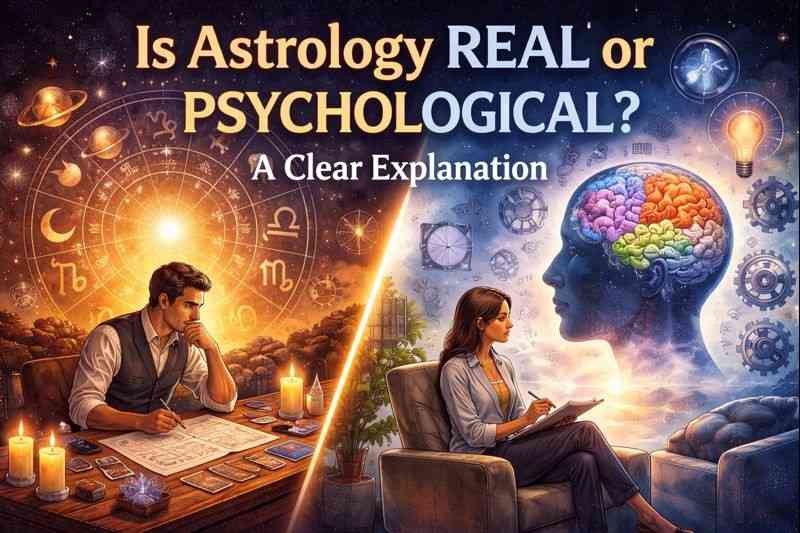
Introduction: Why This Question Refuses to Go Away
People across cultures ask the same question again and again: is astrology real, or does psychology explain everything it claims to predict? This debate continues because astrology sits at the crossroads of belief, observation, emotion, and logic. Some people experience striking accuracy in astrological readings. Others dismiss astrology as confirmation bias or personality illusion.
To understand the truth clearly, we need to move beyond extreme opinions. We must examine astrology’s foundations, its psychological overlaps, its limitations, and its real-world use. Only then can we answer this question honestly and intelligently.
Also read – Does Astrology Really Work? What Research, Psychology & Data Reveal
What Does “Astrology Is Real” Actually Mean?
Before judging astrology, we need clarity. When people ask “is astrology real,” they often mean different things. Some expect astrology to behave like physics or biology. Others expect spiritual insight or emotional guidance.
Astrology does not claim to work like laboratory science. Instead, it works as a symbolic system that studies correlations between planetary movements and human experiences. Astrologers observe repeating patterns over centuries. They analyze planetary cycles, timing, and symbolism rather than cause-and-effect mechanisms.
Therefore, astrology’s reality depends on how you define “real.” It does not predict events mechanically. Instead, it describes tendencies, cycles, and psychological climates.
Also read – Why Astrology Feels Surprisingly Accurate (Even to Skeptics)
The Historical Roots of Astrology
Astrology did not begin as entertainment. Ancient civilizations treated it as a serious knowledge system. Babylonians tracked planetary movements thousands of years ago. Egyptians aligned temples with stars. Indian sages developed Jyotish as a spiritual science linked with karma and time. Greek philosophers later merged astrology with mathematics and geometry.
Throughout history, astrologers advised kings, physicians, and scholars. They observed agriculture cycles, epidemics, and social changes alongside planetary patterns. This long tradition does not automatically prove astrology correct, but it does show consistent human engagement with cosmic observation.
Such endurance raises a valid question: would astrology survive for millennia if it held no value at all?
How Astrology Claims to Work
Astrology does not say planets force actions. Instead, it suggests planets reflect timing and inner states. Many astrologers use the phrase “as above, so below” to explain this connection.
A birth chart captures the sky’s arrangement at your birth moment. Astrologers read this chart as a symbolic map of personality traits, emotional patterns, talents, and challenges. Transits then show when certain themes activate over time.
Astrology focuses on probability, not certainty. It highlights tendencies rather than fixed outcomes. This distinction matters because critics often judge astrology using standards it never claimed to meet.
The Psychological Argument Against Astrology
Psychology presents strong counterpoints. Critics argue that astrology works because of cognitive biases rather than cosmic influence. The most common explanation involves the Barnum effect. This effect occurs when people accept vague statements as deeply personal.
For example, phrases like “you value independence but also seek connection” apply to nearly everyone. When people see these descriptions in horoscopes, they assume accuracy.
Confirmation bias also plays a role. People remember correct predictions and forget incorrect ones. Additionally, emotional vulnerability makes people seek meaning, which astrology conveniently provides.
Also read – IS ASTROLOGY A SCIENCE OR PSEUDOSCIENCE? A CLEAR, NEUTRAL BREAKDOWN
Where Psychology and Astrology Overlap
Interestingly, psychology does not fully dismiss astrology’s usefulness. Carl Jung, a pioneer of depth psychology, explored astrology extensively. He studied synchronicity, which describes meaningful coincidences without direct causation.
Astrology often mirrors psychological archetypes. Mars represents aggression and drive. Venus symbolizes attraction and harmony. Saturn reflects discipline and fear. These symbols align closely with recognized psychological traits.
In this sense, astrology functions as a language of the psyche. It gives people a structured way to understand inner conflicts and motivations. Therefore, psychology may explain how astrology works rather than prove it false.
Why Astrology Feels Personal and Accurate
People often say astrology feels “too accurate to ignore.” Several factors contribute to this experience.
First, birth charts use precise data such as time and place. This specificity creates uniqueness. Second, astrology addresses emotional and existential questions, not just behavior. Third, skilled astrologers ask reflective questions that deepen self-awareness.
When astrology encourages introspection, people connect deeply with it. This process resembles therapeutic dialogue. However, emotional resonance does not automatically mean deception. It means astrology engages the human mind effectively.
Scientific Testing and Its Limits
Scientists often test astrology using controlled experiments. These tests usually involve Sun-sign horoscopes rather than full charts. This approach creates a problem. Astrology does not rely solely on Sun signs.
When researchers test astrology incorrectly, results naturally fail. Some studies that used complete charts and experienced astrologers produced mixed outcomes. They neither confirmed nor fully debunked astrology.
Science demands repeatability and measurable mechanisms. Astrology operates symbolically and contextually. This difference creates a mismatch. Therefore, science struggles to evaluate astrology properly without redefining its criteria.
Also read – Why Life Feels Stuck According to Astrology
Is Astrology Real According to Science?
From a strict scientific viewpoint, astrology lacks empirical proof as a causal system. Scientists do not recognize planetary influence as a measurable force on psychology.
However, science does not label astrology useless. Instead, it categorizes astrology as a belief system with psychological impact. Science acknowledges that belief frameworks shape behavior, decision-making, and emotional regulation.
Thus, astrology remains unproven scientifically but not meaningless.
Is Astrology Real in Daily Life?
Many people do not care about scientific validation. They care about results. Astrology often helps people understand relationships, timing, career decisions, and emotional patterns.
For example, astrology encourages patience during difficult transits. It promotes self-awareness during emotional cycles. It offers language for experiences people struggle to explain logically.
In this sense, astrology becomes a tool rather than a doctrine. Tools do not need absolute truth. They need usefulness.
Astrology as a Reflective Framework
Astrology works best when used reflectively, not fatalistically. Healthy astrology empowers choice. It does not remove responsibility.
When astrologers emphasize free will, astrology supports growth. When they predict doom, astrology harms trust. Therefore, the quality of application matters more than belief.
Astrology should guide, not govern.
Cultural Conditioning and Astrology
Culture shapes how people perceive astrology. In India, astrology integrates with rituals, marriage decisions, and spirituality. In the West, astrology often appears as lifestyle content.
These cultural lenses influence expectations. People who grow up with astrology treat it as practical wisdom. Skeptics raised in scientific environments demand evidence.
Neither perspective is wrong. They simply prioritize different forms of knowledge.
Also read – Why Career Growth Feels Slow Despite Hard Work (Astrology View)
Why Astrology Continues to Survive
Astrology survives because it adapts. It evolves with language, psychology, and social change. Modern astrologers integrate counseling skills. They focus on empowerment rather than prediction.
Astrology also fills a gap. Modern life offers information but lacks meaning. Astrology addresses purpose, timing, and identity.
As long as humans seek meaning, astrology will remain relevant.
Can Astrology and Psychology Coexist?
Astrology and psychology do not need to compete. They can complement each other. Psychology explains mechanisms. Astrology explains timing and symbolism.
Some therapists even use astrology as a self-reflection tool. They do not treat it as factual destiny. They treat it as narrative exploration.
This balanced approach removes fear and superstition while preserving insight.
Also read – Free Birth Chart Calculator: How to Read Your Astrology Chart
Common Misunderstandings About Astrology
Many people misunderstand astrology because of oversimplification. Newspaper horoscopes reduce astrology to entertainment. Social media exaggerates predictions.
True astrology requires training, context, and ethics. Serious astrologers avoid absolute claims. They focus on themes and cycles.
When people judge astrology based on shallow content, they misjudge the entire field.
Is Astrology Dangerous?
Astrology becomes harmful only when people surrender agency. When someone avoids medical care or life responsibility because of astrology, problems arise.
Healthy astrology encourages awareness, not dependency. Ethical astrologers remind clients that choices matter more than charts.
Responsibility always belongs to the individual.
So, Is Astrology Real or Psychological?
The honest answer includes both. Astrology works psychologically through symbols, reflection, and meaning-making. It also operates as a symbolic timing system observed across centuries.
Astrology does not fit neatly into scientific categories. However, it does not need to. Many valuable systems, such as art and philosophy, also resist measurement.
Astrology remains real in experience, guidance, and introspection even if science does not validate it fully.
Also read – Free Astrology Tools You Can Use Without Signup
How to Use Astrology Wisely
Use astrology to understand yourself, not escape reality. Combine astrology with logic, self-reflection, and responsibility.
Question predictions that create fear. Trust interpretations that promote clarity and growth.
When used thoughtfully, astrology becomes a mirror rather than a cage.
Frequently Asked Questions About Astrology and Psychology
Is astrology real or just psychological?
Astrology functions as a symbolic and psychological framework rather than a physical science. It helps people understand patterns, timing, and inner experiences, even though it does not operate through measurable cause-and-effect mechanisms.
Why does astrology feel accurate to so many people?
Astrology feels accurate because it uses symbolic language, personalized birth data, and reflection-based interpretation. Psychological factors like self-awareness, emotional resonance, and pattern recognition also enhance this experience.
Does science support astrology?
Mainstream science does not recognize astrology as a causal system. However, science acknowledges that belief systems and symbolic frameworks can influence behavior, emotions, and decision-making.
Is astrology the same as confirmation bias?
Confirmation bias explains part of astrology’s appeal, but it does not fully account for structured chart analysis, long-term timing patterns, or deep psychological insight found in serious astrological practice.
How is astrology different from psychology?
Psychology explains mental mechanisms and behavior patterns, while astrology focuses on symbolic timing, cycles, and archetypes. Both address the human mind but from different perspectives.
Can astrology and psychology work together?
Yes. Many practitioners use astrology as a reflective tool alongside psychological understanding. This combined approach supports self-awareness without removing personal responsibility.
Why do scientists criticize astrology?
Scientists criticize astrology because it lacks empirical testing, repeatability, and measurable mechanisms. Astrology operates symbolically, which does not fit traditional scientific evaluation models.
Is astrology dangerous to believe in?
Astrology becomes harmful only when people surrender free will or avoid real-world responsibility. Ethical astrology encourages awareness and choice, not dependency or fear.
Are newspaper horoscopes real astrology?
No. Newspaper horoscopes oversimplify astrology. True astrology requires a complete birth chart, contextual analysis, and ethical interpretation.
How should astrology be used wisely?
Astrology should be used as a tool for reflection, timing awareness, and self-understanding, alongside logic, responsibility, and critical thinking.
Final Conclusion: A Balanced Perspective
So, is astrology real? Astrology is real as a psychological and symbolic framework that helps people understand themselves and navigate time. It is not a replacement for science, medicine, or personal responsibility.
Astrology survives because it speaks to the human need for meaning. It organizes chaos into narrative. It offers language for inner experience.
When you approach astrology with awareness, curiosity, and balance, it becomes a powerful tool rather than blind belief.
Sources & References
This article is informed by classical astrological texts, modern psychology research, and contemporary explanatory resources.
- Shloka.life – Astrology Explained: Articles exploring astrology as a symbolic and psychological framework for understanding life patterns. https://www.shloka.life
- Brihat Parashara Hora Shastra: Foundational Vedic astrology scripture describing planetary symbolism, timing systems, and life patterns. https://archive.org/details/brihatparasharahorashastra
- Phaladeepika by Mantreshwara: Classical astrological text focusing on interpretation of planetary positions and life themes. https://archive.org/details/phaladeepika
- Carl Jung – Synchronicity: Psychological concept explaining meaningful coincidences without causal connection. https://www.goodreads.com/book/show/821922.Synchronicity
- American Psychological Association (APA): Research on cognitive bias, personality perception, and belief frameworks. https://www.apa.org/monitor/nov01/bias
- Barnum Effect – Psychology Explanation: Overview of why vague personality statements feel personally accurate. https://www.psychologytoday.com/us/basics/barnum-effect
- History of Astrology – Encyclopaedia Britannica: Historical overview of astrology across civilizations. https://www.britannica.com/topic/astrology


4 Comments