
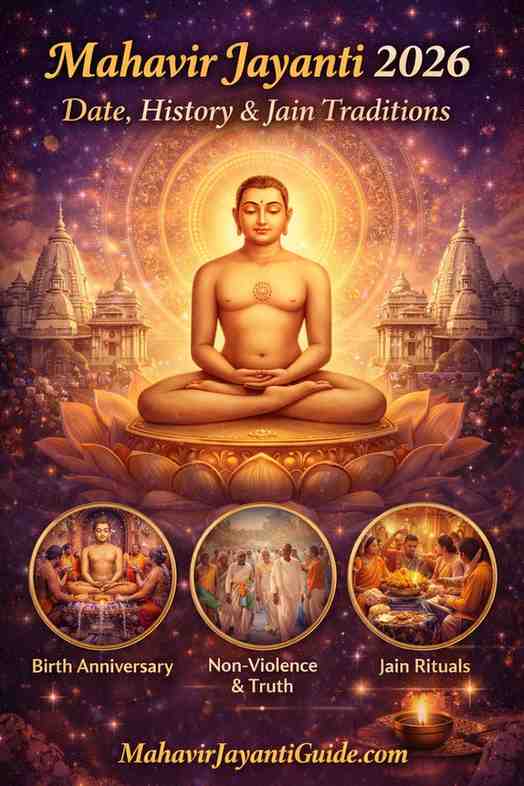
Introduction to Mahavir Jayanti 2026
Mahavir Jayanti 2026 will be celebrated on April 2, 2026 (expected), marking the birth anniversary of Lord Mahavir, the 24th Tirthankara of Jainism. Every year, devotees across India and around the world observe this sacred festival with devotion, spiritual reflection, and community service.
Since Jainism follows a traditional lunar calendar, the festival falls on the 13th day of the bright half (Shukla Paksha) of the month of Chaitra. Therefore, the date usually comes in March or April according to the Gregorian calendar.
Importantly, Mahavir Jayanti holds immense religious and philosophical significance. Lord Mahavir dedicated his life to promoting non-violence (Ahimsa), truth (Satya), non-possessiveness (Aparigraha), and self-discipline. Consequently, his teachings continue to influence millions even today.
Across India, Jain temples witness large gatherings on this day. Devotees perform prayers, offer rituals, and participate in processions. Moreover, charitable activities increase significantly, as followers believe that service and compassion honor Mahavir’s legacy.
In cities like Mumbai, Ahmedabad, Jaipur, Delhi, and Kolkata, Jain communities organize grand events. Processions featuring Lord Mahavir’s idol move through streets, accompanied by devotional songs and spiritual discourses.
Also Read :- Pratyangira Devi Puja: Black Magic Removal Guide
Mahavir Jayanti 2026 Date and Calendar Significance
Mahavir Jayanti 2026 is expected to be observed on Thursday, April 2, 2026, according to the Jain lunar calendar. However, final confirmation depends on the traditional Panchang calculations followed by Jain communities.
The festival falls on Chaitra Shukla Trayodashi, which refers to the 13th day of the waxing moon phase in the month of Chaitra. Therefore, the celebration aligns with the Hindu lunar calendar but carries distinct Jain religious importance.
Unlike fixed Gregorian dates, Jain festivals follow lunar cycles. Consequently, Mahavir Jayanti shifts slightly each year. This variation often creates curiosity among people searching for the exact date.
Moreover, the Government of India declares Mahavir Jayanti as a gazetted public holiday. Therefore, banks, government offices, and many institutions remain closed. This recognition highlights the festival’s national importance.
In addition, Jain temples begin preparations days in advance. Organizers schedule special prayer sessions, charity drives, and educational programs. Therefore, the celebration extends beyond a single day.
Importantly, the timing of the birth of Lord Mahavir holds symbolic value. According to Jain scriptures, Queen Trishala experienced auspicious dreams before Mahavir’s birth. These dreams indicated the arrival of a great spiritual leader.
Also Read :- Somnath Jyotirlinga: Eternal Shrine of Lord Shiva
Furthermore, astrologers note that Mahavir was born under favorable planetary alignments. Devotees often discuss these symbolic elements during religious gatherings.
Therefore, Mahavir Jayanti 2026 represents not only a historical remembrance but also a deeply symbolic spiritual occasion.
Now that we have clarified the date and calendar context, let us explore the history and life of Lord Mahavir in detail.
History and Life of Lord Mahavir
Also Read :- Shakti Peeth Temples in India: Sacred Seats of the Divine Mother
To understand the significance of Mahavir Jayanti 2026, one must explore the life and teachings of Lord Mahavir. He was born in 599 BCE (according to traditional Jain belief) in Kundagrama, near present-day Vaishali in Bihar.
Born as Vardhamana to King Siddhartha and Queen Trishala, Mahavir grew up in a royal family. However, despite his comfortable upbringing, he displayed extraordinary spiritual awareness from a young age.
At the age of 30, he renounced worldly life. He left behind wealth, power, and family to seek ultimate truth. Consequently, he adopted a life of intense meditation and ascetic discipline.
For nearly 12 years, Mahavir practiced severe penance and deep meditation. He endured hardships with remarkable patience. Eventually, he attained Kevala Jnana (absolute knowledge). From that moment onward, he became a Tirthankara — a spiritual teacher who guides others toward liberation.
Moreover, Mahavir emphasized Ahimsa (non-violence) as the highest virtue. Unlike mere avoidance of physical harm, he extended non-violence to thoughts and speech. Therefore, his philosophy encouraged total compassion.
Additionally, he promoted Aparigraha (non-attachment). He taught that excessive desire leads to suffering. By reducing attachment, individuals can achieve inner peace.
Importantly, Mahavir structured Jainism into a disciplined path that included monks, nuns, and household followers. His teachings spread widely across ancient India.
Therefore, Mahavir Jayanti 2026 celebrates not just his birth but also his revolutionary spiritual philosophy
Core Teachings of Lord Mahavir and Their Modern Relevance
Also Read :- Bhairav Puja – Protection & Legal Victory (2026) guide
After understanding the life of Lord Mahavir, we must now explore his core teachings. These principles form the foundation of Jain philosophy and continue to guide millions even today.
First and foremost, Lord Mahavir emphasized Ahimsa (Non-Violence). However, his concept of non-violence extended far beyond physical harm. He urged followers to avoid violence in thoughts, words, and actions. Therefore, Ahimsa demands compassion toward all living beings, including animals, insects, and even microorganisms.
Consequently, many Jains follow strict vegetarian or vegan diets. They avoid harming animals and practice careful living. In today’s world, where environmental concerns and animal rights movements gain momentum, Mahavir’s philosophy appears remarkably relevant.
Secondly, Mahavir promoted Satya (Truthfulness). He encouraged people to speak truthfully and act honestly. Importantly, truth in Jainism must align with kindness. Therefore, followers avoid harsh speech even when telling the truth.
Thirdly, he taught Aparigraha (Non-Possessiveness). According to Mahavir, attachment to wealth, power, or material possessions creates suffering. Therefore, he advised limiting desires. In modern consumer-driven societies, this teaching offers powerful guidance for achieving mental peace.
Additionally, Mahavir introduced Anekantavada (Theory of Multiple Perspectives). This principle teaches that truth has multiple dimensions. Therefore, individuals should respect different viewpoints. In today’s polarized world, this philosophy promotes tolerance and dialogue.
Furthermore, he emphasized self-discipline and meditation. Spiritual growth requires effort and control over ego and desire. Therefore, Jain monks and nuns follow rigorous vows even today.
As a result, Mahavir Jayanti 2026 will not only celebrate a historical figure but also highlight timeless principles. His teachings address modern challenges such as violence, greed, intolerance, and environmental degradation.
Now that we understand his philosophy, let us examine how Jain communities observe Mahavir Jayanti with devotion and tradition.
Jain Traditions Observed on Mahavir Jayanti
As Mahavir Jayanti 2026 approaches, Jain communities across India prepare with devotion and enthusiasm. Unlike loud festive celebrations, this occasion reflects spiritual depth and discipline.
First, devotees visit Jain temples early in the morning. They offer prayers, chant sacred hymns, and participate in special rituals. Importantly, many temples organize Abhisheka, a ceremonial bathing of Lord Mahavir’s idol with water, milk, and fragrant substances.
Moreover, devotees decorate temples with flowers and lights. The atmosphere becomes serene and spiritually uplifting. Religious leaders deliver sermons that explain Mahavir’s teachings and inspire ethical living.
Additionally, community members organize Rath Yatras (processions). During these events, they place Lord Mahavir’s idol on a decorated chariot and carry it through streets. Devotees sing bhajans and spread messages of non-violence and peace.
Furthermore, charitable activities form a central part of the celebration. Jain communities distribute food, donate clothes, and support hospitals or educational institutions. Therefore, Mahavir Jayanti emphasizes service rather than material celebration.
Importantly, many followers observe fasting on this day. Some choose partial fasts, while others undertake complete fasting as an act of spiritual purification.
In schools and community centers, children participate in cultural programs. They perform skits and speeches based on Mahavir’s life. Consequently, younger generations learn about Jain values from an early age.
Thus, Mahavir Jayanti 2026 will combine prayer, charity, education, and reflection.
Next, let us explore the rituals and grand processions that characterize Mahavir Jayanti celebrations across India.
Rituals and Grand Processions in India
Across India, Mahavir Jayanti stands out as one of the most important Jain festivals. While the rituals remain spiritually focused, the public processions create a vibrant cultural atmosphere.
Firstly, the day begins with Snatra Puja, a special ritual that commemorates the birth of Lord Mahavir. Devotees reenact symbolic aspects of his birth ceremony described in Jain scriptures. Through these rituals, they honor his spiritual greatness.
After temple prayers, communities organize grand Rath Yatras. These processions move through major streets in cities such as Ahmedabad, Jaipur, Mumbai, and Delhi. Devotees decorate chariots with flowers and colorful fabrics.
Moreover, participants carry Jain flags and banners displaying messages of Ahimsa and peace. Religious songs fill the air, creating a devotional environment. However, celebrations remain disciplined and peaceful, reflecting Jain values.
Additionally, community kitchens often distribute free food and water during processions. Therefore, service remains central even during public celebrations.
Authorities frequently coordinate with Jain organizations to manage traffic and ensure safety. Since large gatherings occur, proper planning becomes essential.
Furthermore, many Jain organizations host seminars and lectures on environmental protection and ethical living. They connect Mahavir’s teachings with contemporary issues such as climate change and social harmony.
Unlike festivals centered on entertainment, Mahavir Jayanti maintains spiritual dignity. Devotees celebrate joyfully yet responsibly.
Therefore, Mahavir Jayanti 2026 will showcase India’s rich Jain heritage while reinforcing timeless moral values.
Mahavir Jayanti 2026 as a Public Holiday in India
Beyond its religious importance, Mahavir Jayanti 2026 also holds national significance in India. The Government of India recognizes the festival as a gazetted public holiday, which highlights the deep cultural contribution of the Jain community to the nation’s heritage.
On April 2, 2026 (expected), government offices, banks, and many educational institutions will remain closed. Consequently, Jain families will have the opportunity to participate fully in temple visits, rituals, and community service activities without professional obligations.
Moreover, several state governments organize official events to honor Lord Mahavir’s teachings. Political leaders often deliver speeches emphasizing non-violence, ethical governance, and social harmony. Therefore, Mahavir Jayanti becomes not only a religious observance but also a reminder of universal values.
Importantly, national media platforms publish articles and special features explaining the philosophy of Jainism. Educational institutions conduct seminars and essay competitions that encourage students to explore Mahavir’s life and contributions.
Additionally, statues and monuments of Lord Mahavir receive floral tributes. Cultural organizations arrange exhibitions showcasing Jain art, manuscripts, and architecture. As a result, the broader public gains awareness about Jain heritage.
Furthermore, the recognition of Mahavir Jayanti as a public holiday reflects India’s commitment to religious diversity. The country celebrates festivals of multiple faiths, which strengthens unity and mutual respect.
Thus, Mahavir Jayanti 2026 will serve as both a spiritual celebration and a symbol of India’s inclusive identity.
Now, let us explore how Mahavir Jayanti influences society through ethical and social impact.
Social and Ethical Impact of Mahavir Jayanti
Although Mahavir Jayanti marks a historical birth anniversary, its deeper influence extends into social and ethical transformation. Lord Mahavir’s teachings continue to shape moral consciousness across generations.
First and foremost, Ahimsa (non-violence) influences not only personal conduct but also social movements. Leaders such as Mahatma Gandhi drew inspiration from Jain principles of non-violence. Consequently, Mahavir’s philosophy indirectly shaped India’s freedom struggle.
Moreover, Aparigraha (non-possessiveness) encourages responsible consumption. In a world dominated by materialism, this teaching promotes sustainability and environmental awareness. Therefore, many Jain organizations actively support animal welfare and ecological initiatives.
Additionally, Mahavir Jayanti inspires charitable activities. On this day, communities organize blood donation camps, food distribution programs, and medical check-ups. Such initiatives demonstrate practical compassion rather than symbolic worship.
Furthermore, Anekantavada (respect for multiple viewpoints) strengthens democratic dialogue. This principle teaches tolerance and open-mindedness. In diverse societies, this philosophy fosters peaceful coexistence.
Importantly, Jain educational institutions use Mahavir Jayanti as an opportunity to teach ethical leadership. Students learn about discipline, truthfulness, and humility through cultural programs and discussions.
Therefore, Mahavir Jayanti 2026 will not only celebrate tradition but also reinforce ethical values relevant to modern challenges.
Next, let us examine how Jain communities around the world celebrate this sacred occasion.
Global Celebration of Mahavir Jayanti
Although India hosts the largest Jain population, Mahavir Jayanti is celebrated worldwide. Jain communities in the United States, United Kingdom, Canada, Kenya, and Australia organize temple gatherings and cultural events.
Firstly, Jain temples abroad conduct special prayers similar to those in India. Devotees perform Abhisheka, recite scriptures, and listen to sermons. Despite geographical distance, the spiritual essence remains consistent.
Moreover, diaspora communities often combine traditional rituals with educational outreach. They invite scholars to explain Jain philosophy to younger generations. Consequently, cultural continuity remains strong.
Additionally, global Jain organizations host online lectures and webinars. These digital platforms allow worldwide participation. Therefore, Mahavir Jayanti reaches audiences beyond physical temple spaces.
Furthermore, many international Jain groups engage in philanthropic projects during this period. They raise funds for education, healthcare, and disaster relief initiatives. Thus, Mahavir Jayanti strengthens global humanitarian efforts.
Importantly, social media amplifies the celebration. Devotees share inspirational quotes, historical insights, and temple images. As a result, awareness about Jainism spreads across digital platforms.
Therefore, Mahavir Jayanti 2026 will unite Jain communities globally through shared devotion and ethical commitment.
Frequently Asked Questions (FAQs) – Mahavir Jayanti 2026
1. When is Mahavir Jayanti in 2026?
Mahavir Jayanti in 2026 is expected to be celebrated in April, marking the birth anniversary of Lord Mahavir.
2. Who was Lord Mahavir?
Lord Mahavir was the 24th Tirthankara of Jainism who taught the principles of non-violence, truth, and compassion.
3. Why is Mahavir Jayanti celebrated?
It is celebrated to honor the birth and teachings of Lord Mahavir and promote Jain values.
4. What are the main rituals of Mahavir Jayanti?
Devotees perform prayers, visit temples, participate in processions, and engage in charitable activities.
5. What is the significance of Mahavir Jayanti?
The festival emphasizes non-violence (Ahimsa), truth (Satya), and spiritual awakening.
6. Is Mahavir Jayanti a public holiday in India?
Yes, it is observed as a public holiday in many parts of India.
7. How do Jains celebrate Mahavir Jayanti?
Jains celebrate by offering prayers, reading scriptures, fasting, and organizing community events.
8. What teachings of Lord Mahavir are followed today?
His teachings of non-violence, truthfulness, non-attachment, and self-discipline are widely followed.
9. Are there special foods prepared on Mahavir Jayanti?
Jains prefer simple, vegetarian, and non-violent food, avoiding root vegetables on this day.
10. Can non-Jains participate in Mahavir Jayanti celebrations?
Yes, people of all communities can participate and learn from the teachings of Lord Mahavir.
Conclusion
Mahavir Jayanti 2026, expected on April 2, 2026, commemorates the birth of Lord Mahavir, the 24th Tirthankara of Jainism. However, beyond a historical remembrance, the festival represents a celebration of timeless values.
Throughout this blog, we explored:
- The date and calendar significance of Mahavir Jayanti 2026
- The life and history of Lord Mahavir
- Core teachings such as Ahimsa, Satya, and Aparigraha
- Jain traditions, rituals, and processions
- Public holiday recognition in India
- Social and global impact
Ultimately, Mahavir Jayanti reminds humanity that peace begins with self-discipline. Non-violence, truth, and compassion remain powerful solutions to modern conflicts.
Therefore, as April 2, 2026 approaches, devotees will honor Lord Mahavir not only through rituals but also through ethical living.
1 Comment