
Introduction
Meenakshi Temple in Madurai stands as a grand symbol of Dravidian architecture, vibrant festivals, and rich mythology. This blog explores its architectural marvels, tales, and key festivals to watch in 2026.
Architectural Splendor of Meenakshi Temple
Also Read :- Temples Along the Ganga: From Gangotri to Kashi Vishwanath
Dravidian Masterpiece
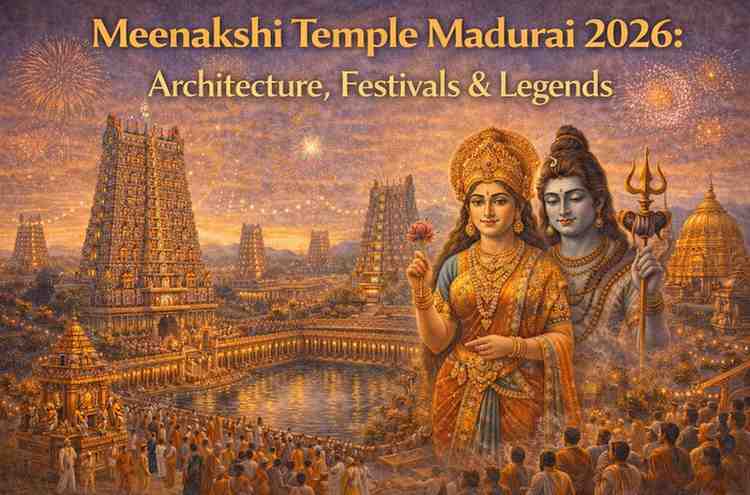
The temple complex covers approximately 254.1 meters by 237.6 meters and boasts 14 towering gopurams. The iconic southern gopuram reaches about 170 feet. These gopurams, adorned with thousands of intricately carved sculptures, depict mythological stories and divine beings. They serve as monumental gateways oriented to cardinal directions.
Key Structures
- Sundareswarar Shrine Gopuram: The oldest gateway leading to Lord Shiva’s shrine.
- Kadaka Gopuram: Mid-16th-century five-storey entrance to Goddess Meenakshi’s main shrine.
- Mandapams (Pillared Halls): Elaborate halls that showcase exquisite artwork and accommodate ritual gatherings.
Symbolism and Sacred Layout
The temple layout is designed per the principles of Shilpa Shastras, with concentric enclosures fortified by high walls. The temple forms the spiritual and cultural heart of Madurai city.
Also Read :- Saptashrungi to Trimbakeshwar: Nashik’s Divine Circuit
Festivals of Meenakshi Temple in 2026
Chithirai Thiruvizha (April-May)
A 12-day festival is known for the celestial wedding (Thirukalyanam) of Goddess Meenakshi and Lord Sundareswarar. It features flag hoisting, coronation ceremonies, and grand processions. The goddess is mounted on an elephant.
Aavani Festival (August)
The festival lasts 18 days and celebrates Lord Sundareswarar’s coronation as the king of Madurai. There are special rituals dedicated to Lord Chandrashekhar and farewell ceremonies for deities.
Theppotsavam (Float Festival) (January)
The deities are taken in a grand procession on the sacred waters of Vandiyur Mariamman Teppakulam. This symbolizes divine blessings showered upon the devotees.
Also Read :- Ujjain Mahakaleshwar: Bhasma Aarti Booking & Temple Rituals
Other Notable Festivals
- Oonjal Festival (June): Deities rocked gently on swings in elaborate ceremonies.
- Margali Thiruvembavai, Thai Pongal, Navarathri: Celebrated with fervor through devotional music and rituals.
Legends and Mythology Surrounding Meenakshi Temple
Origin Story
The Pandyan king Malayadhwaja and queen Kanchanmala performed a yajna seeking an heir. However, they were blessed with a girl born with three breasts – Meenakshi. Prophecies stated the third breast would vanish once she met her husband.
Divine Dance Hall
The temple is believed to be one of the five cosmic dance halls of Shiva (Panch Sabhas). This marks it as a site of divine cosmic energy and artistic heritage.
Madurai as a Sacred Serpent City
Local lore says Madurai was planned in the shape of a coiled serpent (Halasya), with the temple at its center. This embodies spiritual and urban harmony.
Also Read :- 12 Jyotirlinga Temples in India: Complete Darshan & Travel Guide
Important Rituals and Devotional Practices
- Daily Pujas: Kalasandhi and more from early morning till night.
- Abhishekam and Aarti: Performed to honor both Meenakshi and Sundareswarar.
- Kumarapujas: Dedicated to young girls symbolizing the goddess.
- Processions: Featuring vahanas (vehicles) like the elephant and flower palanquin, central to major festivals.
How to Experience Meenakshi Temple in 2026
- Best Time to Visit: During the Chithirai Festival for elaborate celebrations and vibrant cultural experiences.
- Timings: Open from early morning till late evening with special timings during festivals.
- Visitor Tips: Respect temple customs, dress modestly, and plan for large crowds during festivals.
Contemporary Renovations and the 2026 Kumbhabhishekam Preparation
The Meenakshi Temple is undergoing extensive renovations ahead of a grand Kumbhabhishekam (consecration ceremony) scheduled for January 2026. This marks the first such event in over 17 years. Restoration works include the intricate refurbishment of gopurams, mandapams, and the sanctum sanctorum. The renovations ensure architectural fidelity based on Agama Shastra principles. These efforts aim at spiritual rejuvenation and enhanced pilgrimage experiences. There are plans for digital live-streaming to connect devotees globally.
Also Read :- Temples of Love: Sacred Shrines Dedicated to Divine Couples
Architectural Grandeur: Highlights of the Temple Complex
Spanning around 254 by 237 meters, the compound features fourteen towering gopurams covered with vibrant sculptures of gods, goddesses, mythical creatures, and floral patterns. The southern gopuram, towering at approximately 170 feet, is the tallest. Mandapams like the Vasantha Mandapam and Kilikoondu Mandapam showcase ornamental pillars and frescoes, reflecting the Nayaka dynasty’s contributions during the 16th and 17th centuries.
Festivals and Celebrations in 2026
- Chithirai Festival: The grand celestial wedding of Goddess Meenakshi and Lord Sundareswarar continues to captivate millions.
- Aavani Festival: Commemorating Lord Sundareswarar, featuring ritualistic ceremonies and cultural processions.
- Theppotsavam (Float Festival): Held in January 2026 with deities paraded on illuminated floats in the temple tank.
- Upcoming Events: The temple’s July and August calendar includes Bhagavathi Seva and Naga Panchami celebrations. These events draw devotees from across Tamil Nadu.
Legends Enshrined in Stone and Story
The temple’s origin story of the three-breasted Meenakshi, destined to lose her third breast when meeting her consort, intertwines divine lore with Madurai’s historic narrative. Architectural symbolism and sculptures vividly depict these stories, enhancing devotees’ experiential connection to the myths.
Visitor Information for 2026
The temple remains open daily with special extended hours during festivals. Large crowds gather especially during Chithirai and Theppotsavam. Visitors are advised to plan accommodations in advance and observe temple protocols, including modest dress and photography restrictions.
Early Origins and Legendary Foundations
The earliest forms of a temple dedicated to Goddess Meenakshi likely date back to the 6th to 7th century CE. Legend attributes the founding to Pandya King Kulasekara Pandya, who, after prayers for an heir, was blessed with Meenakshi, an incarnation of Goddess Parvati. Nearby myths tell of Indra founding the temple after witnessing a miraculous self-manifested lingam and lotuses, attributing a divine origin to the site.
Pandya Period Developments (1190–1300 CE)
Pandya Emperor Sadayavarman Kulasekaran I (r. 1190–1216) built key portions of the temple, including the early gopurams and sanctums. His successor, Maravarman Sundara Pandyan II (1238–1251), added the striking Chitra Gopuram featuring detailed frescoes and secular religious themes on its walls.
Decline and Destruction in the 14th Century
The temple suffered extensive damage during Delhi Sultanate invasions led by Malik Kafur in the early 1300s. Valuable artifacts were looted and parts of the temple town destroyed, initiating a decline.
Revival under Vijayanagara and Nayak Dynasties (16th–17th Century)
The Vijayanagara rulers reopened and rebuilt the temple after decades of abandonment. Nayak King Vishwanatha Nayakar fortified and expanded the complex, designing the city plan according to Shilpa Shastras. His successor, Tirumala Nayaka, enriched the temple with grand mandapams like the Vasantha Mandapam and Kilikoondu Mandapam, showcasing pillars and sculptures that remain masterpieces.
Colonial Era to Modern Restoration
From the 18th century onward, the temple’s condition deteriorated due to neglect during colonial rule. In 1959, Tamil Hindus organized restoration initiatives, culminating in the 1995 kumbhabhishekam (consecration) that revived the temple’s spiritual and cultural vibrancy.
Ancient Beginnings and Legendary Origins
The roots of the Meenakshi Temple trace back to possibly the 4th to 7th century CE or earlier, with references in Tamil Sangam literature. Legend holds that Pandya King Kulasekara Pandya built the temple after divine blessings resulted in the birth of Meenakshi, a three-breasted princess destined to find her consort and fulfill cosmic balance. Early shrines were modest but sacred, marking the divine presence in Madurai.
Pandya Dynasty Contributions (12th–13th Century)
Significant temple construction began under Pandya rulers like Sadayavarman Kulasekaran I and Maravarman Sundara Pandyan II. They built foundational gopurams such as the Chitra Gopuram noted for vibrant frescoes and expanded mandapams enhancing ritual space. The temple flourished as a regional religious center during this period.
Destruction and Decline (14th Century)
During the early 1300s, armies of the Delhi Sultanate under Malik Kafur invaded, looting and extensively damaging the temple complex and surrounding city. This marked a period of decline with the temple remaining closed and urban life disrupted.
Vijayanagara Revival and Nayak Era Expansion (16th–17th Century)
The Vijayanagara rulers restored the temple core, followed by Nayak kings Vishwanatha Nayakar and Tirumala Nayaka who transformed it into the architectural marvel known today. They fortified the complex, constructed towering gopurams (including the 170 ft southern gopuram), and added striking mandapams like the Vasantha Mandapam, incorporating intricate sculptures and murals depicting myths and legends.
Colonial to Modern Period Restoration
Post-Nayak decline followed until the mid-20th century, when local communities and scholars initiated restoration, culminating in the 1995 kumbhabhishekam (temple reconsecration). Today, ongoing renovations prepare for the upcoming 2026 Kumbhabhishekam.
Architectural Layout and Symbolism
The temple is designed according to traditional Shilpa Shastra with concentric enclosures, fortified walls, and radiating streets framing the sacred core. Each gopuram serves as a monumental gateway telling stories rendered in stone, affirming Madurai’s spiritual and cultural centrality.
Architectural Marvel of Meenakshi Temple Madurai
The Towering Gopurams: Gateways to the Divine
One of the most awe-inspiring aspects of the Meenakshi Temple complex is its 14 grand gopurams (gateway towers). These monumental structures soar between 45 to 52 meters (approximately 150 to 170 feet) in height, with the southern gopuram standing tallest at about 170 feet, dominating the Madurai skyline.
Each gopuram functions not merely as an entry point but as a symbolic threshold between the earthly and divine realms. Their pyramid-like form, composed of rhythmic tiers diminishing in size upward, draws eyes heavenward, allegorically representing the devotee’s spiritual ascent. Adorned with thousands of vividly painted stucco figures—gods, goddesses, demons, and celestial beings—the gopurams vividly narrate tales from Hindu mythology, blurring the line between architectural sculpture and storytelling.
Chitra Gopuram
Built by the Pandya king Maravarman Sundara Pandyan II (1238–1251 CE), the Chitra Gopuram, also known as Muttalakkum Vayil, is notable for its intricate frescoes and carvings representing both religious and secular themes, offering a vibrant panoramic of Tamil culture.
Kadaka Gopuram
Located near the Goddess Meenakshi shrine, this five-tiered gateway rebuilt in the 16th century by Nayak king Tumpichi Nayakkar, serves as the entrance to the sanctum of the goddess. It was walled up for some decades in the 20th century and later reopened after renovation works.
Nadukkattu Gopuram (Idaikattu Gopuram)
Situated between the Meenakshi and Sundareswarar shrines, this gateway accesses the Mukkuruni Vinayakar (Ganesha) shrine and serves as a vital internal link between the two main sanctums.
The Sanctums: Heart of the Temple
At the heart of the sprawling complex lie two principal sanctums—the shrine of Goddess Meenakshi and the shrine of her consort, Lord Sundareswarar (Shiva). The temple uniquely places Goddess Meenakshi at the forefront, reflecting the matrilineal and Shakta tradition where feminine divine power takes spiritual precedence.
The Meenakshi sanctum is a marvel of gold-plated vimanas (sanctum towers), exquisitely carved and radiant in design. The sanctum interiors are designed for intense devotion, housing divine idols and operating as the spiritual nucleus of the temple.
The Mandapams: Pillared Halls of Art and Worship
Intricate mandapams (pillared halls) dot the temple, serving as congregational spaces for rituals, dance, music, and scholarly discourse.
Vasantha Mandapam
The वसंत मंडपम् or “Spring Hall” boasts 48 exquisitely carved pillars, each adorned with mythological depictions such as lions, यलि, horses, and celestial beings. This hall traditionally hosts the वसंत उत्सव (spring festival) and stands as the artistic pinnacle of Nayak dynasty architecture. Its intricate carvings and rhythmic spatial design embody both spiritual symbolism and architectural mastery, providing a majestic setting for festive ceremonies and devotional gatherings.
Symbolism and Sacred Lake
Central to the temple’s spiritual symbolism is the Potramarai Kulam (Golden Lotus Tank), surrounded by colonnaded corridors. The temple’s sacred pond, known as பொற்றாமரை குளம், is believed to be the bathing place of Goddess Meenakshi. Pilgrims traditionally cleanse themselves in this pond before entering the temple, thereby symbolizing ஆறுதல் சுத்திகரிப்பு—ritual purification that prepares them spiritually for worship within the divine precincts. This practice reflects the profound connection between physical cleansing and inner sanctity upheld at the temple.
The temple complex itself follows the principles of शिल्प शास्त्र and वास्तु शास्त्र, incorporating multiple concentric walls and four entrances aligned with the cardinal directions. These design elements create successive sacred enclosures that elevate devotees progressively toward higher spiritual realms. The layout reflects deep architectural wisdom, ensuring spiritual, symbolic, and physical harmony throughout the pilgrimage journey.
Sculptural Richness
Over 33,000 sculptures decorate the temple complex. These portray a wide range of mythological, historical, and cultural narratives—from the divine exploits of Meenakshi and Sundareswarar to secular folk tales and depictions of local flora and fauna. The sculptures serve both educational and devotional functions, immersing visitors in a vivid, devotional atmosphere.
This detailed architectural overview highlights Meenakshi Temple’s blend of spiritual symbolism, artistic grandeur, and masterful Dravidian craftsmanship, contributing to its status as a supreme architectural and cultural landmark in 2026.
Frequently Asked Questions (FAQs) – Meenakshi Temple Madurai
1. What is Meenakshi Temple in Madurai famous for?
Meenakshi Amman Temple in Madurai is famous for its magnificent Dravidian architecture, colorful gopurams (temple towers), and its dedication to Goddess Meenakshi and Lord Sundareswarar (Shiva).
2. Who are the main deities of Meenakshi Temple?
The temple is dedicated to Goddess Meenakshi, a form of Parvati, and Lord Sundareswarar, a form of Lord Shiva.
3. Where is Meenakshi Temple located?
Meenakshi Temple is located in the historic city of Madurai in the Indian state of Tamil Nadu.
4. What is unique about the architecture of Meenakshi Temple?
The temple is known for its towering gopurams covered with thousands of colorful sculptures depicting gods, goddesses, and mythological stories.
5. What is the Meenakshi Thirukalyanam festival?
Meenakshi Thirukalyanam is the divine wedding festival of Goddess Meenakshi and Lord Sundareswarar, celebrated during the grand Chithirai Festival in Madurai.
6. When is the best time to visit Meenakshi Temple?
The best time to visit Meenakshi Temple is between October and March when the weather is pleasant and festivals are celebrated with great devotion.
7. What rituals are performed at Meenakshi Temple?
Daily rituals include pujas, abhishekam, temple aartis, and the nightly procession of Lord Sundareswarar to Goddess Meenakshi’s shrine.
8. Why is the temple called Meenakshi Amman Temple?
The temple is named after Goddess Meenakshi, whose name means “fish-eyed goddess,” symbolizing compassion and divine vision.
9. What is the significance of the Golden Lotus Tank?
The Golden Lotus Tank (Potramarai Kulam) inside the temple complex is believed to be the sacred pond where ancient Tamil poets once tested their literary works.
10. Is Meenakshi Temple one of the oldest temples in India?
Yes, Meenakshi Temple has a history dating back over a thousand years and has been an important cultural and spiritual center of Tamil Nadu.
Conclusion
In 2026, Meenakshi Temple remains a breathtaking blend of devotion, artistry, and legend—a must-visit spiritual landmark evoking timeless divine grace and cultural vitality.
12 Comments