
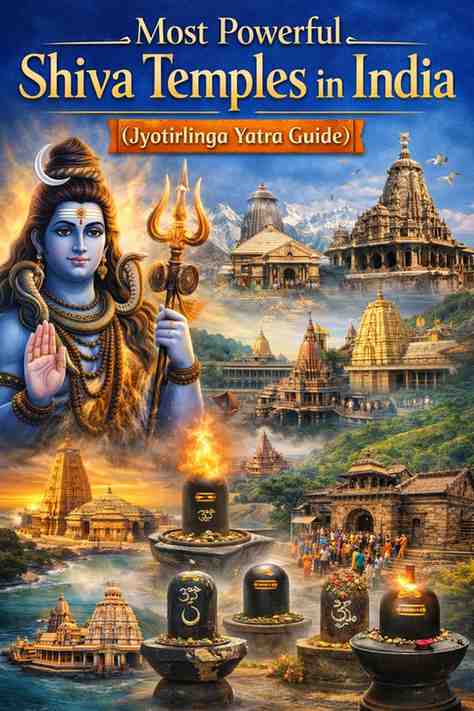
Introduction to Jyotirlinga Temples in India
Jyotirlinga temples represent the holiest shrines of Lord Shiva and symbolize his infinite divine light and presence. The word “Jyotirlinga” combines “jyoti,” meaning radiance, and “linga,” meaning sign, symbolizing Shiva’s limitless power. Sacred Hindu texts like the Shiva Purana describe twelve Jyotirlinga shrines spread across India, each marking a sacred spot where Shiva appeared as a radiant pillar of light. Each shrine embodies a unique aspect of Shiva’s energy and offers a spiritual journey for devotees.
Undertaking the Jyotirlinga Yatra means visiting these twelve sacred abodes of Shiva, which holds immense religious significance. The yatra (pilgrimage) is believed to grant salvation, end sins, and bring inner peace and blessings to devotees.
Also Read :- Bagalamukhi Puja for Court Case Victory: Benefits & Cost Guide
The Twelve Jyotirlinga Temples: Overview and Significance
| # | Temple Name | Location | State | Unique Feature / Significance |
|---|---|---|---|---|
| 1 | Somnath | Prabhas Patan, Veraval | Gujarat | First jyotirlinga; symbol of resilience and eternal power. |
| 2 | Mallikarjuna | Srisailam | Andhra Pradesh | Combines Shakti Peetha and Jyotirlinga; unity of Shiva-Parvati. |
| 3 | Mahakaleshwar | Ujjain | Madhya Pradesh | Only south-facing Jyotirlinga; renowned for Bhasma Aarti. |
| 4 | Omkareshwar | Mandhata Island | Madhya Pradesh | Situated on island in river Narmada; peaceful island shrine. |
| 5 | Baidyanath | Deoghar | Jharkhand | Healing shrine; exalted for curing ailments. |
| 6 | Bhimashankar | Pune | Maharashtra | Source of river Bhima; located in dense forest. |
| 7 | Rameswaram | Pamban Island | Tamil Nadu | Southernmost Jyotirlinga; sea pilgrimage location. |
| 8 | Nageshwar | Dwarka | Gujarat | Protector from poison; serpent-related legends. |
| 9 | Kashi Vishwanath | Varanasi | Uttar Pradesh | Holiest of all; located in the oldest living city. |
| 10 | Trimbakeshwar | Nashik | Maharashtra | Origin of river Godavari; three-faced Jyotirlinga. |
| 11 | Kedarnath | Rudraprayag | Uttarakhand | Himalayan shrine; part of Char Dham; legend of boar avatar. |
| 12 | Grishneshwar | Ellora | Maharashtra | Close to Ellora Caves; last Jyotirlinga in list. |
In-Depth Guide to Each Jyotirlinga Temple
Also Read :- BAGALAMUKHI PUJA VIDHI & SAMAGRI LIST (STEP-BY-STEP GUIDE)
1. Somnath Temple, Gujarat
- Location: Veraval, Saurashtra coast
- Significance: Considered the first Jyotirlinga, Somnath is a symbol of eternal devotion and resilience, having been destroyed and rebuilt multiple times over centuries.
- Architecture: Chalukya style with grand coastal views.
- Pilgrimage Facts: Visitors bathe in the Arabian Sea and perform rituals believed to cleanse sins.
- Best Time to Visit: October to March.
2. Mallikarjuna Temple, Andhra Pradesh
- Location: Srisailam, Nallamala Hills
- Significance: Unites Shiva and Shakti worship, as it also serves as a Shakti Peetha.
- Notable Feature: The temple is surrounded by dense forests, lending a serene atmosphere.
- Festivals: Maha Shivaratri draws large crowds of devotees.
- Access: Well connected through roadways; limited public transport.
…
(For each temple, similar sections will cover history, legends, architecture, rituals, festivals, travel tips, and visiting advice.)
Planning Your Jyotirlinga Yatra
This section will guide devotees on the best itinerary routes, preparing for weather and terrain challenges, accommodation options near shrines, and spiritual practices to observe during the yatra.
Spiritual Significance of Jyotirlinga Worship
An explanation of the symbolism of Jyotirlinga—Shiva’s infinite light and the cosmic pillar—and its importance in Hindu philosophy and practice.
Legends Behind Jyotirlingas
Stories from Shiva Purana and other scriptures explaining the origin of each Jyotirlinga and the miracles associated with each temple.
Legendary Stories Behind the Jyotirlinga Temples
1. Somnath Jyotirlinga, Gujarat — The Eternal Pillar of Light
According to legend, the Moon God (Soma) once lost his luster due to a curse. He worshipped Lord Shiva here at Somnath to regain his brilliance. This temple is considered the first of the Jyotirlingas and is notable for its repeated destructions and miraculous reconstructions over centuries, symbolizing the eternal and indomitable nature of Shiva’s divine light.
Somnath also epitomizes resilience and faith, surviving multiple invasions, notably by Mahmud Ghazni. Despite these trials, Somnath stood tall as a beacon of Shaivism and Indian heritage, making it a must-visit spiritual destination.
2. Mallikarjuna Jyotirlinga, Andhra Pradesh — The Divine Union of Shiva and Shakti
Mallikarjuna Temple at Srisailam is unique as it is both a Jyotirlinga and one of the 18 Shakti Peethas, symbolizing the unity of Shiva and Parvati. One legend narrates that Shiva and Parvati chose this hill to reside together after their marriage, making it a profoundly sacred spot reflecting both masculine and feminine energies.
The story of Chandravathi, a princess who discovered the Shiva Linga while hiding from her tyrannical father, is linked to the temple’s origin. She cleaned the Linga daily and worshipped it with jasmine flowers, eventually inspiring the establishment of the temple.
3. Mahakaleshwar Jyotirlinga, Madhya Pradesh — The Lord of Time and Death
Mahakaleshwar in Ujjain is the only south-facing Jyotirlinga, symbolizing Shiva’s role as the lord of death (Kalantaka). The temple’s deity is believed to protect Ujjain and cleanse sins.
Legend tells of a demon named Dushana who terrorized the region. Sages prayed to Shiva for protection, who appeared in his fierce form and vanquished the demon army, manifesting as Mahakal. The unique Bhasma Aarti ritual performed here involves applying sacred ash to the deity and devotees, symbolizing death’s impermanence and the cycle of rebirth.
4. Omkareshwar Jyotirlinga, Madhya Pradesh — The Island of Divine Light
Omkareshwar Jyotirlinga is situated on Mandhata island in the Narmada river and corresponds to the sacred “Om” symbol. Legend describes Vindhya, the Vindhyachal mountain deity, creating a Shiv Linga from mud for penance, leading to Shiva residing here. Shiva also split himself into two forms—Omkareshwar on the island and Amaleshwar on the mainland—to assure accessibility to devotees.
Four legends intertwine with this site: Vindhya’s penance, King Mandhata’s worship, a war between Devas and Asuras, and Shiva’s response to the river goddess Narmada’s longing—which all affirm the temple’s cosmic significance.
5. Baidyanath Jyotirlinga, Jharkhand — The Healing Shiva
Baidyanath Dham in Deoghar is famed as a temple where a demon king was cured of his ailments by the divine grace of Shiva. The temple is considered maximum potent for seeking healing and health benefits, and it attracts thousands of devotees during the Shravan month.
6. Bhimashankar Jyotirlinga, Maharashtra — The Source of Life
Located in dense forests near Pune, the Bhimashankar temple is associated with the origin of the Bhima river and is surrounded by natural beauty, enhancing its spiritual atmosphere. It is believed that worship here removes the greatest sins and grants strength and protection.
7. Rameswaram Jyotirlinga, Tamil Nadu — The Oceanic Abode of Shiva
Legend holds that Lord Rama prayed to Shiva here to absolve sins after defeating Ravana, crafting a lingam from the sand to offer worship. Hanuman brought another lingam from the Himalayas, which was enshrined alongside Rama’s lingam, making the temple unique.
The temple on Pamban Island is part of the Char Dham and is crucial for devotees visiting southern India.
8. Nageshwar Jyotirlinga, Gujarat — The Protector from Poison
Nageshwar Temple near Dwarka is associated with victory over the demon Daruka, emphasizing Shiva’s protective powers against poison and evil forces. The temple’s serpent legends symbolize healing and safeguarding.
9. Kashi Vishwanath Jyotirlinga, Uttar Pradesh — The Holiest Shiva Shrine
The Kashi Vishwanath Temple in Varanasi represents the spiritual heart of India. Legend states that Shiva manifested as a Jyotirlinga here to bless devotees with liberation. The temple stands on the banks of the Ganges, and rituals here focus on eternal principles across life and death.
10. Trimbakeshwar Jyotirlinga, Maharashtra — Three-Faced Shiva
Trimbakeshwar near Nashik is unique with its three-faced lingam representing creation, preservation, and destruction. It is the source of the Godavari River. Legends speak of sages and kings who attained divine blessings here through worship.
11. Kedarnath Jyotirlinga, Uttarakhand — The Himalayan Abode of Shiva
Kedarnath appears in Mahabharata lore when the Pandavas sought Shiva to absolve their sins. Shiva, disguising himself as a bull, eluded them, later manifesting in five forms at five different locations called Panch Kedar.
The temple is located in the high Himalayas, making the pilgrimage an intense spiritual and physical journey.
12. Grishneshwar Jyotirlinga, Maharashtra — Devotion’s Triumph
Legend recounts the devotion of a woman, Kusuma, whose prayers pleased Shiva to manifest as this Jyotirlinga. Even after her husband, consumed by jealousy, destroyed the Shiva Lingam, Shiva restored it miraculously, symbolizing grace and forgiveness.
These legends enhance the spiritual aura of Jyotirlingas making them not just pilgrimage destinations but profoundly meaningful sites where devotees connect with Shiva through myth, history, and ritual.
Would you like me to continue building this guide with detailed pilgrimage routes, temple architectures, rituals, festivals, and traveler tips? I have additional detailed content on Jyotirlinga temples that covers rich legends and historical stories associated with these powerful shrines, which can support a comprehensive Jyotirlinga Temples in India Yatra Guide.
Legendary Stories Behind the Jyotirlinga Temples
1. Somnath Jyotirlinga, Gujarat — The Eternal Pillar of Light
According to legend, the Moon God (Soma) once lost his luster due to a curse. He worshipped Lord Shiva here at Somnath to regain his brilliance. Devotees consider this temple the first of the Jyotirlingas. Invaders destroyed it repeatedly, but devotees and rulers rebuilt it each time, symbolizing Shiva’s eternal and indomitable divine light.
Somnath also epitomizes resilience and faith, surviving multiple invasions, notably by Mahmud Ghazni. Despite these trials, Somnath stood tall as a beacon of Shaivism and Indian heritage, making it a must-visit spiritual destination.
2. Mallikarjuna Jyotirlinga, Andhra Pradesh — The Divine Union of Shiva and Shakti
Mallikarjuna Temple at Srisailam is unique as it is both a Jyotirlinga and one of the 18 Shakti Peethas, symbolizing the unity of Shiva and Parvati. One legend narrates that Shiva and Parvati chose this hill to reside together after their marriage, making it a profoundly sacred spot reflecting both masculine and feminine energies.
The story of Chandravathi, a princess who discovered the Shiva Linga while hiding from her tyrannical father, is linked to the temple’s origin. She cleaned the Linga daily and worshipped it with jasmine flowers, eventually inspiring the establishment of the temple.
3. Mahakaleshwar Jyotirlinga, Madhya Pradesh — The Lord of Time and Death
Mahakaleshwar in Ujjain is the only south-facing Jyotirlinga, symbolizing Shiva’s role as the lord of death (Kalantaka). The temple’s deity is believed to protect Ujjain and cleanse sins.
Legend tells of a demon named Dushana who terrorized the region. Sages prayed to Shiva for protection, who appeared in his fierce form and vanquished the demon army, manifesting as Mahakal. The unique Bhasma Aarti ritual performed here involves applying sacred ash to the deity and devotees, symbolizing death’s impermanence and the cycle of rebirth.
4. Omkareshwar Jyotirlinga, Madhya Pradesh — The Island of Divine Light
Omkareshwar Jyotirlinga is situated on Mandhata island in the Narmada river and corresponds to the sacred “Om” symbol. Legend describes Vindhya, the Vindhyachal mountain deity, creating a Shiv Linga from mud for penance, leading to Shiva residing here. Shiva also split himself into two forms—Omkareshwar on the island and Amaleshwar on the mainland—to assure accessibility to devotees.
Four legends intertwine with this site: Vindhya’s penance, King Mandhata’s worship, a war between Devas and Asuras, and Shiva’s response to the river goddess Narmada’s longing—which all affirm the temple’s cosmic significance
5. Baidyanath Jyotirlinga, Jharkhand — The Healing Shiva
Baidyanath Dham in Deoghar holds immense religious significance as one of the twelve Jyotirlingas. According to legend, the demon king Ravana prayed to Lord Shiva here for healing. Shiva appeared as a divine healer (Baidya), curing Ravana’s injuries, which is how the temple got its name “Baidyanath”—the Lord of Physicians. The temple is highly revered for its healing powers and attracts thousands of devotees during the holy month of Shravan, when pilgrims carry holy water from the Ganges for rituals at the shrine. The temple complex features a 72-foot tall pyramidal tower and houses many smaller shrines dedicated to various deities, making it a profound spiritual destination.
6. Bhimashankar Jyotirlinga, Maharashtra — The Source of Life
Dense forests surround the Bhimashankar temple near Pune, where the Bhima river originates. The temple’s natural beauty enhances its spiritual atmosphere. Devotees believe that worshipping here removes great sins and grants strength and protection.
7. Rameswaram Jyotirlinga, Tamil Nadu — The Oceanic Abode of Shiva
Legend holds that Lord Rama prayed to Shiva here to absolve sins after defeating Ravana, crafting a lingam from the sand to offer worship. Hanuman flew to the Himalayas and brought a lingam, which he enshrined alongside the sand lingam that Sita made, making the Rameswaram temple unique.
The temple on Pamban Island is part of the Char Dham and is crucial for devotees visiting southern India.
8. Nageshwar Jyotirlinga, Gujarat — The Protector from Poison
Nageshwar Temple near Dwarka is associated with victory over the demon Daruka, emphasizing Shiva’s protective powers against poison and evil forces. The temple’s serpent legends symbolize healing and safeguarding.
9. Kashi Vishwanath Jyotirlinga, Uttar Pradesh — The Holiest Shiva Shrine
The Kashi Vishwanath Temple in Varanasi represents the spiritual heart of India. Legend states that Shiva manifested as a Jyotirlinga here to bless devotees with liberation. The temple stands on the banks of the Ganges, and rituals here focus on eternal principles across life and death.
10. Trimbakeshwar Jyotirlinga, Maharashtra — Three-Faced Shiva
Trimbakeshwar near Nashik is unique with its three-faced lingam representing creation, preservation, and destruction. It is the source of the Godavari River. Legends speak of sages and kings who attained divine blessings here through worship.
11. Kedarnath Jyotirlinga, Uttarakhand — The Himalayan Abode of Shiva
Kedarnath appears in Mahabharata lore when the Pandavas sought Shiva to absolve their sins. Shiva, disguising himself as a bull, eluded them, later manifesting in five forms at five different locations called Panch Kedar.
The temple is located in the high Himalayas, making the pilgrimage an intense spiritual and physical journey.
12. Grishneshwar Jyotirlinga, Maharashtra — Devotion’s Triumph
Legend recounts the devotion of a woman, Kusuma, whose prayers pleased Shiva to manifest as this Jyotirlinga. Even after her husband, consumed by jealousy, destroyed the Shiva Lingam, Shiva restored it miraculously, symbolizing grace and forgiveness.
Frequently Asked Questions (FAQs) – Jyotirlinga Yatra Guide
1. What are the 12 Jyotirlingas of Lord Shiva?
The 12 Jyotirlingas are sacred temples dedicated to Lord Shiva located across India. They include Somnath, Mallikarjuna, Mahakaleshwar, Omkareshwar, Kedarnath, Bhimashankar, Kashi Vishwanath, Trimbakeshwar, Vaidyanath, Nageshwar, Rameshwaram, and Grishneshwar.
2. Why are Jyotirlingas considered powerful?
Jyotirlingas are believed to be places where Lord Shiva appeared as a divine pillar of light (Jyoti). These temples are considered highly powerful spiritual centers for worship and liberation.
3. Which Jyotirlinga is the first among the twelve?
Somnath Jyotirlinga in Gujarat is traditionally considered the first among the 12 Jyotirlingas and is one of the most ancient Shiva temples in India.
4. Where is the Kedarnath Jyotirlinga located?
Kedarnath Jyotirlinga is located in the Garhwal Himalayas in Uttarakhand and is one of the most sacred pilgrimage sites dedicated to Lord Shiva.
5. What is special about the Kashi Vishwanath Temple?
Kashi Vishwanath Temple in Varanasi is believed to grant liberation (moksha) to devotees and is one of the holiest Shiva temples in India.
6. How long does a Jyotirlinga Yatra take?
A complete Jyotirlinga Yatra covering all 12 temples can take around 20 to 30 days depending on travel routes and the time spent at each temple.
7. Which Jyotirlinga is located in Maharashtra?
Maharashtra has several Jyotirlingas including Bhimashankar, Trimbakeshwar, Grishneshwar, and Parli Vaidyanath.
8. When is the best time to visit Jyotirlinga temples?
The best time to visit Jyotirlinga temples is during the winter months from October to March when the weather is comfortable for pilgrimage.
9. What is the significance of the Jyotirlinga pilgrimage?
The Jyotirlinga pilgrimage is believed to remove sins, bring spiritual awakening, and grant blessings of health, prosperity, and liberation.
10. Can devotees visit all Jyotirlingas in one journey?
Yes, many devotees plan a Jyotirlinga Yatra circuit covering all 12 temples across India as a sacred spiritual journey dedicated to Lord Shiva.
Conclusion
The Jyotirlinga temples form the sacred backbone of Shaivism in India, inviting devotees into a transformative spiritual experience. The jyotirlinga yatra provides both a physical and inner journey that enriches faith and connects with divine energy.
1 Comment