
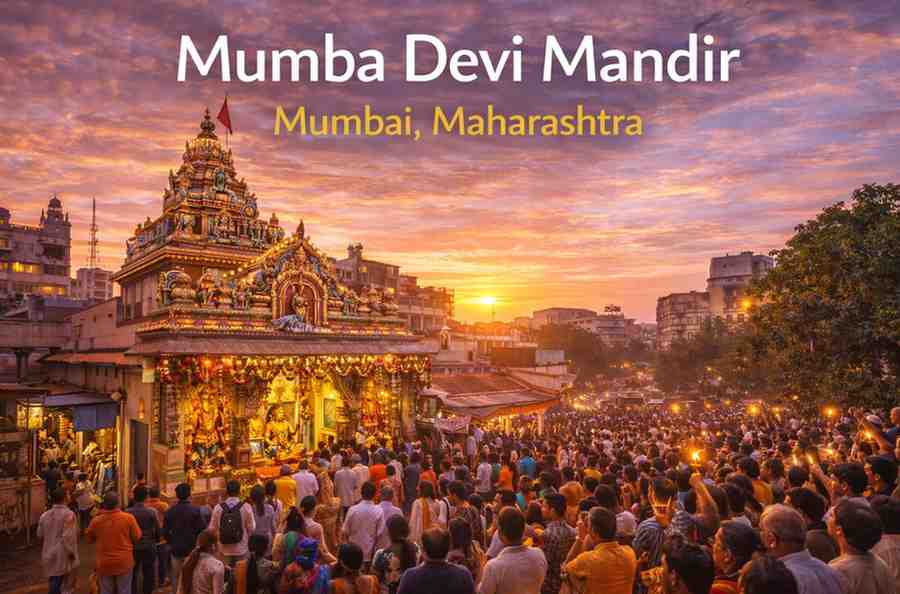
In the heart of South Mumbai stands the Mumba Devi Mandir, one of the city’s oldest and most revered temples. Devotees regard Goddess Mumba Devi as the patron deity of Mumbai, and the city’s identity deeply intertwines with this temple. In fact, the goddess’s name—’Mumba’ combined with ‘Aai’ (meaning mother in Marathi)—gave the city its very name, Mumbai. Located in Bhuleshwar, one of the busiest and most traditional neighborhoods of Mumbai, the temple attracts thousands of devotees daily and remains a living symbol of the city’s spiritual and cultural roots.
Also Read :- Krishna Temples in India (Dwarka, Udupi, Vrindavan)
Temple Overview
The sanctum houses a black stone idol of Goddess Mumba Devi, notably depicted without a mouth. This unique feature symbolizes her immense power and conveys the belief that divine strength lies in action and protection rather than in words. Devotees offer flowers, coconuts, sweets, and silver ornaments, seeking blessings for prosperity, health, and peace. Despite its modest size, the temple radiates a powerful sense of devotion and is a sacred space for people from all walks of life.
Why the Temple is Famous
For locals, visiting the shrine is akin to paying respect to the mother of their city. During festivals, especially Navratri, the temple transforms into a vibrant center of devotion, with chants, rituals, and colorful decorations attracting huge crowds. Its importance lies as much in its spiritual role as in its historical and cultural connection with the identity of Mumbai.
Also Read :- Top Vishnu Temples in South India: Divine Abodes of Lord Narayana
Historical & Cultural Background
The history of the temple dates back to the 14th century.Local people and sages invoked Goddess Mumba Devi to defeat the demon Mumbarka, who terrorized the region. The goddess destroyed him, and people have revered her as the land’s protector ever since. Originally, they built the temple in the Bori Bunder area (where Chhatrapati Shivaji Maharaj Terminus now stands), but authorities relocated it to Bhuleshwar in the 18th century.
Culturally, the temple represents the enduring faith of Mumbai’s people. Surrounded by Bhuleshwar’s traditional markets, jewelry shops, and bustling lanes, a visit to the temple often extends into experiencing the vibrant lifestyle of old Mumbai. It is this seamless blending of faith and daily life that makes the temple so special.
Short Note on the Deity
Goddess Mumba Devi is considered a manifestation of Goddess Shakti, the divine feminine power. She is worshipped as the embodiment of strength, protection, and motherhood. Her depiction without a mouth is highly symbolic, emphasizing the belief that divine power operates silently but effectively, safeguarding the city and its people.
Also Read :- Meenakshi Temple Madurai 2026: Architecture & Festivals
What makes temple unique
What makes the Mumba Devi Mandir truly unique is its deep association with the identity of Mumbai itself. Unlike many temples renowned for their grand architecture, this shrine stands out for its historical simplicity and cultural significance. Very few cities in the world can trace their name and spiritual roots directly to a deity, and Mumbai is one of them. This connection makes the temple not just a religious landmark but also a cornerstone of the city’s heritage.
Temple History of Mumba Devi Mandi
The Mumba Devi Mandir is not just a place of worship; it is a living testimony to Mumbai’s origins, mythological traditions, and historical evolution. For centuries, the temple has been central to the spiritual life of the region, inspiring faith, protecting its people, and shaping the identity of the city that eventually became one of India’s most important metropolises. Its history is a blend of myth, folklore, written records, and cultural memories.
Mythological Origin Stories
According to local legends, a powerful demon named Mumbarka plagued the western coast of India, terrorizing sages, farmers, and traders. Unable to endure his tyranny, the people prayed to the divine mother for protection. The combined energies of Lord Brahma, Lord Vishnu, and Lord Shiva created a powerful goddess—Mumba Devi, a manifestation of Shakti. Armed with divine weapons and unstoppable strength, she fought and slew Mumbarka, liberating the region from his oppression.The people then associated the land with Mumba Aai (Mother Mumba), which over time evolved into “Mumbai.
It is believed that the combined energies of Lord Brahma, Lord Vishnu, and Lord Shiva gave rise to a powerful goddess—Mumba Devi, a manifestation of Shakti. Armed with divine weapons and unstoppable strength, she fought and eventually slew Mumbarka, liberating the region from his oppression. Before his death, the demon is said to have repented and requested that the land be named after the goddess who defeated him. Thus, the land came to be associated with Mumba Aai (Mother Mumba), and over time, this evolved into “Mumbai.”
This mythological tale not only highlights the goddess’s role as protector but also reflects the age-old Hindu belief in Shakti as the force that restores cosmic balance by defeating evil.
Historical Records and Renovations
The origins of the Mumba Devi Mandir as a physical structure are traced to the 14th century, during the reign of Hindu rulers in the region. Initially, the temple is said to have stood in Bori Bunder, the area that is now home to the Chhatrapati Shivaji Maharaj Terminus (CSMT). The original shrine was reportedly destroyed or significantly damaged over the centuries, possibly during the Portuguese occupation of parts of coastal Maharashtra.
By the 18th century, the temple had been rebuilt and relocated to Bhuleshwar, where it stands today. Historical records indicate that local merchants and wealthy communities played a significant role in its reconstruction, reflecting the close relationship between trade guilds and places of worship in pre-colonial India.
During the colonial era, the temple continued to be maintained by merchant communities, especially the Pathare Prabhu and other native groups, who considered Mumba Devi as their patron goddess. Though the British administration was not directly involved in its upkeep, they recognized the temple’s importance in preserving local faith and culture.
Also Read :- Bhimashankar Jyotirlinga: History, Significance & Travel Tips
Temple’s Role in Shaping City Identity
The Mumba Devi Mandir occupies a unique place in the history of Mumbai. Unlike other cities where temples stand as landmarks of faith, this shrine directly shaped the identity of the metropolis.
In cultural terms, the temple has been a site where diverse communities converge. From fishermen and traders to modern professionals, people across backgrounds continue to visit the shrine, reflecting Mumbai’s ethos of inclusivity and resilience. The temple is also a reminder of the city’s indigenous roots, even as it evolved into a global financial hub.
Navratri celebrations at the temple further highlight its cultural significance. During this festival, the temple becomes a center of devotion, with thousands of devotees visiting daily, reinforcing the idea of Mumbai as a city that thrives on both tradition and modernity.
The temple has also played a role in preserving Marathi and Koli cultural traditions. By serving as a focal point of worship, it has ensured that local customs, rituals, and folk practices tied to the goddess continue to survive in the rapidly modernizing city.
Architecture & Idol Description of Mumba Devi Mandir
The Mumba Devi Mandir in Bhuleshwar, Mumbai, is one of the oldest shrines of the city. Unlike many grand temples of India that display elaborate Nagara or Dravidian architectural features, this temple is characterized by its regional simplicity, reflecting the local traditions of western India. Its architecture is modest yet spiritually profound, emphasizing devotion over ornamentation.
Style of the Temple
The temple follows a regional vernacular style of construction rather than the classic Nagara (North Indian) or Dravidian (South Indian) models. Built from stone and brick, the structure is compact and functional, designed to suit the crowded urban environment in which it exists. The shikhara (tower) is relatively small and unembellished compared to larger temples, reflecting the understated aesthetics of local temple architecture in Maharashtra.
The overall style aligns with what scholars often describe as Maharashtrian regional temple architecture, where emphasis is placed on the sanctum (garbhagriha) and inner spiritual experience rather than monumental external display.
Idol of Goddess Mumba Devi
At the heart of the temple lies the most striking feature — the idol of Goddess Mumba Devi. The image is carved from black stone, a material traditionally associated with strength and permanence in Hindu iconography.
The idol is unique in several respects:
Associated deities: Inside the sanctum, images of other deities like Lord Hanuman and Lord Ganesha are also present, emphasizing the interconnectedness of divine forces.
Mouthless depiction: The goddess is portrayed without a mouth, symbolizing the belief that the divine mother does not need words to protect and guide her devotees. Her silence signifies immense spiritual strength and selfless guardianship.
Seated posture: She is often described as being in a calm seated pose, radiating serenity and power.
Adornments: The idol is decorated with silver ornaments, garlands of fresh flowers, and sometimes silk fabrics offered by devotees. During festivals like Navratri, the idol is richly adorned with special jewelry and attire, enhancing her divine presence.
This combination of simplicity in form with profound symbolism makes the idol of Mumba Devi one of the most spiritually powerful images in the region.
Temple layout
The temple follows a traditional Hindu layout, though on a smaller scale compared to larger shrines.
- Garbhagriha (Sanctum): The innermost chamber houses the idol of Mumba Devi. This space is dimly lit, creating an atmosphere of reverence and concentration. Devotees approach the sanctum to offer flowers, coconuts, and prayers.
- Mandap (Assembly Hall): In front of the sanctum lies the mandap, a pillared hall where devotees gather. It is simple in design, accommodating the daily flow of worshippers.
- Shikhara (Superstructure): The tower above the sanctum is modest in height and design, distinguishing it from the tall spires of Nagara temples. Its plain exterior is typical of regional temples in urban settings, where functionality outweighs grandeur.
- Surroundings: The temple is situated amidst the bustling Bhuleshwar market, with shops and narrow lanes enveloping it. This urban setting makes the temple’s spiritual calm stand in stark contrast to the noise outside.
Special Sculptures, Carvings, and Murals
While the temple does not boast of monumental sculptures or murals like those in larger complexes, it features traditional carvings on its walls and pillars. These include floral motifs, geometric patterns, and small symbolic figures that highlight the temple’s cultural antiquity. The idol itself, with its stark black stone presence, serves as the most powerful artistic element of the shrine.
Comparison with Other Temples in the Region
When compared to other temples in Maharashtra, the Mumba Devi Mandir stands out for its intimate scale and urban integration. For instance:
- Temples like the Mahalakshmi Mandir in Mumbai or the Bhimashankar Jyotirlinga in Pune district exhibit larger, more elaborate Nagara-style features with prominent shikharas. In contrast, Mumba Devi Mandir remains small and modest.
- Unlike the Shirdi Sai Baba Temple or the Siddhivinayak Temple, which attract massive crowds and feature more modern architectural expansions, Mumba Devi Mandir has preserved its old-world charm and simplicity.
- Its uniqueness lies not in external grandeur but in its historical and cultural identity — being the shrine of the goddess after whom Mumbai is named.
This comparison highlights how the temple represents the soul of old Mumbai, standing as a humble yet deeply significant spiritual site amidst the city’s modern skyline.
Religious Importance & Beliefs of Mumba Devi Mandir
The Mumba Devi Mandir in Bhuleshwar is not just a temple — it is the spiritual anchor of Mumbai. Generations of devotees, from fishermen and traders to modern professionals, have turned to her for blessings of prosperity, safety, and strength. The temple’s religious importance lies in the deep connection between the goddess and the identity of Mumbai itself.
Spiritual Significance
Mumba Devi reflects these qualities by being both a nurturing guardian and a fierce protector.
Her mouthless idol, carved from black stone, carries profound symbolism. Devotees believe that the absence of a mouth signifies her silent strength — she does not need words to safeguard her children. This form teaches the value of actions over speech, devotion over display, and inner strength over external expression. For many, she represents the silent yet powerful spirit of Mumbai itself: resilient, tireless, and protective.
Miracles and Famous Stories
Over centuries, several stories and local legends have highlighted the miraculous powers of Mumba Devi. Fishermen, particularly from the Koli community, narrate tales of how prayers to the goddess ensured safe returns from the sea. Many believe that storms would calm or fishing expeditions would succeed when undertaken with her blessings.
Another popular belief is that the goddess continues to protect Mumbai from calamities. Locals often attribute the city’s resilience in the face of floods, fires, or other disasters to the divine grace of Mumba Devi. Even in modern times, many devotees claim to have experienced personal miracles after praying at the temple — from recovery from illnesses to success in business and resolution of family problems.
Though such stories vary, they all share a common theme: the goddess as an ever-watchful mother, silently guiding and protecting her children.
Rituals and Pooja beliefs
Daily rituals at the Mumba Devi Mandir follow traditional Hindu customs, focusing on simplicity and devotion.
- Morning and evening aarti: The day begins and ends with aarti (ritual of light), accompanied by bells, chants, and offerings of flowers and coconuts.
- Offerings: Devotees bring garlands, red cloth, silver ornaments, and sweets like pedhas or modaks as tokens of respect. Coconuts are especially significant, symbolizing purity and the removal of ego.
- Navratri celebrations: The temple becomes a hub of devotion during Navratri. Bhajans (devotional songs), kirtans, and cultural performances add to the festive spirit.
- Special pujas: Some devotees sponsor rituals like Satyanarayan puja or havans (fire offerings) for prosperity, health, or fulfillment of wishes.
The belief is that offering prayers with true faith at Mumba Devi Mandir brings divine blessings for wealth, health, and protection from misfortune.
Role for Devotees
For the people of Mumbai, the goddess is more than a deity; she is a guardian mother figure. Devotees approach her with a variety of hopes and needs:
- Prosperity: Businessmen and traders often begin new ventures after seeking her blessings, believing that she ensures success and growth.
- Health and protection: Families pray for good health and safety from accidents or natural disasters.
- Fulfillment of wishes: Many visit the temple with personal desires — be it marriage, children, or career success — and return to offer thanks once their prayers are answered.
- Spiritual solace: Amidst the chaos of the city, devotees find peace and grounding in the temple’s serene environment.
The temple’s religious role thus extends far beyond ritual — it offers psychological and emotional strength to millions of Mumbaikars.
Connection with Local Communities
The Koli community, Mumbai’s original inhabitants and traditional fishing folk, have a particularly strong bond with Mumba Devi. For centuries, the Kolis have worshipped her as their gram devi (village goddess). Before setting out to sea, fishermen would pray at the temple for safe journeys and abundant catches. Even today, many continue this practice, reinforcing the goddess’s role as protector of livelihoods.
Beyond the Kolis, other local communities — traders, artisans, and families settled in Bhuleshwar — also consider the goddess their patron deity. Festivals at the temple often bring together diverse groups, symbolizing Mumbai’s inclusive spirit.
This connection highlights how the temple has functioned not just as a religious site but as a cultural meeting point where faith unites different sections of society.
Celebrations
Festivals & Celebrations at Mumba Devi Mandir
These festivals are not merely religious events; they are a reflection of the city’s cultural unity, resilience, and unwavering faith in its guardian goddess.
Major Annual Festivals
Navratri
The most significant festival celebrated at Mumba Devi Mandir is Navratri, the nine-night festival dedicated to Goddess Durga and her various forms.
Devotees observe fasting, participate in bhajans (devotional songs), and offer special pujas. The atmosphere becomes electric with devotion, as thousands line up daily to seek blessings.
Diwali
During Diwali, the festival of lights, the temple glows with rows of oil lamps and vibrant rangolis at its entrance. Families visit the shrine to offer prayers for prosperity, success, and happiness in the coming year. Traders and business communities especially flock to the temple on Lakshmi Puja day, believing that worshipping Mumba Devi along with Goddess Lakshmi enhances financial blessings.
Gudi Padwa
As the Marathi New Year, Gudi Padwa is another important festival at the temple. Devotees seek blessings for prosperity and good fortune in the year ahead.
Daily Aarti Rituals
Apart from annual festivals, the daily rituals at Mumba Devi Mandir hold immense significance.
- Morning Aarti begins with the ringing of bells and chanting of hymns, welcoming the day with divine blessings.
- Evening Aarti is performed with lamps, incense, and devotional songs, creating a serene atmosphere amidst the bustle of the city outside.
These daily aartis, though simple, are powerful in drawing devotees closer to the goddess. Many locals make it a routine to stop by the temple on their way to work, believing that beginning or ending the day with her blessings ensures peace and success.
Special Annual Mela / Jatra
The temple also hosts a special fair (jatra) during Navratri. The fair not only adds vibrancy to the celebrations but also connects local artisans, traders, and devotees in a cultural exchange. This mela reflects how spirituality and community life go hand in hand in Mumbai’s traditions.
Unique Temple-Specific Celebrations
What makes Mumba Devi Mandir’s festivals distinct is their connection with the city’s identity. Since the goddess guards Mumbai, the entire city receives her blessings during her celebrations, which extend beyond just religious rituals.
- Special adornments: During major festivals, the idol is dressed in elaborate jewelry and rich attire, offerings made by devotees in gratitude for answered prayers.
- Koli community rituals: The fishing community often offers the first catch of the season to Mumba Devi, thanking her for safeguarding their livelihoods. This practice ties the temple’s celebrations to Mumbai’s cultural roots.
- Community participation: Regardless of caste, class, or background, devotees from across Mumbai come together during festivals, symbolizing the inclusive spirit of the goddess.
Temple Timings & Aarti Schedule
Below is a detailed schedule of temple timings and special aartis:
| Day | Morning Timings | Evening Timings | Special Aarti / Ritual |
| Monday | 6:00 AM – 12:00 PM | 4:00 PM – 9:00 PM | Shiv Aarti |
| Tuesday | 6:00 AM – 12:00 PM | 4:00 PM – 9:00 PM | Devi Aarti (Dedicated to Goddess Mumba) |
| Saturday | 6:00 AM – 12:00 PM | 4:00 PM – 9:00 PM | Navgraha Pooja |
| Other Days | 6:00 AM – 12:00 PM | 4:00 PM – 9:00 PM | Regular Aarti & Pooja |
Additional Notes
- Morning aarti generally begins around 7:00 AM, marking the start of the day with chants and bell sounds.
How to Reach Mumba Devi Mandir
The Mumba Devi Mandir, located in the bustling Zaveri Bazaar area of South Mumbai, is easily accessible by various modes of transport.
By Train
Mumbai’s suburban railway system is the most popular way to reach the temple. The nearest railway station is Charni Road (Western Line), which is approximately 1.5 km from the temple. From the station, visitors can either take a short taxi/auto ride or walk through the busy lanes.
Other nearby stations include:
- Marine Lines (Western Line) – about 2 km away.
- Chhatrapati Shivaji Maharaj Terminus (CSMT – Central Line) – around 3 km from the temple.
For those arriving by long-distance trains, both Mumbai Central and CSMT are convenient points, as local transport options are easily available from there.
By Air
The nearest airport is Chhatrapati Shivaji Maharaj International Airport, located about 20–22 km from the temple. From the airport, visitors can hire a prepaid taxi, book app-based cabs like Ola or Uber, or use local BEST buses to reach South Mumbai. Depending on traffic, the journey usually takes around 45 minutes to 1.5 hours.
By Road
Mumbai’s extensive road network makes road travel another comfortable option.
- BEST buses connect most parts of Mumbai with stops near Zaveri Bazaar, Kalbadevi, and Crawford Market – all within walking distance of the temple.
- Taxis and auto-rickshaws are easily available across the city and can drop visitors right at the temple’s entrance lane.
- For those driving, parking can be challenging due to the narrow lanes of Zaveri Bazaar. It is advisable to park at nearby areas such as Crawford Market or Metro Cinema and walk to the temple.
Google Maps Assistance
For first-time visitors, the easiest way to navigate is by using Google Maps. By typing “Mumba Devi Mandir” in the search bar, devotees can get real-time directions based on their current location. Walking routes from nearby stations and traffic updates for road travelers make the journey smoother.
Local Guidance for First-Time Visitors
- The temple stays open daily from 6:00 AM to 9:45 PM, except on Mondays when it closes.
- Wear modest and clean traditional clothes to respect the temple’s sacred environment.
- Remove footwear before entering; use the designated shoe storage areas outside the temple.
- Follow local customs, maintain silence inside the temple, and respect other devotees.
- Carry offerings such as flowers, coconuts, and incense sticks to present during puja.
- Expect narrow lanes and heavy crowding around Zaveri Bazaar; walking is usually the fastest way to reach the temple.
- The best visiting months are October to March for pleasant weather and during Navratri for special celebrations.
- The temple does not charge any entry fee; voluntary donations and offerings are welcome.
- These guidelines ensure a smooth, respectful, and spiritually enriching visit to Mumba Devi Mandir.
Nearby Attractions
Visiting Mumba Devi Mandir provides an excellent opportunity to explore South Mumbai’s rich cultural and historical landscape. The temple is located in Bhuleshwar, surrounded by bustling markets, historic monuments, and iconic temples.
Other Temples
- Siddhivinayak Temple (Prabhadevi) – Famous for Lord Ganesha, about 7 km away.
- Mahalakshmi Temple – Dedicated to Goddess Mahalakshmi, around 6 km from Bhuleshwar.
- Babulnath Temple – An ancient Shiva shrine located 4 km away, offering panoramic views of the city.
Historical Monuments
- Chhatrapati Shivaji Maharaj Terminus (CST) – UNESCO World Heritage Site, 2–3 km away.
- Gateway of India – Iconic waterfront monument, around 5 km from the temple.
- Rajabai Clock Tower & University of Mumbai – A colonial-era landmark 3 km away.
Cultural Hotspots
- Zaveri Bazaar – Famous for jewelry shops, located adjacent to the temple.
- Crawford Market – Traditional market offering fresh produce, spices, and household items.
- Marine Drive & Girgaum Chowpatty – Ideal for evening strolls, about 6–7 km away.
Suggested 1-Day Itinerary
- Morning darshan at Mumba Devi Mandir (6–9 AM)
- Walk through Zaveri Bazaar for local shopping
- Visit Crawford Market and enjoy traditional snacks
- Afternoon sightseeing at Gateway of India and Marine Drive
- Evening visit to Babulnath Temple or Mahalakshmi Temple for sunset darshan
This combination of spiritual, cultural, and historic sites makes a single-day trip in South Mumbai memorable for both devotees and tourists.
Dress code
- Wear modest clothing; traditional attire is preferred but not mandatory.
- Avoid sleeveless tops, shorts, or revealing clothing.
Visitor Guidelines
- Photography is strictly prohibited.
- Visitors can take pictures in the outer courtyard and surrounding areas if permitted.
Temple Facilities
- Prasad: Available daily after darshan.
- Restrooms and water: Basic facilities available near the temple.
- Parking: Limited street parking; nearby lots at Crawford Market or Kalbadevi recommended.
Dos and Don’ts
Dos:
- Maintain silence inside the temple.
- Offer flowers or coconuts as a sign of devotion.
- Follow the queue and respect timings.
Don’ts:
- Do not touch the idol.
- Avoid littering; use designated bins.
- Refrain from eating or smoking within temple premises.
Best Time to Visit
- October–March: Pleasant weather and festive season.
- Navratri (September–October): For special celebrations and darshan.
By following these guidelines, visitors ensure a safe, respectful, and spiritually fulfilling experience.
FAQ Section
Q1: Where is Mumba Devi Mandir located?
A: The temple is located in Bhuleshwar, South Mumbai, near Zaveri Bazaar and Kalbadevi.
Q2: What is the history of Mumba Devi Mandir?
A: Dating back to the 14th century, the temple honors Goddess Mumba, the city’s patron deity. It was originally in Bori Bunder and later relocated to Bhuleshwar in the 18th century.
Q3: What are the darshan timings?
A: Morning: 6:00 AM – 12:00 PM, Evening: 4:00 PM – 9:00 PM.
Q4: Which festivals are celebrated here?
A: Major festivals include Navratri, Diwali, Gudi Padwa, and other local celebrations with special aartis and rituals.
Q5: How to reach from the nearest railway station?
A: The closest station is Charni Road (Western Line), about 1.5 km away. Visitors can walk or take an auto/taxi.
Q6: Is photography allowed?
A: Photography is prohibited inside the sanctum.
Q7: What is the best time to visit?
A: October to March, during pleasant weather and festival season, is ideal for darshan and sightseeing.
Q8: What facilities are available for devotees?
A: The temple provides Prasad, restrooms, and nearby parking.
Conclusion
The Mumba Devi Mandir is far more than a temple; it is a living testament to Mumbai’s spiritual roots, cultural heritage, and communal identity. Dedicated to Goddess Mumba, the city’s guardian, it embodies the protective, nurturing, and resilient spirit of the metropolis. Visiting the temple allows devotees and tourists alike to connect with the city’s ancient traditions while experiencing its vibrant present.
The temple’s significance extends beyond religious practice. From the quiet devotion of morning darshan to the grandeur of Navratri celebrations, every aspect of Mumba Devi Mandir reinforces the values of faith, resilience, and inclusivity. For the Koli community, the original inhabitants of Mumbai, the goddess remains an eternal guardian, preserving their cultural legacy.
For devotees, visiting Mumba Devi Mandir is a source of spiritual solace, prosperity, and hope. The temple offers a space to reflect, pray, and seek blessings for health, wealth, and protection.
Whether you are a first-time visitor, a lifelong devotee, or a traveler exploring Mumbai’s cultural heartbeat, the temple provides a transformative experience.
In conclusion, Mumba Devi Mandir is a must-visit for anyone seeking a connection with Mumbai’s heritage and spirituality. It is a place where history, faith, and culture converge, offering blessings that extend from the goddess to the city she protects. Visiting the temple is not just a religious ritual; it is an invitation to be part of Mumbai’s living legacy, and to carry forward the blessings of Mother Mumba in one’s own life.
2 Comments