
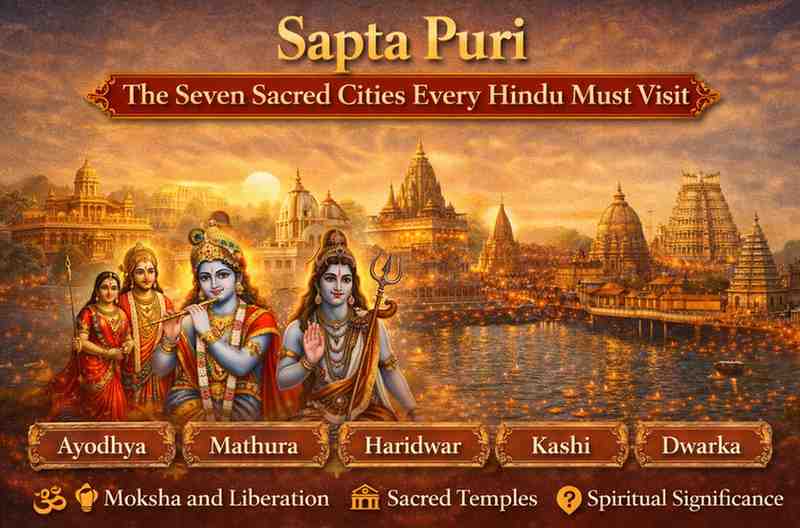
Sapta Puri, known as the Seven Sacred Cities, are the holiest pilgrimage sites in Hinduism, each with profound spiritual and historical significance. These cities—Ayodhya, Mathura, Haridwar, Varanasi, Kanchipuram, Ujjain, and Dwarka—have been revered for centuries as places that grant moksha (liberation) to devotees. Below is a detailed and comprehensive blog tailored for SEO with the focus keyword “Sapta Puri temples in India,” exploring each city’s unique history, spiritual legends, top temples, and pilgrimage experience.
Introduction: The Spiritual Significance of Sapta Puri
The Sapta Puri, Sanskrit for “Seven Cities,” are considered the most sacred of all Hindu pilgrimage destinations. Each city stands as a tirtha—a crossing point between the material and the divine—welcoming millions of pilgrims yearly in pursuit of blessings and liberation from the cycle of birth and death. In Hindu belief, visiting these Sapta Puri temples in India is a journey not just across physical landscapes, but through the spiritual heart of Sanatana Dharma.
Also Read :- North India Temple Tour: Kashi, Mathura & Haridwar
The Seven Sacred Cities:
- Ayodhya
- Mathura
- Haridwar
- Varanasi (Kashi)
- Kanchipuram
- Ujjain
- Dwarka
Ayodhya: Birthplace of Lord Rama
Also Read :- Rahu Shanti Puja – Benefits, Cost & Online Vidhi (2026 Guide)
Spiritual Heritage
Ayodhya, set on the banks of the Sarayu River in Uttar Pradesh, is believed to be the birthplace of Lord Rama. This city is mentioned in the ancient epics—the Ramayana and Garuda Purana—and is considered one of the most revered tirthas for Vaishnavites.
Major Temples
- Ram Janmabhoomi Temple: The grand temple marks the spot widely revered as the birthplace of Lord Rama. Its recent reconstruction has drawn global attention, making it a landmark of devotion and unity.
- Hanuman Garhi: Situated atop a small hillock, this temple is dedicated to Lord Hanuman, Rama’s supreme devotee.
- Kanak Bhavan: Known for its beautiful idols of Lord Rama and goddess Sita.
Pilgrimage Experience
Pilgrims flock to Ayodhya throughout the year, especially during festivals like Ram Navami, immersing themselves in rituals, aartis, and the serene ghats of Sarayu River.
Also Read :- Rahu Ketu Shanti Puja – Complete Remedy Guide (2026)
Mathura: The Land of Krishna’s Birth
Spiritual Heritage
Mathura, another ancient city in Uttar Pradesh, is the birthplace of Lord Krishna, the eighth avatar of Vishnu. Krishna’s playful tales and miracles narrated in the Bhagavata Purana shape the city’s vibrant spiritual life.
Major Temples
- Krishna Janmabhoomi Temple: Built over the legendary prison where Krishna was born, this temple is the city’s spiritual focal point.
- Dwarkadhish Temple: Known for vibrant celebrations and intricate architecture.
- Vishram Ghat: A revered spot on the Yamuna River, believed to be where Krishna rested after vanquishing his tyrant uncle, Kansa.
Pilgrimage Experience
Mathura transforms during Janmashtami and Holi, with lively festivals, devotional singing, and spiritual fervor permeating the atmosphere.
Haridwar: The Gateway to the Gods
Spiritual Heritage
Haridwar, also referred to as “Maya,” is the entry point to the Char Dham Yatra and a prominent Shaiva and Vaishnava pilgrimage site. The sacred Ganga descends from the Himalayas at Haridwar, and the city’s ghats are central to Hindu rituals, especially for ancestral rites and purification.
Major Temples
- Har Ki Pauri: The most famous ghat, where the legendary Ganga Aarti takes place daily.
- Mansa Devi Temple: Situated on a hill, this temple offers breathtaking views of the city and the Ganges.
- Chandi Devi Temple
- Maya Devi Temple: One of the Shakti Peethas and the city’s namesake.
Pilgrimage Experience
Haridwar bursts into life during the Kumbh Mela and Ganga Dussehra, drawing millions of devotees. Ritual baths and evening aartis remain unforgettable spiritual highlights.
Varanasi (Kashi): The Eternal City
Spiritual Heritage
Regarded as the holiest city in Hinduism, Varanasi (also called Kashi) lies on the western banks of the Ganga in Uttar Pradesh. It is the city of Lord Shiva and is revered as the ultimate destination for attaining salvation.
Major Temples
- Kashi Vishwanath Temple: One of the twelve Jyotirlingas, this temple marks the spiritual epicenter of the city and welcomes devotees worldwide.
- Annapurna Devi Temple
- Durga Kund Temple
- Tulsi Manas Mandir.
Pilgrimage Experience
The Ganga aarti at Dashashwamedh Ghat, boat rides at dawn, and darshan at the ancient temples define the spiritual pulse of Varanasi. Cremation ghats like Manikarnika are believed to guarantee moksha upon one’s death.
Kanchipuram: The City of Thousand Temples
Spiritual Heritage
Located in Tamil Nadu, Kanchipuram is known as the “Kashi of the South” and the city of temples. It holds importance for both Shaivites and Vaishnavites, featuring grand architecture and age-old legends.
Major Temples
- Kamakshi Amman Temple: Dedicated to the goddess Parvati, this temple is an architectural and spiritual marvel.
- Ekambareswarar Temple: A showcase of Dravidian architecture dedicated to Shiva.
- Varadaraja Perumal Temple: Revered among the 108 Divya Desams dedicated to Lord Vishnu.
Pilgrimage Experience
Festivals like the marriage celebration of Kamakshi and temple chariot processions enthrall devotees. Temple traditions and cultural performances keep the city vibrant throughout the year.
Ujjain: Seat of Mahakaleshwar Jyotirlinga
Spiritual Heritage
Ujjain, or Avantika, in Madhya Pradesh, is famed for the Mahakaleshwar Jyotirlinga and its prominence in astral worship and Shaiva traditions. The city is a major site for spiritual learning and ritual observances.
Major Temples
- Mahakaleshwar Temple: Enshrines one of the most esteemed Jyotirlingas, attracting lakhs of devotees annually.
- Bade Ganeshji Ka Mandir
- Kal Bhairav Temple
- Harsiddhi Mata Temple.
Pilgrimage Experience
The Kumbh Mela, held every 12 years, transforms Ujjain into a sea of spiritual seekers. Rituals dedicated to time (Kala) and astrology are especially prominent, given the city’s cosmic connections.
Dwarka: Krishna’s Royal Capital
Spiritual Heritage
Dwarka, located in Gujarat, is revered as the ancient kingdom of Lord Krishna and a principal destination in the Krishna pilgrimage circuit.
Major Temples
- Dwarkadhish Temple: The grand centerpiece dedicated to Krishna as the king, marked by unique architecture and ancient tradition.
- Rukmini Devi Temple: Honoring Krishna’s principal queen.
- Bet Dwarka: An island temple believed to have been Krishna’s residence.
Pilgrimage Experience
Janmashtami and Holi turn Dwarka into a vibrant, festive city, with devotional singing, rituals, and chariot processions celebrated by pilgrims and tourists alike.
Sapta Puri Yatra: Journey of the Soul
Why Pilgrimage to Sapta Puri?
The scriptures affirm that visiting the Sapta Puri temples in India ensures liberation from the cycle of rebirth, offering moksha to sincere pilgrims. The Garuda Purana extols these cities as givers of salvation, and various shlokas praise the transformative power of their tirthas.
Planning the Route
- While there is no fixed order, many pilgrims opt for a northern-to-southern or east-to-west progression.
- Each city is well connected by rail, road, and air.
- Tour packages and pilgrimage routes are widely available, catering to individual, group, or custom yatra experiences.
Rituals and Traditions
- Ritual baths in sacred rivers, temple darshans, participation in aartis, and parikramas are integral to the Sapta Puri experience.
- Major festivals amplify each city’s spiritual energy and serve as high points for devotees.
Temples of Sapta Puri: A Comparative Table
| City | State | Top Temple(s) | Primary Deity | Major Festival(s) |
|---|---|---|---|---|
| Ayodhya | Uttar Pradesh | Ram Janmabhoomi, Hanuman Garhi | Rama, Hanuman | Ram Navami, Diwali |
| Mathura | Uttar Pradesh | Krishna Janmabhoomi, Dwarkadhish | Krishna, Vishnu | Janmashtami, Holi |
| Haridwar | Uttarakhand | Har Ki Pauri, Mansa Devi | Vishnu, Shiva, Devi | Kumbh Mela, Ganga Dussehra |
| Varanasi | Uttar Pradesh | Kashi Vishwanath, Annapurna Devi | Shiva, Parvati | Mahashivratri, Ganga Aarti |
| Kanchipuram | Tamil Nadu | Kamakshi Amman, Ekambareswarar | Parvati, Shiva | Kamakshi Brahmotsavam |
| Ujjain | Madhya Pradesh | Mahakaleshwar Jyotirlinga | Shiva | Kumbh Mela, Mahashivratri |
| Dwarka | Gujarat | Dwarkadhish, Rukmini Devi | Krishna | Janmashtami, Holi |
Cultural Impact and Modern Relevance
Even as India modernizes, the Sapta Puri temples in India remain spiritual beacons, attracting not only devout Hindus but also tourists, historians, and cultural scholars. Their historic temples, legendary narratives, and ongoing traditions ensure that these cities are as meaningful today as they were millennia ago.
Visiting these sacred cities remains an aspiration for millions, and the spiritual merit of the Sapta Puri yatra lies as much in the journey as in the darshan itself.
Frequently Asked Questions About Sapta Puri
1. What is Sapta Puri in Hinduism?
Sapta Puri refers to the seven sacred cities in Hinduism that are believed to grant moksha or liberation. These cities hold deep religious and spiritual significance for devotees.
2. Which cities are included in Sapta Puri?
The seven sacred cities of Sapta Puri are Ayodhya, Mathura, Haridwar, Kashi (Varanasi), Kanchipuram, Ujjain, and Dwarka.
3. Why are the Sapta Puri cities considered sacred?
These cities are associated with major Hindu deities, ancient temples, and mythological events. Visiting them is believed to purify the soul and help devotees attain spiritual liberation.
4. What does the term Sapta Puri mean?
The term Sapta Puri comes from Sanskrit where “Sapta” means seven and “Puri” means sacred city. Together it refers to the seven holy cities of Hindu pilgrimage.
5. Which Sapta Puri city is associated with Lord Shiva?
Kashi (Varanasi) is closely associated with Lord Shiva and is considered one of the most sacred cities in Hinduism.
6. Which Sapta Puri city is the birthplace of Lord Krishna?
Mathura is believed to be the birthplace of Lord Krishna and is one of the most important pilgrimage destinations for devotees.
7. Why is Ayodhya included in Sapta Puri?
Ayodhya is considered sacred because it is the birthplace of Lord Rama, one of the most revered avatars of Lord Vishnu.
8. What is the spiritual significance of visiting Sapta Puri?
Visiting the Sapta Puri cities is believed to cleanse sins, bring spiritual awakening, and guide devotees toward moksha or liberation.
9. Which river flows through Haridwar, one of the Sapta Puri cities?
The sacred River Ganga flows through Haridwar, making it one of the holiest pilgrimage destinations in India.
10. Can pilgrims visit all Sapta Puri cities in one journey?
Yes, many devotees plan extended pilgrimage tours across India to visit all seven Sapta Puri cities as part of their spiritual journey.
Conclusion: Why Every Hindu Must Visit the Sapta Puri Temples in India
A pilgrimage to the Sapta Puri is a journey through the very soul of Hindu India. It is a voyage through time, faith, and culture, promising deep spiritual rewards for the devout and the curious alike. Whether seeking moksha, historical understanding, or personal transformation, the Sapta Puri temples in India offer an unparalleled spiritual legacy waiting to be explored.
2 Comments