
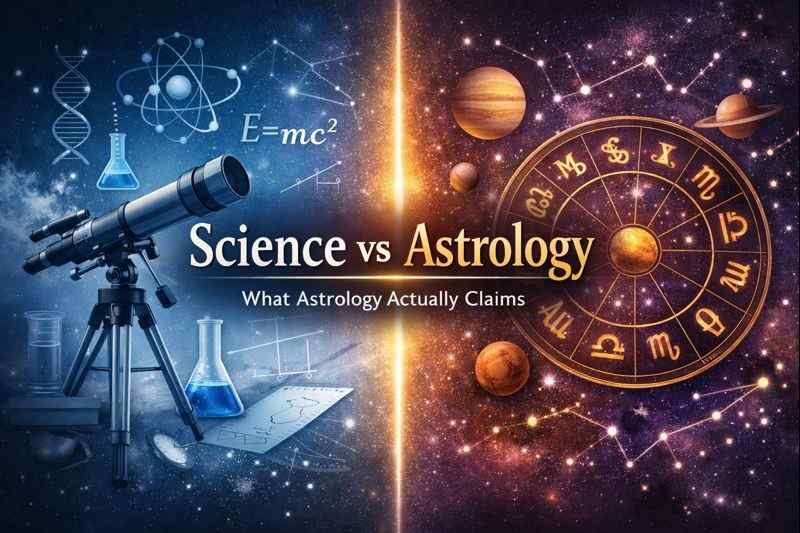
Introduction: Why the Debate Between Science and Astrology Never Ends
The discussion around science vs astrology continues to attract curiosity, skepticism, and deep emotional reactions. On one side, science emphasizes observation, experimentation, and measurable proof. On the other side, astrology focuses on symbolism, cycles, and patterns derived from celestial movements. Because both systems claim to explain human behavior and life events in different ways, confusion often arises.
To truly understand science vs astrology, one must first explore what astrology actually claims instead of what people assume it claims. Only then does a meaningful comparison become possible.
Also read – All Ekadashi of the Year 2026
Understanding the Core of Science
Science functions as a structured method of inquiry. Researchers observe phenomena, form hypotheses, test them through controlled experiments, and revise conclusions based on evidence. This approach values repeatability, falsifiability, and measurable outcomes.
Moreover, science seeks universal laws. Gravity behaves the same way regardless of belief. Chemical reactions follow fixed principles independent of culture. Therefore, scientific truths rely on external validation rather than personal experience.
Because of this foundation, science demands predictive accuracy that can be verified under the same conditions repeatedly.
Understanding the Core of Astrology
Astrology operates on a completely different framework. Instead of physical causation, astrology studies symbolic correlation. It does not claim that planets emit forces that control human behavior. Instead, astrology suggests that planetary movements reflect cycles of time and consciousness.
When astrologers analyze charts, they interpret patterns rather than conduct experiments. The birth chart serves as a symbolic map of tendencies, motivations, challenges, and opportunities.
Thus, astrology claims meaning, not mechanism. This distinction becomes critical when discussing science vs astrology honestly.
The Biggest Misunderstanding About Astrology
Many critics assume astrology tries to function as a scientific system. That assumption creates immediate conflict. Astrology never claimed to follow the scientific method in the modern sense.
Historically, astrology developed long before modern science. Ancient civilizations observed celestial rhythms and correlated them with earthly events. Over time, these observations formed symbolic systems rather than experimental models.
Therefore, astrology claims interpretive insight, not laboratory validation. When critics judge astrology using scientific criteria alone, they evaluate it through a lens it never adopted.
Science vs Astrology: Causation vs Correlation
One of the strongest dividing lines in science vs astrology involves causation. Science seeks cause-and-effect relationships. Astrology observes correlations without asserting direct causation.
For example, astrology does not state that Mars causes aggression. Instead, astrologers say Mars symbolizes assertive energy during specific cycles.
Because correlation does not equal causation, astrology does not violate scientific laws. It simply operates outside their domain.
What Astrology Actually Claims About Human Personality
Astrology does not claim that people lose free will. Instead, astrology suggests predispositions rather than fixed destinies.
A birth chart highlights tendencies, strengths, and challenges. It does not force outcomes. People still make choices based on awareness, environment, and effort.
Therefore, astrology functions more like a psychological language than a deterministic system. This perspective often disappears in shallow science vs astrology debates.
Astrology and Time Cycles
Astrology places enormous importance on time cycles. Just as seasons repeat patterns in nature, astrology observes cycles in human experience.
Planetary transits reflect periods of growth, pressure, introspection, or expansion. These phases resemble psychological seasons rather than mechanical triggers.
Science acknowledges cycles in biology, climate, and physics. Astrology extends cyclical thinking into symbolic and experiential realms.
Why Astrology Cannot Be Tested Like Science
Testing astrology using scientific experiments presents structural limitations. Astrology relies on individual charts, subjective interpretation, and symbolic meaning.
Moreover, astrologers rarely make single-variable predictions. Instead, they assess multiple interacting factors. Science, however, isolates variables to test hypotheses.
Because of this difference, applying laboratory testing to astrology oversimplifies its complexity. This mismatch fuels misunderstandings in science vs astrology discussions.
The Role of Psychology in Astrology
Modern astrologers often align astrology with psychological frameworks. Carl Jung introduced the concept of synchronicity, which describes meaningful coincidences without causal links.
Astrology fits naturally into this idea. Planetary positions synchronize with internal states rather than cause them.
As a result, astrology helps individuals reflect, gain insight, and recognize patterns. Science studies behavior from outside, while astrology explores experience from within.
Why Science Rejects Astrology
Science rejects astrology because astrology does not meet scientific standards of evidence. Scientific institutions require controlled testing, statistical consistency, and reproducibility.
Astrology does not attempt to meet these criteria. Therefore, rejection does not prove astrology false. It only confirms incompatibility between methodologies.
Understanding this nuance brings clarity to the science vs astrology debate.
Where Science and Astrology Overlap
Despite opposition, science and astrology share surprising similarities. Both systems study patterns. Both rely on observation. Both evolved from humanity’s desire to understand existence.
Astronomy emerged from astrology historically. Psychology adopted symbolic analysis long before neuroscience advanced.
Although modern science distanced itself from astrology, their roots remain intertwined.
Astrology as a Language, Not a Law
Astrology functions like a symbolic language. Just as poetry conveys truth without equations, astrology conveys meaning without formulas.
Different astrologers may interpret the same chart differently, just as readers interpret literature uniquely.
This interpretive flexibility frustrates scientific validation but enhances personal relevance.
Science vs Astrology in Everyday Life
People often use astrology for self-reflection rather than prediction. Astrology helps individuals understand emotional patterns, relationship dynamics, and decision-making tendencies.
Science helps individuals diagnose illness, build technology, and explore the universe.
Rather than competing, these systems serve different human needs.
The Problem With Horoscope Columns
Many critics judge astrology based on daily horoscopes. These columns generalize for mass audiences and sacrifice depth for entertainment.
Serious astrology never relies on Sun signs alone. Professional astrologers analyze complete birth charts with precision.
Therefore, dismissing astrology based on newspaper horoscopes creates a false comparison within science vs astrology debates.
Can Astrology and Science Coexist?
Coexistence becomes possible when each system respects its boundaries. Science excels at explaining how the physical world works. Astrology excels at exploring meaning, timing, and self-awareness.
Problems arise only when one system claims authority over the other’s domain.
Balanced understanding allows both perspectives to enrich human knowledge without conflict.
Astrology and Predictive Accuracy
Astrology does not predict exact events like scientific models. Instead, astrology predicts themes, periods, and tendencies.
For example, astrology may indicate emotional challenges during a transit rather than specify exact outcomes.
This difference often leads to unrealistic expectations and disappointment.
Cultural and Historical Importance of Astrology
Astrology shaped ancient calendars, medicine, agriculture, and governance. Civilizations across India, Mesopotamia, Greece, and China integrated astrology deeply into daily life.
Science later replaced many practical functions of astrology, but cultural significance remained.
Understanding this history adds context to modern science vs astrology arguments.
Astrology and Personal Meaning
Many people turn to astrology during uncertainty. Astrology offers language for experiences that science does not address, such as purpose, timing, and emotional cycles.
Science answers “how,” while astrology explores “why.”
This difference explains astrology’s lasting relevance despite criticism.
Common Myths About Astrology
Some believe astrology predicts inevitable fate. Others assume astrology denies logic. Both assumptions misrepresent its actual claims.
Astrology invites awareness rather than submission. Astrology encourages reflection rather than obedience.
Clearing these myths improves dialogue between science vs astrology advocates.
The Role of Belief
Science does not require belief; it requires evidence. Astrology requires openness, not blind faith.
Astrology works through interpretation and resonance rather than proof.
Therefore, belief plays different roles in each system.
Evaluating Astrology Fairly
Fair evaluation requires judging astrology on its own terms. Expecting astrology to behave like physics misunderstands its purpose.
Similarly, expecting science to provide spiritual meaning misunderstands its scope.
Balanced comparison respects differences rather than forcing equivalence.
Why the Debate Continues
The science vs astrology debate persists because humans seek certainty and meaning simultaneously. Science satisfies certainty. Astrology satisfies meaning.
Neither system fully replaces the other.
As long as people search for understanding beyond material facts, astrology will continue alongside science.
The Future of Science vs Astrology
Future discussions may focus less on opposition and more on integration. Psychology, neuroscience, and symbolic studies already explore subjective experience scientifically.
Astrology may evolve as a reflective tool rather than predictive authority.
Open dialogue encourages growth rather than dismissal.
Astrology is not considered a science because it does not follow the scientific method of hypothesis testing, controlled experimentation, and falsifiable predictions.
Astrology claims that planetary positions symbolically reflect psychological tendencies, life themes, and timing patterns—not physical causation.
No. Astrology focuses on tendencies, cycles, and probabilities rather than fixed or guaranteed outcomes.
Scientists reject astrology due to lack of repeatable experimental evidence and measurable causal mechanisms.
Yes. Many view astrology as a symbolic, cultural, or psychological framework rather than a scientific one.
No. Astronomy is a physical science studying celestial bodies, while astrology interprets symbolic meanings assigned to them.
Conclusion: Understanding What Astrology Actually Claims
Science vs astrology remains a complex discussion shaped by misunderstanding and misplaced expectations. Astrology does not claim scientific authority. Astrology claims symbolic insight into time, behavior, and consciousness.
Science does not disprove astrology by ignoring its framework. Science simply operates differently.
When individuals understand what astrology actually claims, the debate transforms into informed comparison rather than rejection.
Ultimately, science explains the world we live in, while astrology helps many people understand their experience within it.


4 Comments