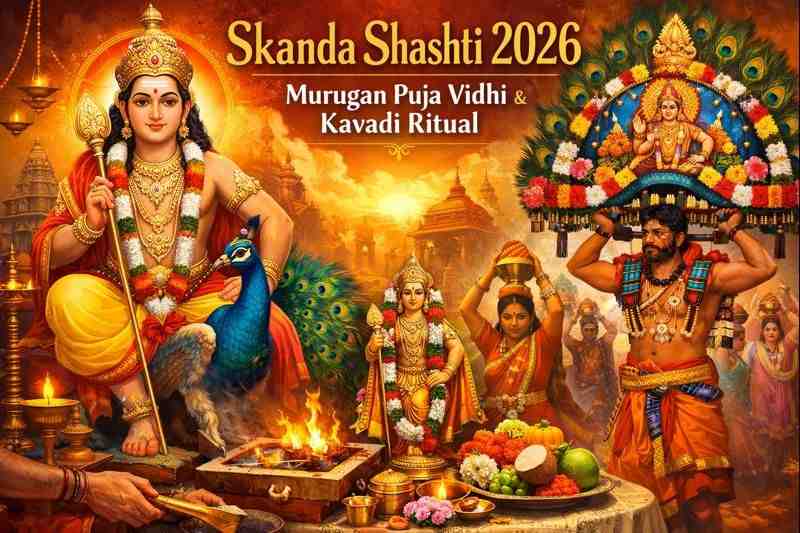
Skanda Shashti 2026 will be one of the most significant festivals dedicated to Lord Murugan, celebrated with fasting, puja, chanting, and temple ceremonies across Tamil Nadu, Sri Lanka, Malaysia, Singapore, and global Murugan communities. Skanda Shashti 2026 honors the divine victory of Lord Murugan over the demon Surapadman, symbolizing the triumph of dharma over adharma and courage over fear. Devotees observe Skanda Shashti 2026 as a sacred period for spiritual purification, vows, kavadi rituals, and seeking strength, clarity, and protection.
Skanda Shashti is one of the most important festivals dedicated to Lord Murugan, also known as Skanda, Subramanya, Kartikeya, and Kumara. He is the son of Lord Shiva and Goddess Parvati, and is worshipped as the God of war, wisdom, courage, and victory.
This festival is celebrated with great devotion in Tamil Nadu, Sri Lanka, parts of Kerala, and among Murugan devotees worldwide. It commemorates the victory of Lord Murugan over the demon Surapadman, symbolizing the eternal truth that good always triumphs over evil.
Skanda Shashti is also considered a time for spiritual purification. Many devotees take vows, fast, chant special hymns, and participate in grand temple rituals. The most famous celebrations happen at the Tiruchendur Murugan Temple in Tamil Nadu.
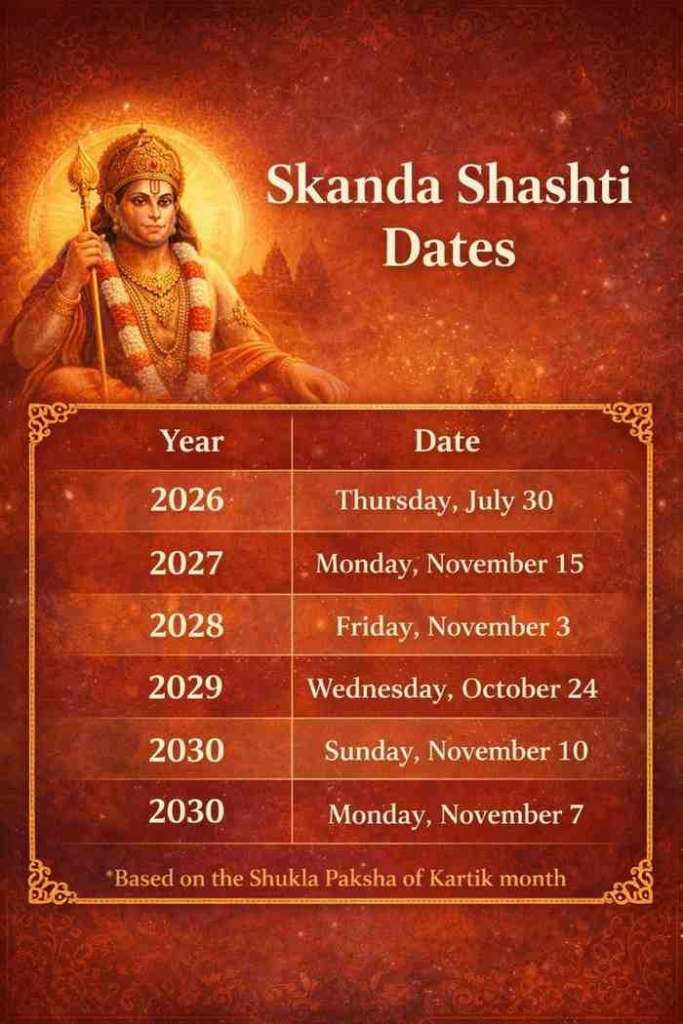
Dates for Skanda Shashti in 2026
In 2026, Skanda Shashti will be observed during the Shukla Paksha (bright fortnight) of the lunar month of Kartik.
According to Panchang, the main celebration day, known as Soorasamharam, is on Thursday, July 30, 2026.
Dates are based on Drik Panchang & regional lunar calendars
The Story Behind Skanda Shashti
According to Hindu mythology, the demon brothers Surapadman, Tarakasura, and Simhamukha created chaos in the world. They had gained immense power through boons and began troubling gods and humans alike.
The devas (gods) prayed to Lord Shiva for help. From the divine sparks of Lord Shiva’s third eye, Lord Murugan was born, holding a spear (Vel) given by Goddess Parvati. Murugan led the divine army and, after six days of fierce battle, defeated Surapadman on the final day, which is celebrated as Soorasamharam.
The next day marks Theerthavari or Thirukalyanam, symbolizing peace and divine union after victory.
Also read – Top 10 Temples in India to Visit in 2026
The Six-Day Ritual Sequence
The festival lasts six days, each with its significance:
- Day 1 – Kappu Kattu (Vow Taking)
Devotees tie a sacred thread on their wrist or arm, promising to observe purity, discipline, and devotion for the next six days. - Days 2–5 – Daily Pujas and Alankarams
Each day, Murugan’s idol is decorated in a different form, such as Bala Murugan (child form), Valli Murugan (with Goddess Valli), or Raja Alankaram (royal decoration). - Day 6 – Soorasamharam
The climax of the festival where the dramatic battle between Murugan and Surapadman is enacted in temples, especially at Tiruchendur. - Day 7 – Theerthavari / Thirukalyanam (optional in some places)
The idol is taken for a holy dip in the sea, river, or temple tank. In some temples, a symbolic divine wedding of Murugan with Goddess Deivayanai is performed.
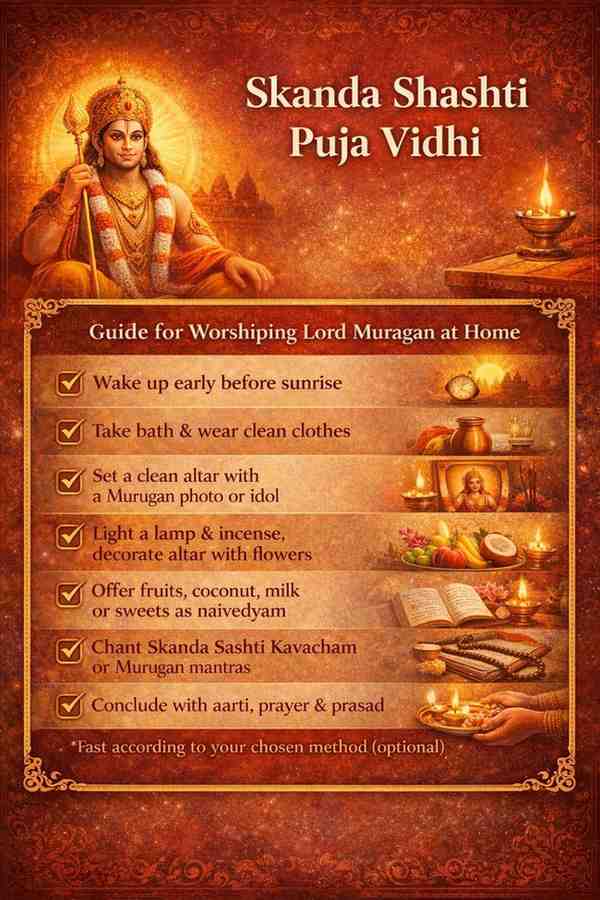
Murugan Puja Vidhi at Home
If you cannot attend temple celebrations, you can still worship Lord Murugan at home:
- Preparation – Clean your home and the puja area. Take a bath early in the morning and wear fresh, simple clothes (preferably white or saffron).
- Setup – Place an idol or framed picture of Lord Murugan on a clean altar. Decorate with flowers like jasmine, lotus, or arali.
- Lighting the Lamp – Light an oil lamp and incense sticks to begin the worship.
- Abhishekam (Ritual Bath) – Offer water, milk, honey, ghee, and rose water to the idol while chanting “Om Saravanabhavaya Namah”.
- Naivedyam (Food Offering) – Offer fruits, coconut, or milk-based sweets.
- Chanting – Recite the Skanda Shashti Kavacham, Kanda Sashti Kavasam, or simple Murugan mantras.
- Aarti – End with aarti and prayer for protection and blessings.
The Kavadi Ritual
The Kavadi is one of the most important aspects of Skanda Shashti for many devotees, especially in Tamil Nadu and Sri Lanka.
- Meaning – Kavadi means “burden” in Tamil. It symbolizes the devotee’s burden being offered to Murugan, who grants relief and blessings.
- Types of Kavadi:
- Paalkavadi – Pots of milk carried to the temple and poured over the idol during abhishekam.
- Pushpa Kavadi – A decorated frame filled with flowers.
- Alagu Kavadi – Involves body piercing as a form of extreme penance (for experienced devotees).
- Paalkavadi – Pots of milk carried to the temple and poured over the idol during abhishekam.
During the Kavadi procession, devotees walk barefoot, often chanting Murugan’s names and hymns.
Want to know more about Festival & Vrata
Fasting Rules During Skanda Shashti
Fasting is an important part of this festival. Devotees choose according to their capacity:
- Nirjala Vrat – Complete fast without food or water (for experienced devotees).
- Phalahar Vrat – Only fruits, milk, and water.
- Ek Bhojan Vrat – One simple vegetarian meal per day.
Avoid:
- Non-vegetarian food
- Alcohol or tobacco
- Onion, garlic, and heavily spiced foods
- Gossip, anger, or negative speech
Important Murugan Mantras
- Basic Mantra – “Om Saravanabhavaya Namah”
- Vel Mantra – “Om Velayuthaya Namah”
- Skanda Shashti Kavacham – A protective hymn composed by Devaraya Swamigal.
Chanting these with devotion is believed to remove obstacles, bring success, and protect from negativity.
Benefits of Observing Skanda Shashti
| Spiritual Benefit | Everyday Benefit |
| Removes past karmic effects | Brings peace of mind |
| Gives courage and strength | Helps face personal challenges |
| Improves focus and clarity | Aids in studies and work |
| Promotes family harmony | Reduces conflicts at home |
| Protection for children | Keeps them safe and healthy |
Do’s & Don’ts
Do’s:
- Begin the day with a bath before sunrise.
- Keep your body and surroundings clean.
- Maintain a peaceful and positive mindset.
- Help others, donate food or clothes.
Don’ts:
- Avoid negative actions, anger, and arguments.
- Do not break your fast without a genuine reason.
- Never disrespect the Kavadi, temple, or sacred items.
Murugan and Astrology: Rahu, Ketu & Mars Connection
In Vedic astrology, Lord Murugan is associated with Mars (Mangal), Rahu, and Ketu. Devotees believe that worshipping Murugan during Skanda Shashti helps reduce challenges related to Graha dosha, confusion, fear, and lack of direction.
• Mars (Mangal): Enhances courage, stamina, competitiveness, and leadership
• Rahu: Reduces anxiety, overthinking, illusions, and fear of failure
• Ketu: Improves focus, spiritual clarity, and detachment from negativity
Astrologers often recommend Skanda Shashti puja for students, young professionals, and those facing career or emotional instability.
Scientific Perspective Behind Skanda Shashti
Beyond tradition, fasting and chanting during Skanda Shashti have measurable effects on the body and mind:
• Fasting gives the digestive system rest and improves clarity and energy
• Milk-based diet during fast supports calmness and reduced inflammation
• Chanting mantras regulates breathing and reduces stress hormones
• Temple rituals synchronize sight, sound, fragrance, and collective emotion
Modern psychologists call this a multi-sensory engagement process, helpful for grounding, anxiety relief, and emotional resilience.
Skanda Shashti Among NRIs and Global Devotees
Skanda Shashti is celebrated worldwide due to the strong Murugan diaspora presence. Major celebrations happen in:
• Singapore (Sri Thendayuthapani Temple)
• Malaysia (Batu Caves Murugan Temple)
• Sri Lanka (Nallur Kandaswamy Temple)
• Australia (Sydney Murugan Temple)
• Canada (Toronto Kailasa Murugan Temple)
• UK (Highgate Murugan Temple)
These temples conduct Kavadi processions, Valli–Deivayanai wedding rituals, and live chants of the Skanda Shashti Kavacham. Many NRIs join remotely due to work schedules and distance.
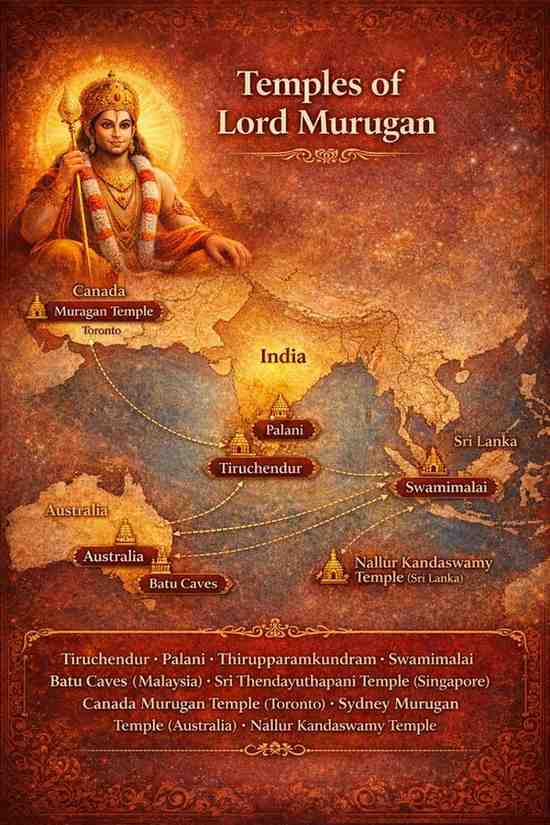
Major Murugan Temples to Visit for Skanda Shashti
Some of the most significant temples include:
• Tiruchendur Murugan Temple (Tamil Nadu)
• Palani Murugan Temple (Tamil Nadu)
• Swamimalai Murugan Temple (Tamil Nadu)
• Thirupparankundram Murugan Temple (Madurai)
• Nallur Kandaswamy (Jaffna, Sri Lanka)
• Sri Thendayuthapani Temple (Singapore)
• Batu Caves Temple (Malaysia)
These temples conduct elaborate rituals, abhishekams, and cultural events during the festival.
Important Murugan Mantras for Skanda Shashti
• Basic mantra: “Om Saravanabhavaya Namah”
• Vel mantra: “Om Velayuthaya Namah”
• Kavacham: Skanda Shashti Kavacham by Devaraya Swamigal
• Subrahmanya Gayatri Mantra:
“Om Tatpurushaya Vidmahe
Mahasenaya Dhimahi
Tanno Shanmukha Prachodayat”
Chanting these mantras is believed to give courage, clarity, and protection from obstacles.
Skanda Shashti Do’s and Don’ts
| Do’s | Don’ts |
|---|---|
| Take bath before sunrise | Avoid non-veg food |
| Maintain discipline & purity | Avoid alcohol or smoking |
| Chant Murugan mantras daily | Avoid negative speech |
| Offer fruits, flowers, milk | Don’t disrespect sacred rituals |
| Practice fasting as per ability | Don’t break fast without cause |
Skanda Shashti for Beginners
If you’re new to the festival, you can keep it simple:
• Light a lamp
• Offer milk, fruit, or flowers
• Chant the basic mantra
• Read Murugan stotra or Kavacham
• Maintain positivity and purity for six days
This makes the festival accessible to youth & international audiences.
Devotees believe that observing Skanda Shashti 2026 with fasting, chanting, and puja brings courage, clarity, and victory over obstacles.
FAQ
Yes, but only with moderate fasting such as phalahar or milk-based diet and after consulting a doctor. Devotion is more important than extreme austerity.
Yes. Children can offer flowers, chant simple Murugan mantras, or observe partial fasting with fruits or milk.
Fruits, milk, curd, coconut water, dry fruits, peanuts, sabudana, and simple vegetarian meals depending on the vrat type.
Yes. Many devotees perform the vrat at home with basic puja, lamp lighting, and mantra chantin
It is especially recommended for students, professionals, young adults, and anyone seeking courage, clarity, or relief from obstacles.
Devotees believe it removes fear, promotes courage, helps overcome difficulties, reduces karmic obstacles, and brings peace and clarity.
Yes. Murugan is associated with Mars, Rahu, and Ketu. Skanda Shashti is believed to help during their challenging planetary periods.
Yes, depending on the fasting type chosen. Nirjala devotees break only at the end, while phalahar devotees break after sunset
It is highly recommended but not compulsory. Even chanting “Om Saravanabhavaya Namah” is beneficial.
Not necessary. Home worship is equally valid. NRIs often join livestream temple pujas when physical visit is not possible.
Online Puja Platforms
If you cannot attend in person, you can join online Murugan pujas through trusted platforms:
- ePuja – Offers Murugan temple pujas with prasadam delivery.
- Srimander – Live video puja with personalized rituals.
- Gurucool.life– Connects you to priests in major Murugan temples.
Conclusion
Skanda Shashti is more than a festival—it’s a spiritual journey of self-purification, discipline, and devotion to Lord Murugan. In 2026, with July 30 as the main celebration day, devotees can prepare by learning the rituals, choosing a fasting method, and keeping a pure heart.
Whether you join grand temple processions, carry a Kavadi, fast strictly, or simply light a lamp at home, Murugan’s blessings will reach you when your devotion is sincere. This is a time to let go of burdens, invite divine protection, and walk forward with courage and clarity.