
Introduction: A Common Question in Astrology
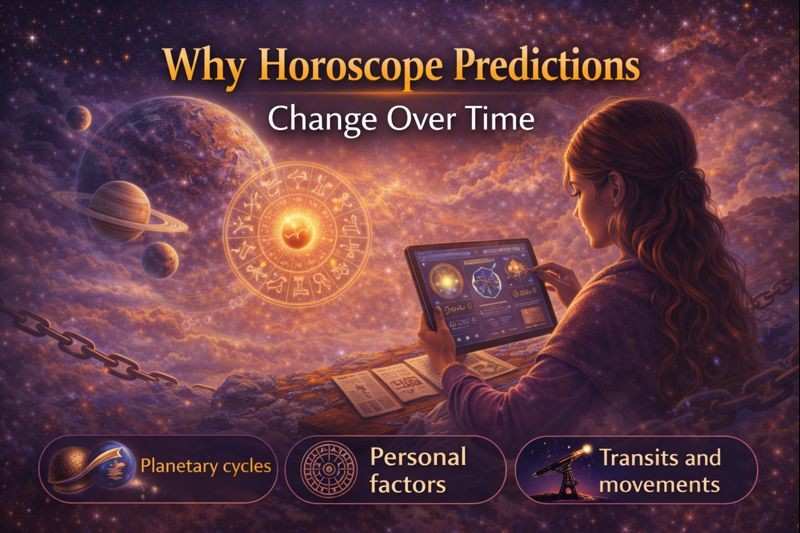
Many people notice one recurring pattern when they follow horoscopes regularly. Predictions that once felt accurate start to shift, evolve, or even contradict earlier readings. This observation often leads to confusion and skepticism. As a result, people ask why astrology predictions change and whether astrology remains reliable at all.
To answer this properly, we must look deeper into how astrology actually works. Horoscope predictions never stand still because life, time, and planetary motion never pause. Astrology reflects movement, not fixed outcomes, which makes change an essential part of its system.
Also Read :- Why Life Feels Stuck According to Astrology
Understanding the Core of Astrology Predictions
To understand why astrology predictions change, we must first clarify what astrology truly studies. Astrology does not predict isolated events randomly. Instead, it tracks planetary movements and studies how those movements interact with a person’s birth chart over time.
Every horoscope draws meaning from two main factors. One factor is the natal chart, which remains constant throughout life. The other factor involves dynamic planetary cycles that continue to change every moment. Because one part stays fixed and the other keeps moving, predictions naturally evolve.
Also Read :- Common Astrology Myths People Still Believe
The Role of Planetary Transits
Planetary transits play one of the biggest roles in explaining why astrology predictions change. A transit occurs when a moving planet forms an angle with a planet in your birth chart.
These transits shift daily, weekly, monthly, and yearly. For example, the Moon changes signs every two and a half days, while Saturn takes about thirty years to complete one zodiac cycle. Because each planet operates on a different timeline, their combined influence constantly changes the astrological climate.
As planets move, they activate different areas of your chart. Therefore, astrologers adjust predictions to match current transits rather than repeating old interpretations.
Progressions and Their Long-Term Influence
Another important reason astrology predictions change involves progressed charts. Progressions reflect inner psychological growth rather than external events.
Over time, progressed planets change signs and houses, symbolizing emotional maturity and evolving priorities. For instance, a progressed Moon shift often marks changes in emotional needs or relationship patterns.
Because people grow, astrology mirrors that growth. Predictions evolve to match who you are becoming, not who you were years ago.
Dashas and Planetary Periods in Vedic Astrology
Vedic astrology explains why astrology predictions change through the dasha system. Dashas represent planetary time periods that dominate different phases of life.
When one dasha ends and another begins, life themes change dramatically. A Venus dasha emphasizes relationships, luxury, and creativity, while a Saturn dasha focuses on responsibility, discipline, and long-term structure.
Because dashas shift at specific times, astrologers revise predictions accordingly. This time-based system makes static predictions impossible.
Free Will and Conscious Choices
Another crucial reason astrology predictions change involves human choice. Astrology does not eliminate free will. Instead, it describes potential outcomes and tendencies.
When people make different decisions, planetary energies express themselves in different ways. For example, a Mars transit may indicate conflict or courage. The outcome depends on how consciously a person channels that energy.
As behavior changes, astrologers update predictions to align with new patterns. Therefore, astrology predictions change because people change.
Also Read ;- Is Astrology Real or Psychological? A Clear Explanation
External Circumstances Also Matter
Life circumstances influence how planetary energies manifest. Social environment, career shifts, relationships, and responsibilities all affect outcomes.
For instance, the same Jupiter transit produces different results for a student, a business owner, and a retiree. Because circumstances evolve, astrologers refine predictions to match current realities.
This adaptability keeps astrology relevant rather than rigid.
Why Daily, Monthly, and Yearly Predictions Differ
Many people wonder why daily horoscopes feel inconsistent with yearly forecasts. The reason lies in layers of astrology.
Daily horoscopes focus on fast-moving planets like the Moon and Mercury. Yearly predictions emphasize slower planets like Saturn, Jupiter, and Rahu.
Both predictions remain correct within their scope. However, they address different time scales. Because astrologers analyze different planetary speeds, astrology predictions change across timelines.
The Difference Between Generic Horoscopes and Personal Charts
Generic horoscopes rely only on the Sun sign. Personal predictions analyze the full birth chart.
Because Sun sign horoscopes address millions of people, astrologers must keep them broad. In contrast, personal astrology tracks exact transits to precise chart points.
When people move from generic readings to personal consultations, they notice fewer contradictions. Astrology predictions change more logically when astrologers use accurate data.
Also Read :- Why Career Growth Feels Slow Despite Hard Work (Astrology View)
Astrology as a Language of Cycles
Astrology works like a language that describes cycles rather than fixed promises. Seasons change, tides rise and fall, and human emotions shift over time. Astrology reflects these natural rhythms.
When cycles repeat, themes return in new forms. A Saturn return at age thirty does not feel the same as one at age sixty. Experience reshapes how planetary energy expresses itself.
Therefore, astrology predictions change because cycles repeat with new awareness.
The Myth of One-Time Accurate Predictions
Many people expect one prediction to cover their entire future. This expectation creates disappointment.
Astrology never claims permanence. Instead, astrologers adjust predictions as planetary patterns unfold. This approach resembles weather forecasting. Meteorologists update forecasts because conditions evolve. Astrology follows the same principle.
Changing predictions do not indicate failure. They indicate refinement.
Emotional Readiness and Timing
Astrology predictions also change because emotional readiness shifts. Certain events activate only when a person becomes psychologically prepared.
For example, relationship opportunities may exist for years, yet commitment happens only when maturity aligns with planetary timing. Astrologers modify predictions when emotional readiness becomes visible.
This alignment explains why predictions grow clearer over time.
How Retrogrades Affect Predictions
Retrograde planets cause delays, reversals, and reevaluation. Mercury retrograde influences communication, while Venus retrograde reshapes relationships and values.
During retrograde periods, astrologers revise interpretations. What once looked straightforward may require patience or reflection.
Because retrogrades alter momentum, astrology predictions change temporarily until planets resume direct motion.
Spiritual Growth and Karma
From a spiritual perspective, astrology predictions change as karmic lessons evolve.
When individuals learn lessons quickly, certain difficulties reduce in intensity. When lessons remain unresolved, challenges repeat. Astrologers adjust predictions based on karmic progress.
Astrology remains responsive rather than punitive.
Why Conflicting Predictions Do Not Invalidate Astrology
Different astrologers may interpret charts differently. Experience, technique, and focus shape interpretation.
One astrologer may emphasize psychological growth, while another highlights external events. Both interpretations may remain valid within context.
Therefore, astrology predictions change not because astrology fails, but because perspective varies.
Astrology as Guidance, Not Fate
Astrology works best as a guiding tool rather than a final verdict.
Predictions show timing, tendencies, and opportunities. They do not lock outcomes into place. When people use astrology consciously, predictions help them navigate choices wisely.
This flexibility strengthens astrology rather than weakening it.
How to Use Changing Predictions Wisely
Instead of seeking fixed answers, ask better questions. Focus on preparation, awareness, and decision-making.
Track long-term patterns rather than reacting emotionally to short-term changes. Use predictions to understand energy trends rather than fearing them.
This mindset transforms astrology into a growth-oriented practice.
Also Read :- Science vs Astrology: What Astrology Actually Claims
Common Misunderstandings About Changing Predictions
Some people assume changing predictions mean astrologers guess randomly. In reality, astrology updates reflect new data and timing.
Others believe astrology should guarantee outcomes. Astrology never promises certainty. It offers probability and insight.
Understanding this distinction builds trust in the process.
Astrology Predictions and Modern Life
Modern life changes rapidly. Career paths evolve, relationships shift, and priorities transform. Astrology adapts to these realities.
As society changes, astrologers refine methods and interpretations. This evolution ensures relevance across generations.
Frequently Asked Questions
Horoscope predictions change because planets are constantly moving. As planetary positions shift, the astrological influences and themes affecting a person also change.
No. Astrology is based on timing and cycles, not fixed outcomes. Changing predictions reflect new planetary transits rather than errors.
Planetary transits refer to the ongoing movement of planets through the zodiac and houses, which influences different areas of life at different times.
Short-term horoscopes focus on fast-moving planets, while long-term changes are influenced by slower planets like Saturn and Jupiter, creating different experiences over time.
Yes. General horoscopes are based on Sun signs, but personal birth charts include Moon signs, rising signs, and house placements, which make predictions more specific and accurate.
Daily horoscopes are generalized and simplified. Different astrologers may interpret the same planetary movements differently, leading to variations.
Yes. Astrology suggests tendencies and timing, not fixed destiny. Personal choices and actions play a major role in how predictions unfold.
Conclusion: Why Astrology Predictions Change for the Better
Astrology predictions change because time moves forward, planets shift positions, and people grow through experience.
Rather than viewing change as inconsistency, consider it refinement. Astrology updates insights to reflect present reality rather than clinging to outdated assumptions.
When understood correctly, changing predictions prove astrology’s strength. They show that astrology remains alive, responsive, and deeply connected to the rhythm of life.
4 Comments