
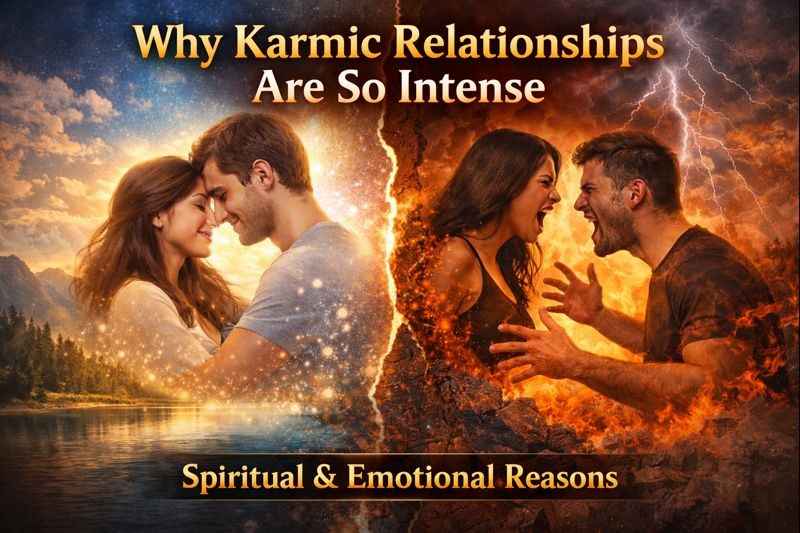
Karmic relationships are unlike any other connection you will experience in life. They arrive suddenly, consume your thoughts, shake your emotions, and often leave you feeling both deeply attached and painfully exhausted. Many people describe karmic relationships as passionate, addictive, confusing, and life-altering.
But why are karmic relationships so intense?
The answer lies far beyond surface-level attraction or compatibility. Karmic relationships operate at the level of soul memory, unresolved karma, emotional wounds, and spiritual evolution. Their intensity is intentional. It exists to awaken, challenge, and transform you.
In this in-depth guide, we explore why karmic relationships feel overwhelming, what makes them so emotionally charged, how they differ from healthy soulmate connections, and what they are meant to teach you before they release you.
Also Read :- Soulmate vs Karmic Relationship: Meaning, Signs, Differences & Spiritual Purpose
Understanding What a Karmic Relationship Really Is
A karmic relationship is a soul-level connection formed to resolve unfinished business from the past—whether from a previous lifetime, ancestral patterns, or unresolved emotional conditioning from early life.
These relationships are not designed primarily for comfort or permanence. They are designed for growth through confrontation.
Unlike soulmate relationships, which feel supportive and grounding, karmic relationships feel urgent and consuming. They pull you in quickly and hold you tightly, often without logic or reason.
This urgency is the first clue to understanding why karmic relationships are so intense.
Also Read :- Karmic Relationship Signs: How to Recognize Powerful but Challenging Soul Connections
The Core Reason Karmic Relationships Feel So Intense
The intensity of karmic relationships comes from activation.
A karmic partner activates:
- Deep emotional wounds
- Subconscious fears
- Unresolved trauma
- Past-life patterns
- Attachment styles formed in childhood
They do not create these wounds—they expose them.
That exposure is uncomfortable, emotional, and destabilizing, which is exactly why karmic relationships feel overwhelming.
Also Read :- Understanding Karmic Relationships: Signs, Stages, and Soul Lessons
Karmic Relationships Activate the Nervous System, Not the Heart
One of the biggest misconceptions is that karmic intensity equals deep love.
In reality, karmic relationships stimulate the nervous system, not the heart.
You may feel:
- Anxiety instead of peace
- Obsession instead of security
- Fear of loss instead of trust
- Emotional highs followed by crushing lows
This rollercoaster effect is a major reason why karmic relationships are so intense.
The body mistakes emotional activation for passion.
Also Read :- Signs of Past Life Karma: How to Recognize Karmic Patterns in Your Life
Trauma Bonding: The Hidden Engine Behind Karmic Intensity
Many karmic relationships are held together by trauma bonding.
Trauma bonding occurs when emotional pain and emotional relief come from the same person. Your brain becomes addicted to the cycle.
Signs of trauma bonding include:
- Feeling unable to leave despite suffering
- Rationalizing harmful behavior
- Confusing pain with love
- Feeling “alive” only with that person
This neurological addiction explains why karmic relationships feel impossible to walk away from.
Also Read :- What Is Karmic Debt? Meaning, Signs, Numbers, and How to Resolve It
Past-Life Karma and Soul Memory
From a spiritual perspective, karmic relationships often involve souls who have met before.
Unresolved dynamics from past lifetimes—such as betrayal, abandonment, power imbalance, or dependency—create energetic threads that pull souls back together.
When these souls meet again:
- Familiarity feels instant
- Attraction feels unavoidable
- Emotions feel disproportionate
This deep soul recognition is another reason why karmic relationships are so intense.
Also Read :-What Is Past Life Karma?
Childhood Wounds Resurfacing in Adult Love
Not all karmic intensity comes from past lives. Much of it comes from early emotional conditioning.
Karmic partners often mirror:
- A distant parent
- An emotionally unavailable caregiver
- A controlling authority figure
- Inconsistent affection patterns
The relationship reopens unresolved childhood wounds, giving you an opportunity to heal them consciously.
Healing, however, rarely feels comfortable.
The Push–Pull Dynamic of Karmic Relationships
A defining trait of karmic relationships is the push–pull cycle.
One moment you feel deeply connected.
The next moment you feel rejected, ignored, or misunderstood.
This inconsistency keeps the emotional system on high alert, creating intensity through uncertainty.
The mind keeps asking:
- “What did I do wrong?”
- “How do I get back to the good moments?”
- “Why does it feel so right and so painful?”
This confusion is central to why karmic relationships are so intense.
Ego Attachment vs Soul Alignment
Karmic relationships often connect through ego needs, not soul alignment.
These ego needs include:
- Validation
- Approval
- Feeling chosen
- Proving worth
- Fear of being alone
When ego is involved, love feels urgent and desperate rather than calm and grounded.
Soul-aligned relationships feel secure.
Ego-attached relationships feel intense.
Why Karmic Love Feels Addictive
The brain chemistry of karmic relationships resembles addiction.
Dopamine spikes during emotional highs.
Cortisol spikes during emotional lows.
This chemical cycle creates dependency, making it difficult to think clearly or make rational decisions.
The emotional body becomes hooked on intensity, reinforcing why karmic relationships are so intense.
Karmic Relationships Are Designed to Break Illusions
Karmic relationships often shatter illusions about:
- Love
- Self-worth
- Attachment
- Control
- Sacrifice
They force you to confront truths you may have avoided, such as:
- Staying too long in unhealthy dynamics
- Ignoring red flags
- Abandoning yourself for love
Breaking illusions is painful—but necessary.
The Role of Astrology in Karmic Relationship Intensity
Astrology frequently reveals karmic bonds through:
- Rahu–Ketu connections
- Saturn aspects on Venus or Moon
- 8th and 12th house overlays
- Past-life indicators in synastry
These placements intensify emotional entanglement and spiritual lessons.
Astrology helps explain why karmic relationships are so intense, but awareness helps you navigate them wisely.
Why Karmic Relationships Often Feel Fated
Many people describe karmic relationships as “destined” or “meant to be.”
This feeling comes from:
- Strong soul memory
- Energetic familiarity
- Emotional pattern recognition
Fated does not mean permanent.
Fated means purposeful.
Emotional Pain as a Catalyst for Growth
Karmic relationships use pain as a teacher.
Pain highlights:
- Where boundaries are missing
- Where self-worth is compromised
- Where healing is needed
Growth through comfort is slow.
Growth through emotional confrontation is fast.
This urgency explains the intensity.
Why Karmic Relationships End Abruptly
Once the lesson is integrated, karmic relationships often dissolve suddenly.
This can happen through:
- Sudden detachment
- Unexpected breakups
- Emotional exhaustion
- Loss of attraction
The soul no longer needs the lesson, so the bond loosens.
The Grief After a Karmic Relationship
Ending a karmic relationship often triggers deep grief—not because it was healthy, but because it was transformative.
You are grieving:
- An old version of yourself
- The illusion of what could have been
- The emotional addiction
Understanding why karmic relationships are so intense helps process this grief without self-blame.
Karmic Relationships vs Soulmate Relationships
| Aspect | Karmic Relationship | Soulmate Relationship |
|---|---|---|
| Emotional State | Anxious | Calm |
| Attachment | Addictive | Secure |
| Growth | Pain-driven | Supportive |
| Duration | Temporary | Long-term |
| Purpose | Healing lessons | Shared evolution |
How to Heal from a Karmic Relationship
Healing requires:
- Emotional detachment
- Nervous system regulation
- Boundary rebuilding
- Self-worth restoration
- Spiritual grounding
The goal is not to forget—but to integrate.
Preparing for Healthy Love After Karma
Karmic relationships prepare you for healthier love by:
- Teaching self-respect
- Breaking attachment cycles
- Strengthening intuition
- Clarifying boundaries
Once the lesson is learned, soulmate-level connections feel peaceful rather than intense.