
Introduction
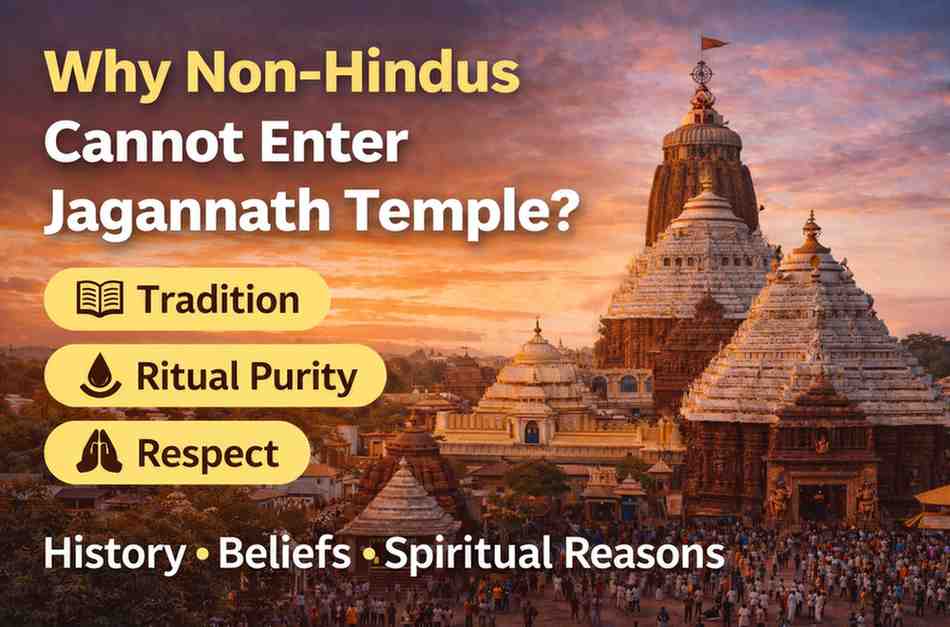
The Jagannath Temple in Puri is one of the most sacred pilgrimage sites in India and holds immense spiritual importance for millions of devotees. Over the years, one question has often sparked curiosity, debate, and misunderstanding among visitors from around the world: Why Non Hindus Cannot Enter Jagannath Temple?
This restriction is frequently viewed through a modern lens of inclusion and exclusion, but its roots lie deeply embedded in history, theology, ritual purity concepts, and the preservation of an ancient spiritual ecosystem. To truly understand the issue, it is essential to approach it with cultural sensitivity, historical awareness, and spiritual context rather than judgment.
Also Read :- Jagannath Temple History: A Timeless Chronicle of Faith
Understanding the Nature of Jagannath Temple
The Jagannath Temple is not merely a tourist site or architectural monument; it is a living spiritual institution governed by centuries-old traditions. Every ritual, rule, and restriction exists within a carefully preserved sacred framework.
Unlike many temples that evolved primarily as places of worship, this shrine functions as a continuous ritual universe where daily ceremonies follow ancient scriptural injunctions without interruption. Understanding this sacred continuity is key to understanding Why Non Hindus Cannot Enter Jagannath Temple.
Also Read :- Why Jagannath Temple Is Famous: A Complete Exploration
The Concept of Ritual Purity in Hindu Temple Traditions
One of the most fundamental aspects behind the restriction is the Hindu concept of ritual purity (shuddhi). Traditional Hindu temples, especially ancient ones, operate under strict ritual discipline.
Priests, offerings, food preparation, deity dressing, and ceremonial timings are governed by elaborate purity rules that are believed to sustain divine energy within the sanctum. Entry restrictions are not personal or discriminatory but ritualistic in nature.
This concept lies at the heart of the temple’s tradition, as it operates within a closed ritual system that assumes a shared framework of religious discipline among all participants.
Historical Context of the Restriction
Historically, temple entry rules were shaped during periods of political instability, invasions, and religious conflict. Sacred spaces were often targeted, desecrated, or misunderstood by outsiders unfamiliar with ritual practices.
Over time, protective boundaries were established to safeguard the sanctity of rituals and the physical safety of the deities. These historical experiences significantly influenced Why Non Hindus Cannot Enter Jagannath Temple, making preservation a priority over openness.
Also Read :- What Is Holi Festival and Why Is It Celebrated? Complete Guide
Jagannath as a Living Deity, Not a Symbol
In many traditions, deities are treated symbolically. In this temple, however, Lord Jagannath is regarded as a living divine presence who eats, sleeps, falls ill, and travels.
Because the deity is regarded as a living king, the temple functions like a royal household governed by strict codes of conduct. Entering such a sacred domestic space requires adherence to specific spiritual disciplines, reflecting the traditional worldview that protects the sanctity of this holy environment.
Also Read :- Why Is Diwali Celebrated? History, Meaning & Spiritual Significance of Diwali
The Role of Mahaprasad and Sacred Food Rituals
One of the most sacred elements of the temple is Mahaprasad—the food offered to the deity and later shared by devotees. This food is believed to carry divine energy and spiritual equality.
Ironically, while entry is restricted, Mahaprasad is open to everyone regardless of religion, caste, or background. This highlights that Why Non Hindus Cannot Enter Jagannath Temple is not about social exclusion but ritual preservation.
Also Read :- Diwali Meaning and History: A Complete Exploration
Influence of Tribal and Indigenous Traditions
Jagannath worship evolved from tribal traditions long before it became part of classical Hinduism. Indigenous communities followed strict ritual boundaries that governed who could participate directly in sacred ceremonies.
These early traditions continue to shape temple practices today. Understanding this tribal spiritual inheritance is essential when examining Why Non Hindus Cannot Enter Jagannath Temple from an anthropological perspective.
Also Read :- What Is Diwali: A Complete Guide to the Festival of Lights
Temple Rules Are Based on Practice, Not Belief
Importantly, the restriction is not based on belief or faith alone but on formal participation in Hindu ritual life. A person born outside Hinduism but formally initiated (ghar wapsi or accepted through ritual conversion) is traditionally allowed entry.
This clarifies Why Non Hindus Cannot Enter Jagannath Temple as a matter of ritual alignment rather than religious identity.
Comparison With Other Global Sacred Spaces
Restrictions are not unique to this temple. Sacred sites worldwide have entry rules:
- The inner sanctum of Mecca is restricted to Muslims
- Certain monasteries restrict access by gender
- Indigenous sacred lands limit entry to initiated members
Viewed globally, Why Non Hindus Cannot Enter Jagannath Temple aligns with universal religious practices of protecting sacred space.
Legal and Administrative Continuity
Post-independence India preserved temple traditions under constitutional protection of religious freedom. Courts have repeatedly ruled that temple management has the right to regulate entry based on tradition.
Thus, Why Non Hindus Cannot Enter Jagannath Temple also has a legal foundation rooted in cultural preservation.
Modern Debate and Ethical Questions
In the modern era, the restriction raises ethical questions about inclusivity and pluralism. However, many scholars argue that spiritual preservation and cultural autonomy must coexist with respect.
The debate around Why Non Hindus Cannot Enter Jagannath Temple continues, but change within sacred traditions typically occurs slowly and organically, not through external pressure.
Spiritual Philosophy of Jagannath: Universal Yet Protected
Paradoxically, Lord Jagannath is considered the most universal deity—Patita Pavana (Savior of the fallen). His Rath Yatra brings him out to the streets to bless everyone without distinction.
This paradox explains Why Non Hindus Cannot Enter Jagannath Temple while still allowing divine access beyond temple walls.
Why the Temple Chooses Outreach Over Entry
Instead of opening the sanctum, the tradition chose outreach:
- Rath Yatra brings the deity to the public
- Mahaprasad is shared with all
- Darshan is possible from temple rooftops and surrounding areas
This model reinforces Why Non Hindus Cannot Enter Jagannath Temple without denying spiritual connection.
Respect Versus Access: A Cultural Perspective
True respect for a culture includes respecting its boundaries. Entry restrictions do not diminish devotion, curiosity, or reverence.
Understanding Why Non Hindus Cannot Enter Jagannath Temple is ultimately about honoring living traditions rather than reshaping them to fit modern expectations.
Common Misconceptions Clarified
- ❌ It is not about caste
- ❌ It is not about superiority
- ❌ It is not about discrimination
- ✅ It is about ritual continuity
- ✅ It is about sacred discipline
Clarifying these misconceptions helps reduce misunderstanding around Why Non Hindus Cannot Enter Jagannath Temple.
Voices From Devotees and Scholars
Many Hindu scholars emphasize that the temple is not closed to people, but open to discipline. Devotion without entry is still considered valid and spiritually meaningful.
These insights further contextualize Why Non Hindus Cannot Enter Jagannath Temple beyond surface interpretations.
The Future of the Tradition
Will the rule change? Possibly—but only through internal spiritual consensus, not external demand. Sacred traditions evolve when communities feel spiritually ready.
Until then, Why Non Hindus Cannot Enter Jagannath Temple remains part of an unbroken sacred lineage.
Frequently Asked Questions
Why are entry rules strict at the Jagannath Temple?
The temple follows ancient ritual traditions that require shared spiritual discipline among participants. These rules are intended to preserve ritual continuity rather than exclude individuals.
Is the restriction based on caste or nationality?
No. The restriction is not related to caste, race, or nationality. It is connected to participation in specific ritual practices that follow traditional Hindu temple discipline.
Can non-Hindus experience the spiritual atmosphere of the temple?
Yes. Visitors can witness the temple from surrounding areas, participate in festivals like Rath Yatra, and receive Mahaprasad, which is shared openly with everyone.
Are there similar restrictions at other religious sites?
Yes. Many sacred places around the world have entry rules based on religious practice, such as restricted sanctums in temples, mosques, monasteries, and indigenous sacred sites.
Is Mahaprasad available to everyone?
Yes. Mahaprasad, the sacred food offered at the temple, is available to all people regardless of religion, caste, or background.
Can the entry rule change in the future?
Any change would depend on internal spiritual consensus within the temple tradition. Sacred practices typically evolve slowly and organically over time.
Conclusion
Understanding Why Non Hindus Cannot Enter Jagannath Temple requires patience, empathy, and cultural humility. The restriction is not rooted in exclusion, but in the protection of a living spiritual ecosystem that has survived for centuries.
The temple offers many paths to connection—through festivals, sacred food, philosophy, and devotion—proving that spiritual access does not always require physical entry.
Respecting boundaries is sometimes the highest form of reverence.


2 Comments