
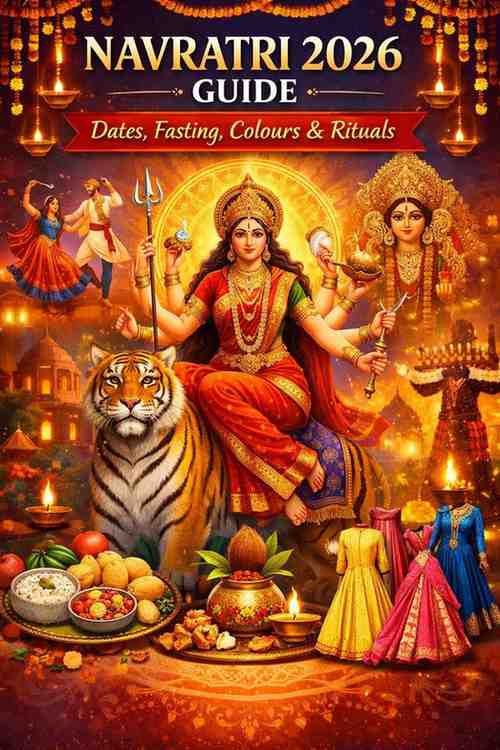
Navratri 2026 is one of the most widely celebrated Hindu festivals, dedicated to the worship of the Divine Mother in her nine powerful forms (Navdurga). Observed with devotion across India, Navratri symbolizes the victory of dharma over adharma and light over darkness.
As families prepare for Navratri 2026, common questions arise around dates, fasting rules, puja vidhi, colours, foods, and regional customs. This complete guide brings everything together so devotees can observe the festival with clarity, discipline, and devotion.
Also read – FOODS TO OFFER DURING SHRADH (PITRU PAKSHA): REGIONAL TRADITIONS EXPLAINED
Navratri 2026 – Quick Overview
- Festival: Sharad Navratri 2026
- Start Date: Wednesday, 14 October 2026
- End Date: Friday, 23 October 2026
- Total Days: 9 nights + Vijayadashami
- Associated Festival: Dussehra
- Primary Deity: Goddess Durga (Navdurga)
Navratri 2026 begins after Pitru Paksha (Shradh), marking the transition from ancestor worship to Devi Shakti upasana.
When Is Navratri 2026? (Dates & Tithi)
Navratri 2026 will begin on Wednesday, 14 October 2026 and conclude on Friday, 23 October 2026, with Vijayadashami (Dussehra).
During these nine days, devotees worship the nine forms of Goddess Durga—starting with Shailputri and ending with Siddhidatri—as per the Ashwin month of the Hindu lunar calendar.
Navratri 2026: 9 Days, 9 Goddesses (Navdurga List)
Navratri 2026: 9 Days, 9 Goddesses (Navdurga List)
| Day | Goddess | Significance |
|---|---|---|
| Day 1 | Shailputri | Strength & purity |
| Day 2 | Brahmacharini | Discipline & devotion |
| Day 3 | Chandraghanta | Courage & grace |
| Day 4 | Kushmanda | Creation & energy |
| Day 5 | Skandamata | Motherly protection |
| Day 6 | Katyayani | Power & justice |
| Day 7 | Kalaratri | Destruction of fear |
| Day 8 | Mahagauri | Peace & wisdom |
| Day 9 | Siddhidatri | Spiritual fulfillment |
Significance of Navratri
Navratri holds deep spiritual and cultural significance in Hindu tradition. The nine sacred nights symbolize the nine divine energies (Navdurga), each governing aspects such as strength, knowledge, protection, abundance, and purity.
From a spiritual perspective, Navratri promotes inner discipline and conscious living. Devotees use this period to adopt a sattvik lifestyle, practice fasting for purification, and engage in mantra chanting to deepen devotion.
Community worship, collective prayers, and cultural participation further strengthen the spiritual atmosphere during these days. It is widely believed that sincere devotion during Navratri helps remove obstacles and invites blessings related to health, protection, peace, and prosperity.
Navratri Puja Vidhi (How to Perform Puja at Home)
A simple Navratri puja can be performed at home:
- Clean the puja area and set up the Kalash
- Place the idol or image of Goddess Durga
- Offer flowers, kumkum, rice, and roli
- Light a ghee lamp and incense
- Recite Durga Chalisa or Navdurga stotras
- Offer fruits, sweets, and vrat food
- Maintain Akhand Jyot if possible
- Perform Kanya Pujan on Day 8 or 9
- Break the fast on Vijayadashami
Navratri Samagri List (Puja Checklist)
To perform Navratri puja smoothly, it is helpful to prepare all essential items in advance. A complete puja samagri list generally includes ritual items, offerings, and materials for daily worship.
Commonly required puja items are:
- Kalash (ritual urn)
- Coconut
- Mango or Ashoka leaves
- Red cloth for the altar
- Kumkum, haldi, and chawal
- Ghee diya or oil lamp
- Incense sticks (agarbatti)
- Fresh flowers, preferably marigold
- Fruits and sweets for naivedya
- Panjiri (as per regional custom)
- Oil and wicks for Akhand Jyot
Having these items ready ensures continuity and focus during the nine days of worship.
Navratri Fasting Rules (Upvas Guidelines)
Fasting during Navratri is observed as a practice of physical purification and spiritual discipline. While fasting traditions vary across regions, certain guidelines are commonly followed by devotees.
During Navratri fasting, devotees are advised to:
- Consume only sattvik food
- Avoid regular grains such as wheat and rice
- Refrain from onion, garlic, alcohol, and non-vegetarian food
- Prefer freshly prepared meals
- Stay hydrated throughout the day
- Break the fast slowly and mindfully
In general, foods such as grains, lentils, packaged snacks, meat, and regular salt are avoided during the vrat period.
Allowed Foods During Navratri Fast
Navratri fasting permits a variety of sattvik and vrat-friendly ingredients that help maintain energy levels while respecting religious guidelines.
Commonly allowed foods include:
- Sabudana
- Singhare ka atta
- Kuttu ka atta
- Samak rice (barnyard millet)
- Potatoes and sweet potatoes
- Makhana
- Paneer and curd
- Peanuts
- Sendha namak (rock salt)
- Ghee and milk
- Fresh fruits and coconut
These foods form the base of most traditional Navratri fasting meals.
Modern Healthy Additions for Navratri Upvas
With changing lifestyles, many devotees now include healthier fasting alternatives that align with nutritional needs while remaining vrat-compliant.
Popular modern additions include:
- Millet-based vrat khichdi
- Peanut chikki prepared with jaggery
- High-protein paneer-based meals
- Roasted makhana snacks
- Low-glycemic vrat kheer
Such options help sustain energy, especially for working professionals, without compromising the spiritual essence of Navratri fasting.
Navratri Colours 2026 (With Meaning & Dress Ideas)
| Day | Colour | Meaning |
|---|---|---|
| Day 1 | Yellow | Joy & prosperity |
| Day 2 | Green | Growth & harmony |
| Day 3 | Grey | Balance |
| Day 4 | Orange | Energy |
| Day 5 | White | Peace |
| Day 6 | Red | Power |
| Day 7 | Royal Blue | Wisdom |
| Day 8 | Pink | Compassion |
| Day 9 | Purple | Spirituality |
Regional Navratri Traditions Across India
Gujarat: Garba & Dandiya celebrations
West Bengal: Durga Puja with pandals and bhog
South India: Golu/Kolu doll displays
North India: Fasting, Devi puja, Ram Lila
Who Should Be Careful While Fasting During Navratri
- Elderly individuals
- Pregnant women
- Diabetics
- People with chronic illness
- Children
Modified fasting or partial vrat is advised with medical guidance.
Conclusion
Navratri 2026 is a powerful blend of devotion, discipline, and celebration. Whether observed through fasting, puja, dance, or community gatherings, the festival offers spiritual renewal and cultural connection. With proper preparation, the nine nights become deeply enriching and joyful.
Navratri 2026 FAQs (English)
When is Navratri 2026?
Navratri 2026 will begin on Wednesday, 14 October 2026 and conclude on Friday, 23 October 2026 with Vijayadashami.
How many days is Navratri celebrated?
Navratri is celebrated for nine nights and ten days, dedicated to the nine forms of Goddess Durga.
What is the significance of Navratri fasting?
Navratri fasting purifies the body and mind, builds self-discipline, and deepens devotion to the Divine Mother.
Which foods are allowed during Navratri fast?
Sabudana, samak rice, kuttu flour, fruits, paneer, makhana, peanuts, and dairy products are commonly consumed.
Which foods should be avoided during Navratri?
Grains, lentils, onion, garlic, alcohol, non-vegetarian food, and processed snacks are avoided during Navratri.
How to perform Navratri puja at home?
Set up a kalash, place Goddess Durga’s idol or image, light a diya, offer flowers and fruits, chant mantras, and perform aarti daily.
What is Kanya Pujan in Navratri?
Kanya Pujan involves worshipping young girls as manifestations of Goddess Durga, usually on the 8th or 9th day.
Are Navratri colours different for each day?
Yes, each day of Navratri has a specific colour symbolizing different divine qualities.
Can working professionals observe Navratri fasting?
Yes, partial fasting with simple sattvik foods is commonly followed by working professionals.
Is Navratri celebrated differently across India?
Yes, traditions vary by region, including Garba in Gujarat, Durga Puja in Bengal, and Golu in South India.
नवरात्रि 2026 से जुड़े अक्सर पूछे जाने वाले प्रश्न (Hindi)
नवरात्रि 2026 कब शुरू होगी?
नवरात्रि 2026 की शुरुआत 14 अक्टूबर 2026 से होगी और 23 अक्टूबर 2026 को विजयादशमी के साथ समाप्त होगी।
नवरात्रि कितने दिनों तक मनाई जाती है?
नवरात्रि नौ रातों और दस दिनों तक मनाई जाती है, जिसमें माँ दुर्गा के नौ रूपों की पूजा होती है।
नवरात्रि व्रत का क्या महत्व है?
नवरात्रि व्रत शरीर और मन की शुद्धि, आत्म-संयम और देवी भक्ति को मजबूत करने के लिए किया जाता है।
नवरात्रि व्रत में क्या खाना चाहिए?
साबूदाना, समा चावल, कुट्टू का आटा, फल, पनीर, मखाना, मूंगफली और दूध से बने खाद्य पदार्थ खाए जाते हैं।
नवरात्रि में किन चीजों से परहेज करना चाहिए?
अनाज, दालें, प्याज, लहसुन, शराब, मांसाहार और पैकेज्ड भोजन से परहेज किया जाता है।
घर पर नवरात्रि पूजा कैसे करें?
कलश स्थापना करें, माँ दुर्गा की मूर्ति या तस्वीर रखें, दीपक जलाएं, फूल अर्पित करें और रोज़ आरती करें।
नवरात्रि में कन्या पूजन क्या होता है?
कन्या पूजन में छोटी बच्चियों को देवी स्वरूप मानकर पूजन किया जाता है, जो अष्टमी या नवमी को किया जाता है।
क्या नवरात्रि के हर दिन अलग रंग होता है?
हाँ, नवरात्रि के प्रत्येक दिन का एक विशेष रंग होता है जो अलग-अलग गुणों का प्रतीक होता है।
क्या डायबिटीज़ के मरीज नवरात्रि का व्रत रख सकते हैं?
हाँ, डॉक्टर की सलाह लेकर कम ग्लाइसेमिक वाले व्रत खाद्य पदार्थों के साथ व्रत रखा जा सकता है।
भारत के अलग-अलग राज्यों में नवरात्रि कैसे मनाई जाती है?
गुजरात में गरबा, बंगाल में दुर्गा पूजा, दक्षिण भारत में गोलू और उत्तर भारत में व्रत एवं रामलीला होती है।
2 Comments