The 16-lunar day period dedicated to honoring our departed ancestors is almost here. Pitru Paksha 2026 (2082–2083 Vikrama Samvata) runs from late September to mid-October 2026. During this sacred fortnight, Hindus express deep gratitude to their Pitrs (ancestors), seeking their blessings for family health, peace, and prosperity.
Knowing the exact calendar dates is crucial because Shraddha rituals must be performed precisely on the lunar tithi corresponding to the day an ancestor passed away.
📋 Table of Contents
- Understanding Pitru Paksha: Lunar Calendars & Significance
- 2026 Mahalaya Paksha Shraddha Calendar & Tithis
- The Scriptural Definition of Shraddha
- Regional Variations of Shraddha Across India & Nepal
- Essential Items Required (Shradh Samagri Checklist)
- Step-by-Step Shradh Vidhi, Tarpan & Pind Daan Guide
- Understanding Pitra Dosh: Ancestral Karma in Your Horoscope
- Powerful Remedies to Perform on Sarva Pitru Amavasya
- Frequently Asked Questions (Pitru Paksha 2026)
- Expert References & Astrological Citations
Understanding Pitru Paksha and Nomenclature
Pitru Paksha is a 15-lunar-day period when Hindus pay homage to their ancestors, especially through food offerings.
- According to the South Indian Amanta calendar, it falls in the lunar month of Bhadrapada, beginning with the full moon day or the day after the full moon day.
- According to the North Indian Purnimanta calendar, this period falls in the lunar month of Ashwin, beginning with the full moon day in Bhadrapada or the next day of the full moon day.
- It is just the nomenclature of lunar months that differs; both North Indians and South Indians perform Shraddha rituals on similar days.
- The last day of Pitru Paksha is known as Sarvapitri Amavasya or Mahalaya Amavasya. Mahalaya Amavasya is the most significant day of Pitru Paksha.
2026 Mahalaya Paksha Shraddha Calendar (Vikrama Samvata 2082–2083)
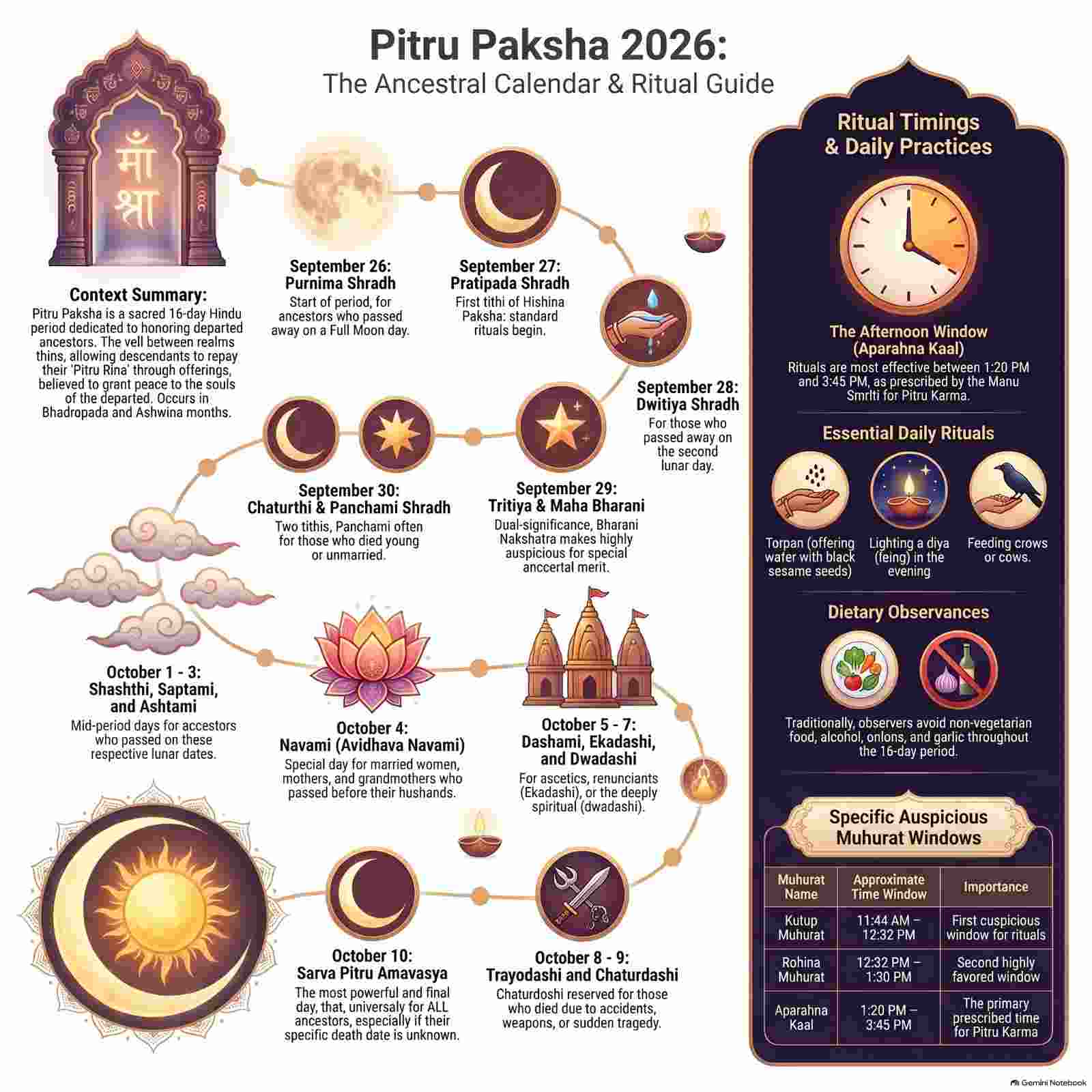
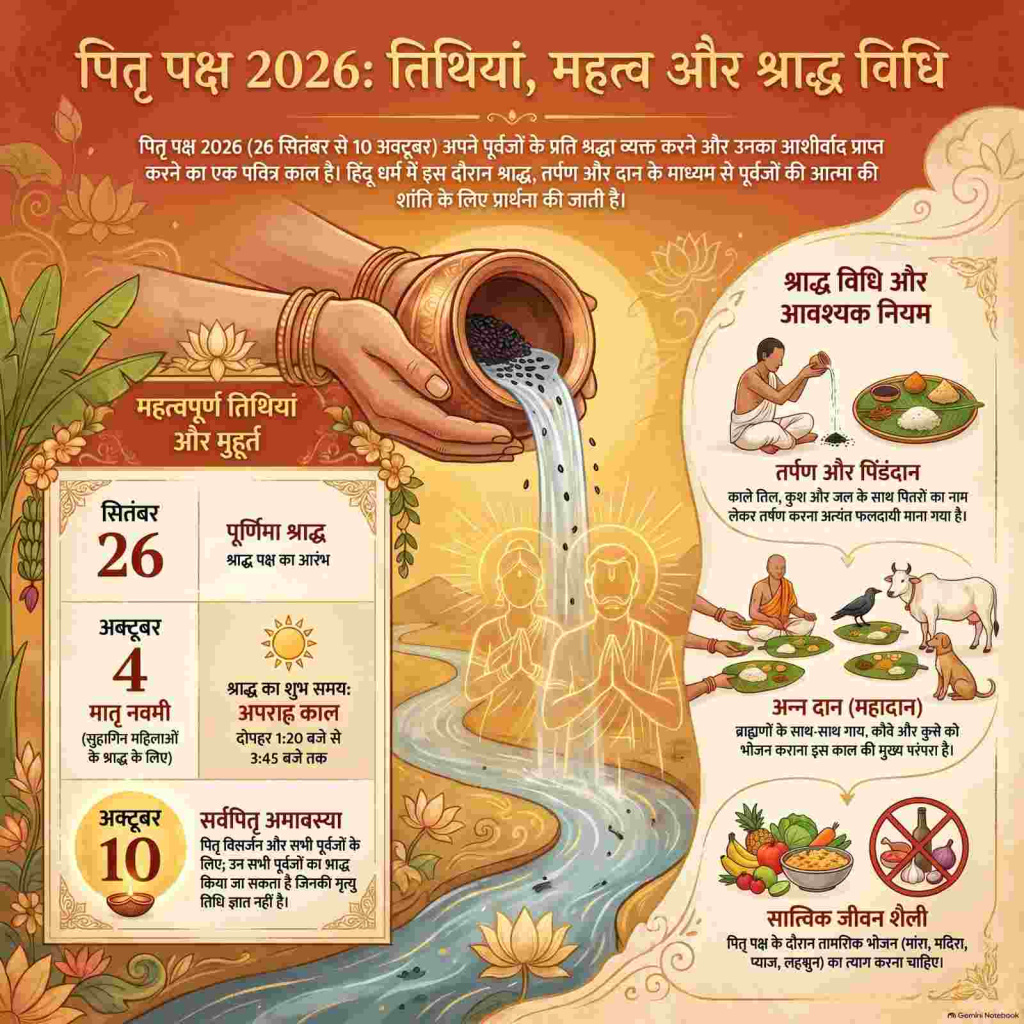
When planning your family rituals, it is essential to follow the exact daily schedule. Here is the complete day-by-day calendar for September and October 2026:
| Shradh Tithi | 2026 Date | Lunar Month / Details |
|---|---|---|
| Purnima Shraddha | September 26, 2026, Saturday | Bhadrapada, Shukla Purnima |
| Pratipada Shraddha | September 27, 2026, Sunday | Ashwina, Krishna Pratipada |
| Dwitiya Shraddha | September 28, 2026, Monday | Ashwina, Krishna Dwitiya |
| Tritiya & Maha Bharani | September 29, 2026, Tuesday | Ashwina, Krishna Tritiya / Bharani Nakshatra |
| Chaturthi & Panchami Shraddha | September 30, 2026, Wednesday | Ashwina, Krishna Chaturthi & Panchami |
| Shashthi Shraddha | October 1, 2026, Thursday | Ashwina, Krishna Shashthi |
| Saptami Shraddha | October 2, 2026, Friday | Ashwina, Krishna Saptami |
| Ashtami Shraddha | October 3, 2026, Saturday | Ashwina, Krishna Ashtami |
| Navami (Matri) Shraddha | October 4, 2026, Sunday | Ashwina, Krishna Navami |
| Dashami Shraddha | October 5, 2026, Monday | Ashwina, Krishna Dashami |
| Ekadashi Shraddha | October 6, 2026, Tuesday | Ashwina, Krishna Ekadashi |
| Dwadashi & Magha Shraddha | October 7, 2026, Wednesday | Ashwina, Krishna Dwadashi / Magha Nakshatra |
| Trayodashi Shraddha | October 8, 2026, Thursday | Ashwina, Krishna Trayodashi |
| Chaturdashi Shraddha | October 9, 2026, Friday | Ashwina, Krishna Chaturdashi |
| Sarva Pitru Amavasya | October 10, 2026, Saturday | Ashwina, Krishna Amavasya (Mahalaya) |
What is Shraddha According to Scriptures?
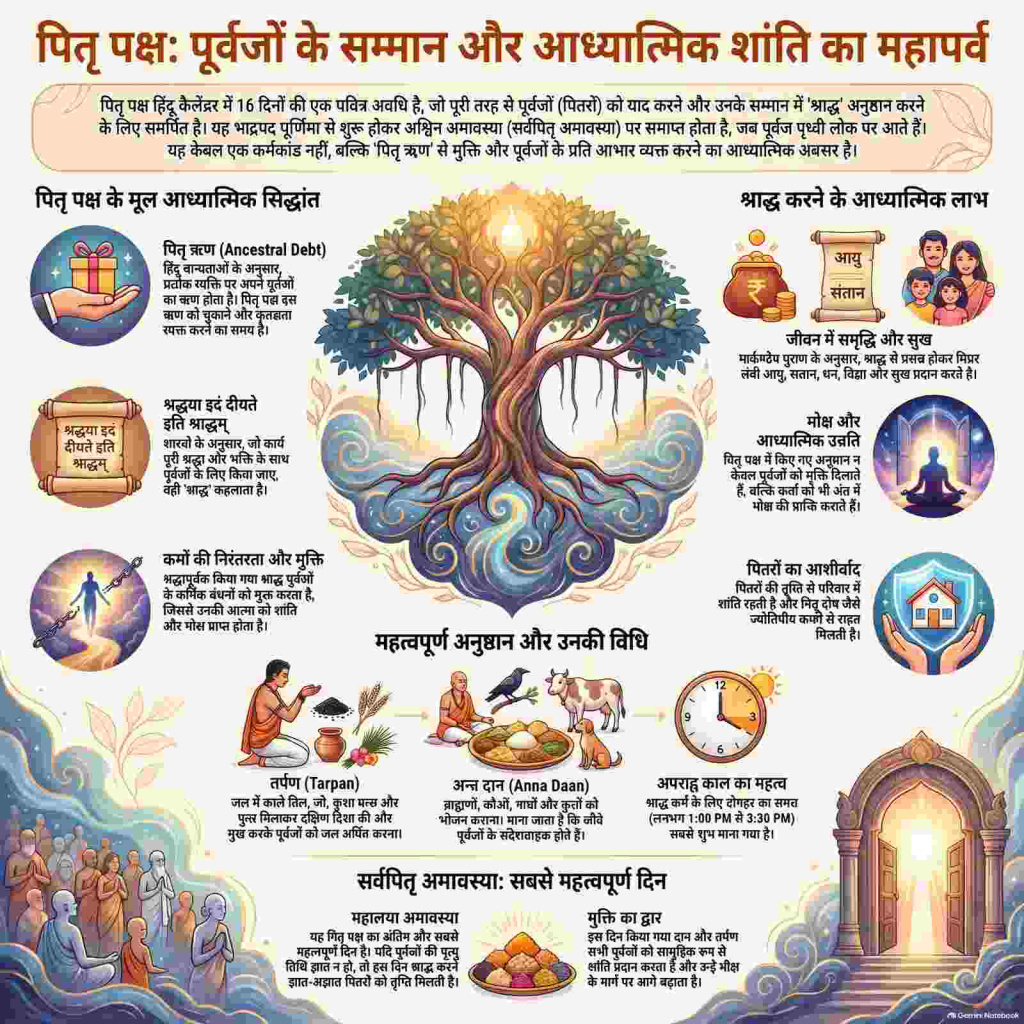
According to the descriptions found in the scriptures, “Shraddhaya Idam Diyate Iti Shraddham”—meaning, any ritual performed for the ancestors with proper method and devotion is called Shraddha. References to Shraddha rituals are found in many ancient texts such as the Manusmriti, Viramitrodaya, Shraddha Kalpalata, Shraddha Tattva, and Pitru Dayita.
Maharshi Parashara notes: “Whatever act is performed with devotion, with Sesame Seeds (Yava), Darbha (Kusha grass) and Mantras, along with offerings of Havishya at the right place, time and to the right recipient, is Shraddha.”
Performing Shraddha brings prosperity and happiness in worldly life, increases the longevity of the performer, and ultimately grants liberation at the end.
The Blessing of the Ancestors
As stated in the Markandeya Purana:
आयुः प्रजां धनं विद्यां स्वर्गं मोक्षं सुखानि च।
प्रयच्छन्ति तथा राज्यं पितरः श्राद्धतर्पितः॥
“When pleased with Shraddha, the ancestors grant the performer wealth, knowledge, happiness, progeny, long life, as well as liberation and moksha.”
Scriptures further emphasize that not only the performer, but also the one who inspires and approves Shraddha, as well as those who know its procedure, all attain the full merit of performing it.
Regional Variations of Shraddha Traditions
Because India is culturally diverse, the execution of Shraddha varies gracefully across regions while preserving the core spiritual intent:
- North India (Uttar Pradesh, Bihar, Rajasthan, Haryana): Pinda Daan holds immense importance. Performing Pinda Daan at sacred hubs like Gaya, Badrinath, Prayag, and Kashi (with Gaya being the most superior) is considered exceptionally meritorious using sesame seeds, barley, rice, milk, honey, and Ghee on a Kusha mat.
- Western India (Maharashtra & Gujarat): Mahalaya Shraddha is widely popular. In Maharashtra, special traditional dishes like Puran Poli, Katt-Saag, Bhaji, and God Shevaya are prepared, followed by obligatory food offerings to Brahmins, cows, crows, and dogs.
- Eastern India (Bengal, Odisha & Assam): Rituals are primarily performed as Tarpan. On Mahalaya Amavasya, people take holy river baths in the Ganga and offer sesame seeds and water.
- South India (Andhra Pradesh, Karnataka, Tamil Nadu, Kerala): Referred to as Pitru Karma. Customs range from Mattu Amavasya in Karnataka to banana leaf and dried coconut offerings in Tamil Nadu, and Bali offerings at temple groves (Deva Sthanam) in Kerala.
- Nepal: Known as Shraddha Karma or Pinda Daan, with daily rituals traditionally observed at the Shri Gokarneshwar Temple in Kathmandu.
Unsure about your ancestral tithi or facing Pitra Dosh?
Analyze your birth chart instantly with our AI Astrologer to identify ancestral blockages and get personalized Vedic remedies computed from authentic rules.
Pitru Paksha 2026: Step-by-Step Shradh Vidhi, Tarpan & Pind Daan Guide
Observing Shradh during Pitru Paksha is one of the most sacred duties in Sanatana Dharma. According to the scriptures (Manusmriti and Markandeya Purana), performing these rites with devotion brings peace to departed souls and grants health, wealth, and spiritual protection to the living.
Whether you are performing the rituals at home or preparing to visit a holy riverbank, this step-by-step guide explains the traditional Shradh Vidhi, Tarpan, and Pind Daan processes.
Essential Items Required (Shradh Samagri)
Before starting the ritual on your designated tithi, ensure you have gathered all necessary items. Having everything ready maintains focus and reverence during the prayers:
Shradh Samagri Checklist
- Kusha Grass (Darbha)
- Black Sesame Seeds (Til)
- Barley (Yava) and Raw Rice
- Pure Cow Ghee and Honey
- Gangajal or Clean River Water
- Raw Milk and White Flour (for Pind)
- Janeu (Sacred Thread worn on the right shoulder)
- Fresh Fruits, Betel Leaves (Paan), and Supari
- Sattvic food ingredients (for Brahmin/Poor feeding)
Step-by-Step Shradh Vidhi at Home
Shradh is ideally performed during Kutup Kala (around midday, roughly between 11:36 AM and 12:24 PM) and Rohini Kala, when the sun’s energy is optimal for ancestral offerings.
Follow these core steps:
- Purification & Attire: Take a bath early in the morning. Wear a clean dhoti or traditional clothes. Wear your sacred thread (Janeu) over your right shoulder (known as Apasavya position), which is specifically prescribed for ancestral rituals.
- Setting the Altar: Sit facing South (the direction of Yama and the Pitrs) on a clean mat made of Kusha grass or wool. Place a clean wooden chowki and spread a white cloth over it.
- Invocation (Avahana): Invite your ancestors with a pure heart, praying that they accept your offerings of food and water. Light a pure ghee lamp and incense sticks.
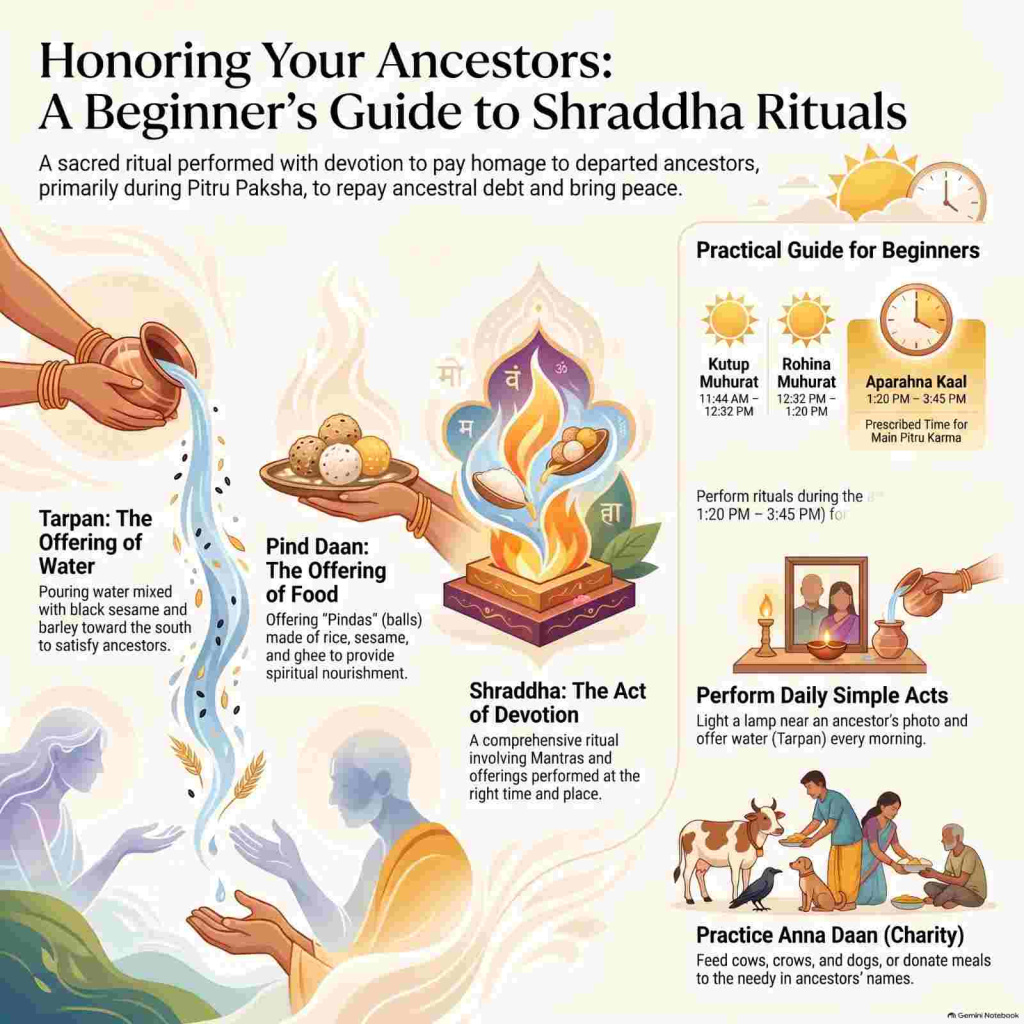
- Tarpan (Offering Water and Sesame): Take water mixed with black sesame seeds, raw rice, and barley in your palms (over Kusha grass) and let it flow down through your thumb—which represents the Pitr Tirtha. Chant ancestral mantras to quench their spiritual thirst.
- Pind Daan (Offering Rice Balls): Prepare cooked rice mixed with black sesame, barley flour, milk, honey, and ghee. Shape them into spherical balls (Pindas) and offer them to the ancestors while reciting sacred names and mantras.
- Pancha Bali Bhog (Offering to Elements): Before your family eats, set aside portions of the prepared food for five living creations: the cow, the crow, the dog, the ants, and the gods. Crows and cows hold special significance during Pitru Paksha as messengers and earthly vessels.
- Brahmin or Priest Feeding: Respectfully feed a Brahmin priest or provide raw Sattvic food materials to the needy, seeking their blessings as a proxy for your ancestors.
Need Guidance on Ritual Procedures or Ancestral Doshas?
Performing Shradh correctly brings immense peace, but if you have specific family questions or want to verify astrological alignments:
Have questions about Shradh rules or Tarpan procedure?
Get instant guidance on ritual protocols, auspicious timings, or ancestral mantra chanting directly from our AI Astrologer.
Pitra Dosh Remedies, Significance & Sarva Pitru Amavasya 2026
As the 16-lunar-day fortnight of Pitru Paksha draws to a close, it culminates in the most powerful day of the entire period: Sarva Pitru Amavasya (Mahalaya Amavasya), falling on Saturday, October 10, 2026.
While the preceding days are designated for ancestors who passed away on specific lunar tithis, Amavasya is the universal day of grace. It is dedicated to every departed soul in your ancestral lineage—including those whose names or exact passing dates are unknown.
Understanding Pitra Dosh: Ancestral Karma in Your Horoscope
In Vedic astrology, when ancestral discontent or unresolved karmic debts reflect in a person’s birth chart (Kundli), it is known as Pitra Dosh. This typically occurs when malefic planets like Rahu, Ketu, or Saturn afflict the Sun (representing the father and lineage) or the 9th house (representing destiny, dharma, and ancestors).
Common Signs of Pitra Dosh in Daily Life:
- Persistent, recurring obstacles in career, marriage, or financial growth despite hard work.
- Chronic health issues or unexplainable delays in having children (progeny hurdles).
- Frequent family discord, mental stress, and a lack of peace at home.
During Pitru Paksha—and specifically on Sarva Pitru Amavasya—performing acts of charity and Tarpan can help dissolve these karmic blockages, transforming ancestral sorrow into lifelong blessings.
Powerful Remedies to Perform on Sarva Pitru Amavasya
If you suspect ancestral blockages or simply want to maximize the spiritual merit of the season, incorporate these potent Vedic remedies on October 10, 2026:
- Perform Tarpan at Water Bodies: If possible, take a holy dip in a sacred river (like the Ganga or Yamuna) or at home using clean water mixed with black sesame (til), offering prayers facing South.
- Feed the Five Elements (Pancha Bali): Prepare fresh food and offer portions directly to cows, crows, dogs, and ants. Feeding a cow on Amavasya is considered exceptionally pacifying for the Pitrs.
- Daan (Charity): Donate food, clothes, grains, or dry rations to the needy or temple priests in the name of your ancestors.
- Light a Mustard Oil Lamp: In the evening of Amavasya, light a dual-wick lamp filled with mustard oil under a Peepal tree or near your home entrance to guide departed souls toward peace and light.
Frequently Asked Questions: Pitru Paksha & Shradh 2026
Here are the most common questions devotees ask regarding Pitru Paksha dates, rituals, and ancestral remedies.
1. When does Pitru Paksha start and end in 2026?
In 2026, Pitru Paksha (the 16-day period honoring ancestors) begins on Saturday, September 26, 2026 (Purnima Shradh), and concludes on Saturday, October 10, 2026 (Sarva Pitru Amavasya).
2. How do I know which date to perform my family’s Shradh?
Shradh should be performed on the exact lunar tithi (e.g., Ashtami, Dashami) of the Hindu calendar month that corresponds to the day your ancestor passed away. If the exact date is unknown, you can perform the rituals on Sarva Pitru Amavasya.
3. What is the significance of Sarva Pitru (Mahalaya) Amavasya?
Falling on October 10, 2026, Sarva Pitru Amavasya is the final and most powerful day of Pitru Paksha. It is dedicated to all departed souls, including those whose death dates are forgotten or unknown. Rituals performed on this day yield maximum spiritual merit.
4. What are the essential items (Samagri) needed for Shradh at home?
The most critical items include Kusha grass (Darbha), black sesame seeds (Til), barley, raw rice, pure cow ghee, honey, Gangajal, and a sacred thread (Janeu). Black sesame is especially important as it is believed to purify offerings and ward off negative energies.
5. What is the best time of day to perform Tarpan and Pind Daan?
The most auspicious time to perform Shradh rituals is during Kutup Kala (midday, roughly between 11:36 AM and 12:24 PM) and Rohini Kala, as the sun’s energy during this window is considered highly favorable for reaching the ancestors.
6. What is the Pancha Bali ritual in Pitru Paksha?
Pancha Bali is the practice of setting aside five portions of the prepared Shradh food before the family eats. These portions are respectfully offered to cows, crows, dogs, ants, and the gods. Crows and cows are viewed as earthly messengers for the ancestors.
7. How does Pitru Paksha help in resolving Pitra Dosh?
Pitra Dosh occurs when ancestral karmic debt reflects in an individual’s horoscope, causing life obstacles. Performing Tarpan, feeding Brahmins, and doing charity during Pitru Paksha—especially on Amavasya—is considered the most effective Vedic remedy to pacify this dosha.
8. Are women allowed to perform Shradh and Tarpan rituals?
Yes. According to contemporary scriptural interpretations and many regional traditions, women—including daughters and wives—are permitted to perform Tarpan, Pind Daan, and ancestral food offerings with deep devotion.
The Lunar Calendars: Understanding the Timing of Pitru Paksha
The sacred 15-day lunar window of Pitru Paksha is dedicated to honoring departed ancestors through heartfelt prayers and food offerings. While the observance is universal across Hinduism, the exact calendar terminology varies by region:
- The South Indian Amanta Calendar: According to this system, the ancestral fortnight falls in the lunar month of Bhadrapada, commencing either on or immediately following the full moon (Purnima).
- The North Indian Purnimanta Calendar: Conversely, this system marks the period during the lunar month of Ashwin, starting the day after the Bhadrapada full moon.
Despite these differing regional naming conventions, the actual dates for Shraddha remain identical across the subcontinent. The observance always concludes on the highly auspicious Sarvapitri Amavasya (Mahalaya Amavasya), which is considered the most powerful day for ancestral rituals.
The Scriptural Essence and Definition of Shraddha
Ancient Vedic texts define this practice simply: “Shraddhaya Idam Diyate Iti Shraddham”—meaning that any offering made to the ancestors with absolute devotion and proper methodology qualifies as Shraddha. Foundational guidelines for these rites are detailed in revered texts such as the Manusmriti, Viramitrodaya, Shraddha Kalpalata, and Pitru Dayita.
Maharshi Parashara further clarifies the core elements of the ritual:
“Shraddha is any act performed with pure devotion, utilizing Darbha (Kusha grass), Yava (Sesame Seeds), and sacred Mantras, while offering Havishya (pure food) at the correct time, place, and to a worthy recipient.”
When performed correctly, Shraddha resolves karmic debts, brings worldly prosperity, and increases the longevity of the performer. It is a vital duty for a wise householder seeking to achieve ultimate liberation.
Wisdom from the Markandeya Purana:
आयुः प्रजां धनं विद्यां स्वर्गं मोक्षं सुखानि च।
प्रयच्छन्ति तथा राज्यं पितरः श्राद्धतर्पितः॥
Ayuh Prajam Dhanam Vidyam Svargam Moksham Sukhani Cha।
Prayachchhanti Tatha Rajyam Pitarah Shraddhatarpitah॥
Translation: “Ancestors, when deeply satisfied by Shraddha offerings, bless the performer with longevity, progeny, wealth, knowledge, worldly happiness, and ultimately, moksha (liberation).”
Vedic scriptures also emphasize that the spiritual merit of Shraddha is not limited to the performer alone; anyone who encourages, facilitates, or possesses knowledge of the ritual procedure also shares in the divine blessings.
Regional Variations: How India and Nepal Observe Shraddha
India’s immense cultural diversity brings beautiful regional nuances to Shraddha rituals, even as the core spiritual intent remains unified:
- North India (UP, Bihar, Rajasthan, Haryana): Pinda Daan is the focal point. Devotees offer Pindas (balls made of rice, barley, black sesame, honey, milk, and ghee) while seated on Kusha grass. Performing this ritual at holy sites like Prayag, Kashi, Badrinath, or Gaya—which is considered the supreme pilgrimage site for ancestral rites—multiplies the spiritual merit.
- West India (Maharashtra & Gujarat): Mahalaya Shraddha is highly venerated. Maharashtrian households prepare traditional Sattvic meals including Puran Poli, God Shevaya, and Katt-Saag. Before the family eats, portions are strictly offered to Brahmins, cows, dogs, and crows. In certain indigenous communities like the Kathkari in Mumbai, an unpeeled coconut is worshiped as a representation of the Pitrs.
- East India (Bengal, Odisha & Assam): The ritual primarily takes the form of Tarpan. On Mahalaya Amavasya, devotees take a purifying bath in the Ganga and offer holy water mixed with black sesame. Assam refers to this as Shraaddhaa (focusing on milk, sesame, and rice), while Odisha ties it to the unique Bada Osha traditions.
- South India (Andhra Pradesh, Karnataka, Tamil Nadu, Kerala): Known as Pitru Karma, southern traditions have unique expressions. Karnataka observes Mattu Amavasya, while Tamil Nadu focuses on Mahalaya Amavasya with offerings like Vadukulam (betel leaves), fresh coconuts, and Brahmin Bhoj. In Kerala, the ritual is called Bali, where plantains and raw rice are offered at sacred groves (Deva Sthanam). In Mysore’s Nilgiri hills, local tribes offer sacrifices to both ancestors and family deities.
- Nepal: Referred to as Shraddha Karma, daily Pinda Daan is a deeply rooted tradition at the Shri Gokarneshwar Temple in Kathmandu, where offerings are meticulously placed on silver or brass plates from Shravan Purnima to the final Amavasya.
📑 Expert References & Astrological Citations
The exact dates, scriptural interpretations, and tithi timings in this guide have been cross-verified with authentic Vedic sources and expert astrologers to ensure complete accuracy for your rituals:
- Drik Panchang: Official Pitru Paksha Shraddha Dates — For precision tracking of Amanta and Purnimanta calendar alignments.
- Akshaya Chaitanya: Shraddh Dates & Tithi Guide — For deeper insights into the philanthropic and spiritual importance of food offerings (Daan).
- Verified by Shloka’s AI Astrologers: The remedial measures, Pitra Dosh calculations, and auspicious Kutup Kala timings provided in this series have been verified by the expert Vedic astrological models at Shloka.
✓ Editorial Verification & Trust
Performing ancestral rituals requires absolute precision in timings and methodology. To ensure the highest level of accuracy for your family’s Shradh, the information in this guide has undergone a rigorous dual-verification process:
- Human & AI Astrological Verification: All dates, exact Tithi timings, and Pitra Dosh remedies have been manually calculated and verified by the senior practicing Vedic astrologers at the Shloka platform. These details were then cross-referenced with our advanced AI Astrologer models to guarantee zero margin of error regarding regional calendar overlaps (Amanta vs. Purnimanta).
- Research & Infographic Precision: To distill complex Puranic scriptures and intricate ritual procedures into the easy-to-follow guides and infographics featured in this post, our research team utilized Google Notebook. This deep research synthesis ensures that every visual and step-by-step instruction strictly adheres to authentic Vedic texts without missing any critical details.
🌺 Catch Up: Ganesh Chaturthi 2026 Guide
The solemn observance of Pitru Paksha begins immediately following the joyous farewell of Anant Chaturdashi. If you want to revisit the exact Panchang timings, city-wise Choghadiya, and home Puja Vidhi used for this year’s Ganeshotsav, explore our complete festival guide.
Read the Ganesh Chaturthi 2026 Guide ➔