
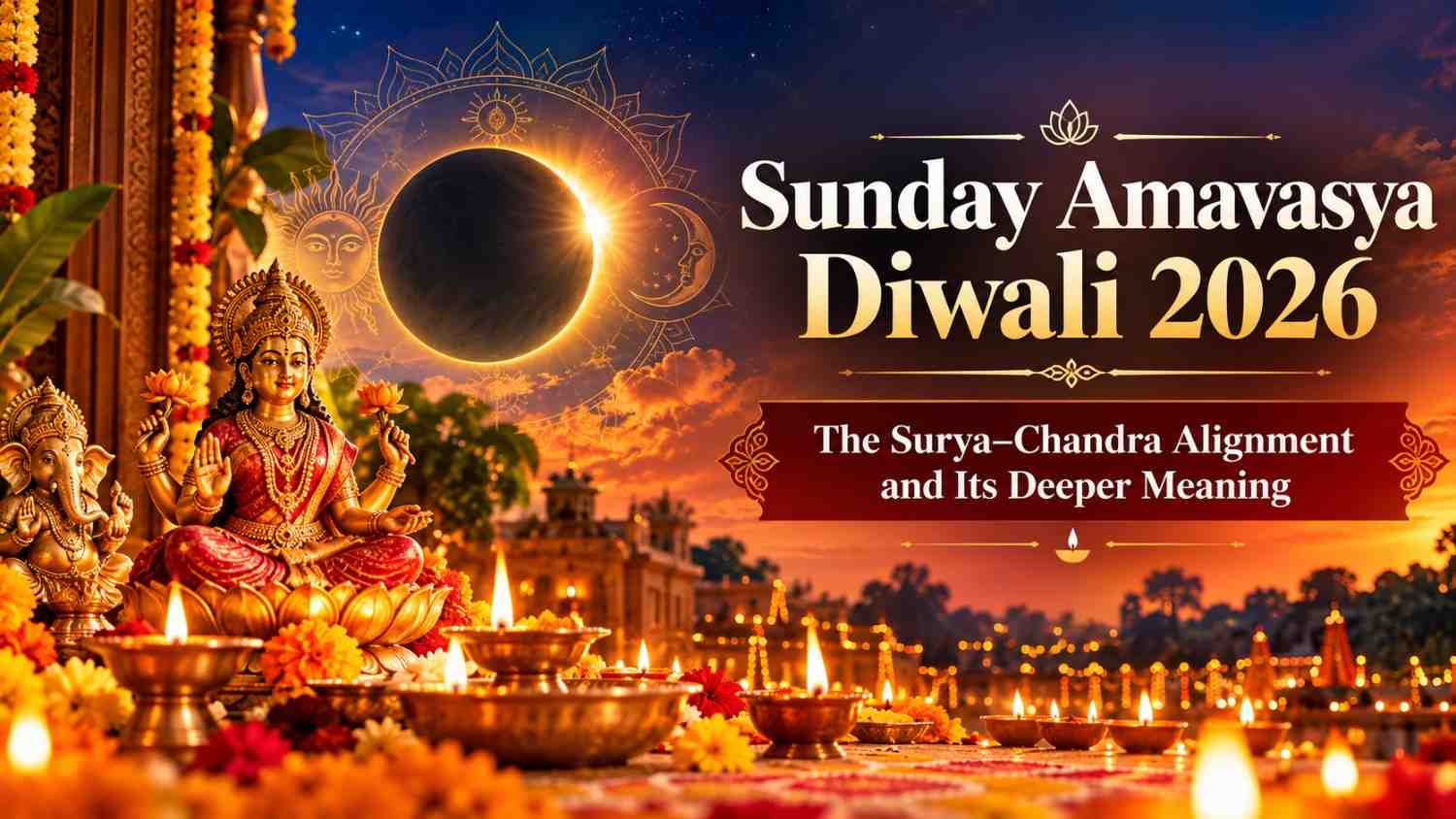
Diwali is a festival of lamps, prayer and new beginnings. In 2026, it falls on a Sunday, bringing together two powerful symbols in traditional Vedic astrology: Surya, the Sun associated with vitality and leadership, and Amavasya, the new-moon tithi associated with darkness, stillness and inward reflection.
This combination offers an interesting way to think about Diwali beyond decorations and celebrations. It invites us to consider what we want to illuminate in our lives, what we are ready to leave behind, and how we can move forward with greater clarity.
Diwali 2026: Quick Panchang Details
The timings below use Jaipur, Rajasthan, as the reference location. They should not be treated as universal timings for every Indian city.
Why Is Diwali 2026 Special for Astrology Enthusiasts?
Diwali is traditionally associated with the worship of Goddess Lakshmi and Lord Ganesha, the lighting of diyas and prayers for prosperity, wisdom and auspicious beginnings. The festival’s date follows the Hindu lunar calendar, which is why it does not fall on the same Gregorian date every year.
In 2026, Lakshmi Puja is observed on Sunday, 8 November. In the traditional planetary associations used in Vedic astrology, Sunday belongs to Surya. The festival also takes place during Amavasya, the new-moon tithi.
This is a meaningful symbolic combination to explore, but it is important to keep the distinction clear: the Sun’s weekday association and the spiritual interpretations of Amavasya belong to astrological and religious traditions. They do not establish that the date will guarantee a particular personal, financial or professional outcome.
What Is Amavasya? Understanding the New-Moon Tithi
Amavasya is the lunar tithi associated with the new moon. Around this phase, the Moon’s illuminated side is turned largely away from Earth, making it difficult to see in the night sky.
In Hindu traditions, Amavasya carries different meanings depending on the occasion and regional customs. It can be a time for prayer, remembrance, reflection and spiritual observances. During Diwali, Amavasya forms the setting for Lakshmi Puja and the lighting of lamps.
The darkness of the new-moon night is also a powerful festival metaphor. A diya does not remove every difficulty from life, but it gives us a way to express hope, devotion and the intention to begin again.
Sunday and Surya: The Symbolism of Light and Leadership
Surya, the Sun, holds an important place in Hindu traditions and Vedic astrology. Symbolically, Surya is associated with vitality, confidence, authority, self-respect, discipline and the ability to take responsibility.
When a festival of light falls on Sunday, these themes offer a useful lens for personal reflection. Instead of treating leadership only as power over others, we can think of it as the ability to direct our own attention, choices and conduct.
- Vitality: What helps you feel present, energetic and engaged with life?
- Clarity: Which decisions need more honesty or careful thought?
- Responsibility: Where can you act with greater consistency?
- Self-respect: Which boundaries or values deserve renewed attention?
These questions do not require you to believe that planetary positions determine your future. They can simply serve as a thoughtful framework for entering the festive season.
Surya and Chandra: Reading the Sun–Moon Relationship
Surya represents the Sun, while Chandra represents the Moon in Hindu cosmology and Vedic astrology. Their relationship is often used symbolically to explore contrasts such as outward action and inward experience, certainty and sensitivity, or visibility and reflection.
During Amavasya, the Sun and Moon are close together in the sky from an astronomical perspective. In astrology, this phase is interpreted through the symbolism of a new lunar cycle. Diwali adds another layer through its traditions of prayer, lamps and welcoming auspicious beginnings.
For this article, the central idea is simple: let outward ambition and inward reflection support one another. A new beginning can be more meaningful when it is accompanied by an honest understanding of what you want to change.
Diwali 2026 Panchang for Jaipur, Rajasthan
Panchang details help establish the traditional calendar context for a festival. The following information is presented for Jaipur and should be checked against a trusted local Panchang before making time-sensitive religious arrangements.
| Panchang Detail | 8 November 2026 |
|---|---|
| Festival | Diwali / Lakshmi Puja |
| Day (Vara) | Ravivara — Sunday |
| Paksha | Krishna Paksha leading into Amavasya |
| Tithi transition | Chaturdashi ends at approximately 11:28 AM; Amavasya follows |
| Amavasya begins | Approximately 11:27 AM on 8 November |
| Amavasya ends | Approximately 12:31 PM on 9 November |
| Nakshatra | Swati, listed for the full night in the cited Jaipur Panchang |
| Yoga | Ayushman, listed until approximately 3:02 AM on 9 November |
| Karana | Shakuni, listed until approximately 11:28 AM |
| Sunrise | Approximately 6:41 AM |
| Sunset | Approximately 5:39 PM |
| Moonrise | Approximately 5:38 AM |
| Moonset | Approximately 4:49 PM |
Diwali 2026 Shubh Muhurat in Jaipur
For Lakshmi Puja, the main listed muhurat in Jaipur is 6:03 PM to 7:59 PM on Sunday, 8 November 2026. This window falls within the listed Pradosh Kaal and Vrishabha Kaal.
| Muhurat | Jaipur Local Time | Traditional Context |
|---|---|---|
| Lakshmi Puja Muhurat | 6:03 PM – 7:59 PM | Main listed window for Lakshmi, Ganesha and Saraswati Puja |
| Pradosh Kaal | 5:40 PM – 8:16 PM | Evening period associated with twilight and traditional worship |
| Vrishabha Kaal | 6:03 PM – 7:59 PM | Fixed-sign ascendant period listed for the main puja window |
| Mahanishita Kaal | Approximately 11:45 PM – 12:37 AM on 9 November | A separate late-night period listed by the source |
The main Lakshmi Puja window is the most relevant timing for many households planning their Diwali worship. The late-night Mahanishita Kaal is a separate traditional observance window and may be relevant to particular practices or customs.
How to Use the Sunday Amavasya Theme for Personal Reflection
You do not need to make dramatic resolutions for Diwali to feel meaningful. A few intentional practices can help you connect the festival’s symbolism with your everyday life.
1. Light a diya with intention
As you light your lamps, take a moment to think about one quality you want to cultivate in the coming months: patience, courage, steadiness, gratitude or generosity. Let the ritual be a reminder of that intention.
2. Review the year honestly
Think about what went well, what was difficult and what you learned. Reflection is not about blaming yourself for every setback. It is about identifying what is within your control and deciding what deserves your attention next.
3. Set one practical goal
Choose a goal that can be translated into action. It could mean spending more time with family, building a healthier routine, managing money more carefully or following through on a project. A specific next step is often more useful than a long list of ambitious promises.
4. Make space for prayer and gratitude
Follow the customs of your household or tradition. Some families focus on Lakshmi and Ganesha Puja, while others include additional prayers, offerings or regional rituals. The form of worship may differ, but gratitude and thoughtful intention can remain central.
Is Sunday Amavasya Diwali Especially Auspicious?
Diwali is already an important religious festival, and Lakshmi Puja is traditionally performed during the appropriate Amavasya and evening muhurat. Sunday adds the traditional symbolism of Surya, making the combination an interesting theme for reflection on responsibility, confidence and renewal.
However, it would be misleading to claim that this date guarantees greater wealth, success, leadership or spiritual progress. Astrology is a traditional belief system, and individual outcomes depend on many factors. Use the symbolism as a source of reflection rather than as a promise of results.
Explore More Diwali Resources and Astrology on Shloka
As you prepare for the festival, explore Diwali-themed wallpapers, read your daily horoscope or connect with an astrologer if you want to discuss questions related to your personal circumstances.
Celebrate Diwali with Shloka
Find festive inspiration and explore astrology resources for the season.
Frequently Asked Questions
When is Diwali in 2026?
Diwali and Lakshmi Puja are observed on Sunday, 8 November 2026. The Amavasya tithi continues until around 12:31 PM on 9 November, according to the cited Jaipur Panchang.
What is the Lakshmi Puja muhurat for Diwali 2026 in Jaipur?
The listed Lakshmi Puja muhurat for Jaipur is 6:03 PM to 7:59 PM on 8 November 2026. Pradosh Kaal is listed as 5:40 PM to 8:16 PM. Timings are location-specific and should be checked against a trusted local Panchang.
What is the Amavasya tithi timing for Diwali 2026?
For the Jaipur Panchang reference used here, Amavasya begins at approximately 11:27 AM on 8 November 2026 and ends at approximately 12:31 PM on 9 November 2026.
What does Sunday Amavasya mean in Vedic astrology?
In traditional Vedic astrology, Sunday is associated with Surya, the Sun, while Amavasya marks the new-moon tithi. Their symbolism can be used as a prompt to reflect on vitality, responsibility, inwardness and renewal. These are traditional interpretations, not scientifically established predictions.
Are Diwali muhurat timings the same in every city?
No. Sunrise, sunset, Pradosh Kaal and Lagna-based muhurat timings vary by location. Always use a Panchang calculated for your city rather than applying Jaipur timings elsewhere.
Why is Amavasya important during Diwali?
Diwali’s Lakshmi Puja is traditionally performed during the Amavasya period. The new-moon setting gives the festival a strong symbolic connection with lighting lamps, welcoming prosperity and bringing light into darkness.
Final Thoughts: Let the Light Begin Within
Sunday Amavasya Diwali 2026 brings together the festival’s familiar message of light with the traditional symbolism of Surya and the new-moon tithi. It offers an opportunity to pause, reflect on the year behind you and choose how you want to move forward.
As you light your diyas on 8 November, let the celebration be more than a beautiful evening. Let it be a reminder to act with care, lead with integrity, appreciate what you have and make room for a thoughtful new beginning.

