
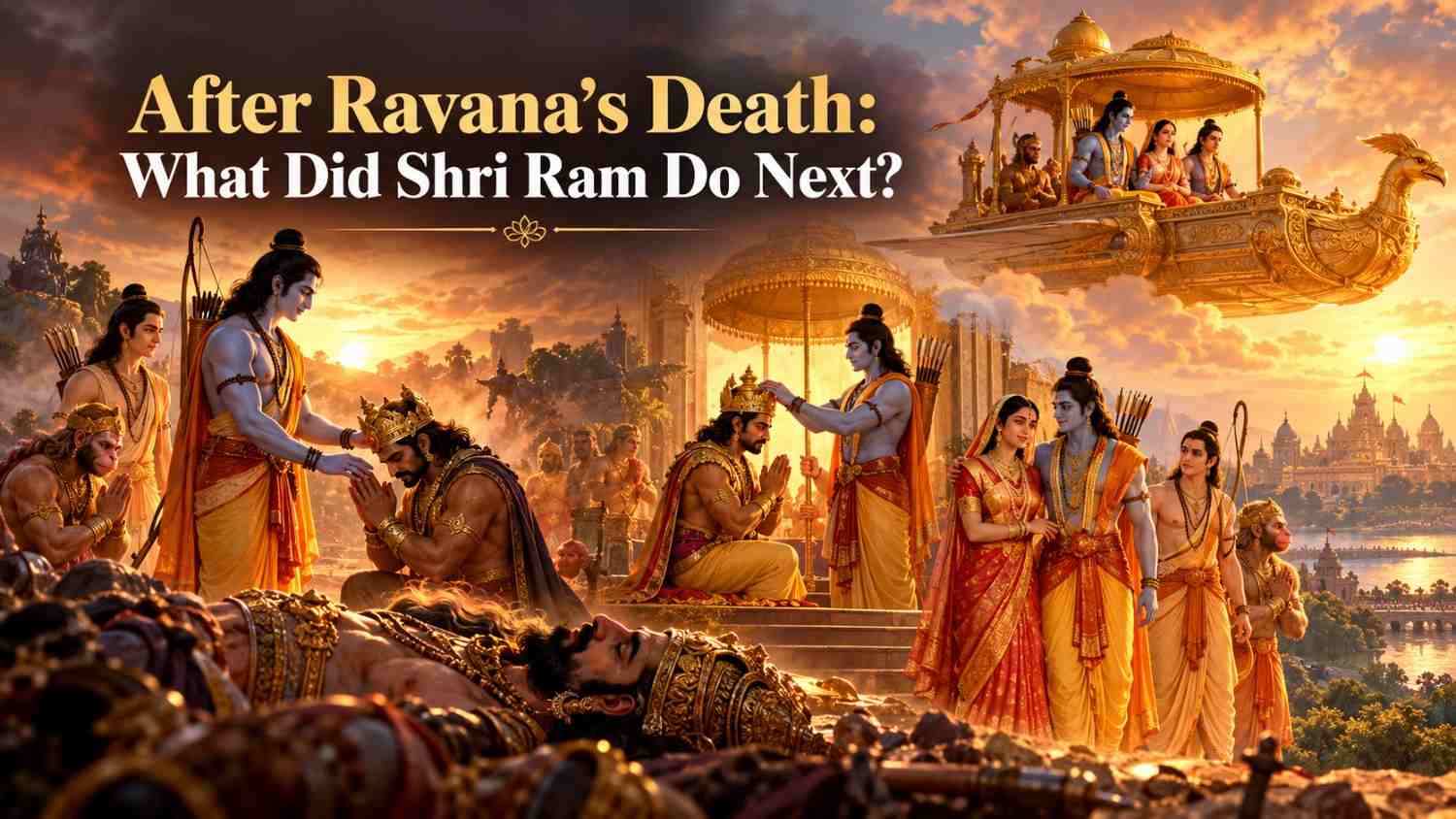
Ravana had fallen. The great war in Lanka was over. But what happened after Shri Ram defeated the king of Lanka? Did he return to Ayodhya immediately, or were there important events before his homecoming?
The story after Ravana’s death is about more than victory. It is also about duty, dignity, the restoration of order, the reunion of Shri Ram and Mata Sita, and the journey home. The Valmiki Ramayana describes these events in its account of the war and its aftermath. Read the Valmiki Ramayana summary.
What happened after Ravana’s death?
The main sequence in the Ramayana includes Ravana’s funeral rites, Vibhishana’s coronation as king of Lanka, Shri Ram and Sita’s reunion, and the journey toward Ayodhya in the Pushpaka Vimana.
1. The War Was Over, but Shri Ram’s Duty Continued
After Shri Ram defeated Ravana, the battle that had devastated Lanka came to an end. Yet the story did not stop at the fall of the enemy. Ravana’s death left a kingdom to govern, a family in mourning, and responsibilities that still needed to be fulfilled.
The next episode reveals an important principle in the narrative: victory does not mean that duty disappears. The events after the battle focus on the fallen king’s funeral, the future of Lanka, and Shri Ram’s reunion with Sita.
2. Why Did Shri Ram Allow Ravana’s Funeral Rites?
In the Valmiki Ramayana, Vibhishana grieves after seeing his brother Ravana defeated. He asks what should be done next. Shri Ram directs him to perform Ravana’s funeral rites, explaining that hostility ends with death.
This is one of the most striking moments after the war. Ravana had been Shri Ram’s adversary, but the fallen king was still to receive the rites due to him. The story places duty and dignity above continuing a cycle of hatred.
You can read this episode in the Valmiki Ramayana, Yuddha Kanda, Sarga 109.
3. Vibhishana Becomes the King of Lanka
Vibhishana had urged Ravana to return Mata Sita and abandon his unjust course. When Ravana refused, Vibhishana left Lanka and joined Shri Ram.
After Ravana’s defeat, Vibhishana was crowned king of Lanka. This marked a new chapter for the kingdom. Instead of claiming Lanka for himself, Shri Ram supported Vibhishana’s rule, restoring leadership to the kingdom after the war.
The coronation is included in the Valmiki Ramayana’s narrative summary, which also outlines Sita’s reunion with Shri Ram and the sighting of the Pushpaka Vimana.
4. Shri Ram and Mata Sita Reunite
With Ravana defeated, the narrative moves toward the reunion of Shri Ram and Mata Sita. Their separation had been central to the events that led to the war.
The reunion in the Valmiki Ramayana is a complex and solemn episode. It includes the episode traditionally known as Agni Pariksha. Different Ramayana retellings present and interpret these events in different ways, so readers should distinguish the account in a particular text from later regional and devotional interpretations.
5. The Pushpaka Vimana: The Journey Home Begins
After the events in Lanka, the story turns toward Ayodhya. The Pushpaka Vimana, a divine aerial vehicle, carries Shri Ram and his companions on the journey home.
The return is more than a change of location. It marks the movement from war and separation toward homecoming, reunion and the restoration of the life interrupted by exile. During the journey, the narrative recalls places connected with the events that brought Shri Ram to Lanka.
The Valmiki Ramayana’s Bala Kanda summary lists Ravana’s destruction, Sita’s recovery, Vibhishana’s coronation, the Pushpaka Vimana, the journey to Ayodhya and the reunion with Bharata.
6. The Journey Includes Sage Bharadwaja and a Message to Bharata
The return narrative includes a visit to Sage Bharadwaja’s hermitage. It also turns attention toward Bharata, who had waited for Shri Ram during the years of exile and governed in his brother’s name.
Shri Ram arranges for Hanuman to go ahead and inform Bharata of his return. This prepares the way for the reunion of the brothers and for Shri Ram’s return to the kingdom.
7. Why Bharata’s Waiting Matters
Bharata’s role gives the homecoming a deeper meaning. In the traditional narrative, he does not simply take Shri Ram’s place as king. He keeps Shri Ram’s sandals on the throne as a symbol of his brother’s rightful authority and waits for his return.
The story of Bharata’s vow is described in the Ayodhya Kanda, Sarga 115. It concerns Bharata’s life at Nandigrama and his commitment to await Shri Ram.
8. How Does This Story Connect to Diwali?
Diwali is widely associated in Hindu tradition with Shri Ram’s return to Ayodhya after exile and his victory over Ravana. The lighting of lamps is remembered as a sign of welcome, joy and the victory of light over darkness.
The story gives the festival a human meaning as well: a family is reunited, a long absence comes to an end, and a kingdom welcomes its rightful ruler.
One distinction matters for this series. The broad narrative links Dussehra with Ravana’s defeat and Diwali with Shri Ram’s homecoming, but a universally accepted scriptural event for every intervening calendar day is not established across all Ramayana traditions. This article follows the broad sequence of the text rather than inventing a separate event for every day.
Continue the Journey: From Dussehra to Diwali
This is Episode 1 in our Ramayana storytelling series. Next, discover why Vibhishana became king of Lanka and what his coronation tells us about leadership, justice and dharma.
Frequently Asked Questions
What happened after Ravana’s death?
After Ravana’s death, Vibhishana grieved and sought guidance about the funeral rites. Shri Ram instructed him to perform the rites. Vibhishana was crowned king of Lanka, and the narrative then moved toward Shri Ram’s reunion with Sita and their return journey.
Why did Shri Ram allow Ravana’s funeral?
In the Valmiki Ramayana, Shri Ram tells Vibhishana that hostility ends with death and that Ravana should receive his funeral rites. The episode is often understood as a lesson in duty and dignity toward a fallen adversary.
Who became king of Lanka after Ravana?
Vibhishana, Ravana’s younger brother, was crowned king of Lanka after Ravana’s defeat.
How did Shri Ram return to Ayodhya?
In the Ramayana, Shri Ram, Sita and Lakshmana travelled toward Ayodhya in the Pushpaka Vimana. The return narrative includes a visit to Sage Bharadwaja’s hermitage and a message to Bharata before their reunion.
What is the Pushpaka Vimana in the Ramayana?
The Pushpaka Vimana is a divine aerial vehicle in the Ramayana. It carries Shri Ram and his companions on the journey from Lanka toward Ayodhya after Ravana’s defeat.
Did Shri Ram return to Ayodhya exactly 20 days after Dussehra?
Diwali is traditionally associated with Shri Ram’s return to Ayodhya after exile. However, a universally accepted day-by-day chronology assigning a separate event to each intervening day between Dussehra and Diwali is not established across all Ramayana traditions.
Why is Diwali associated with Shri Ram’s return?
In a widely followed Hindu tradition, Diwali celebrates Shri Ram’s return to Ayodhya after exile and his victory over Ravana. Lamps symbolise welcome, joy and the victory of light over darkness.
Explore More on Shloka
Continue exploring Hindu traditions, festive stories and astrology resources as you prepare for Diwali.
