

Overview of Ashtavinayak Pilgrimage
The Ashtavinayak refers to a group of eight ancient temples dedicated to different forms of Lord Ganesha, all located in the state of Maharashtra. This pilgrimage circuit is one of the holiest for Ganesha devotees, encompassing temples each with unique legends, sculptures, and rituals.
The pilgrimage begins traditionally at the Mayureshwar Temple in Morgaon and proceeds to temples including Siddhatek, Ballaleshwar, Varadavinayak, Chintamani, Girijatmaj, Vighneshwar, and Mahaganapati. Each temple is linked to stories from Hindu epics that narrate Ganesha’s divine interventions.
Also read – Ganesh Chaturthi 2026 Date & Exact Sthapana Muhurat Time
📋 Table of Contents
Ashtavinayak Yatra Part 1: The Sacred Beginnings (Mayureshwar & Siddhivinayak)
When people think of spiritual journeys in India, massive river dips or Himalayan treks usually come to mind. But for devotees of Lord Ganesha, there is a distinct, deeply transformative pilgrimage circuit right in the heart of Maharashtra: The Ashtavinayak Yatra.
The term Ashtavinayak translates to “Eight Ganeshas.” Unlike ordinary temples, these eight ancient abodes are Swayambhu (self-manifested)—meaning the idols were not carved by human hands, but emerged naturally from the earth or rock formations in unique shapes endowed with divine energy.
If you are planning to embark on this sacred journey, you cannot simply visit these temples in any random order. There is an ancient, unwritten code you must follow.
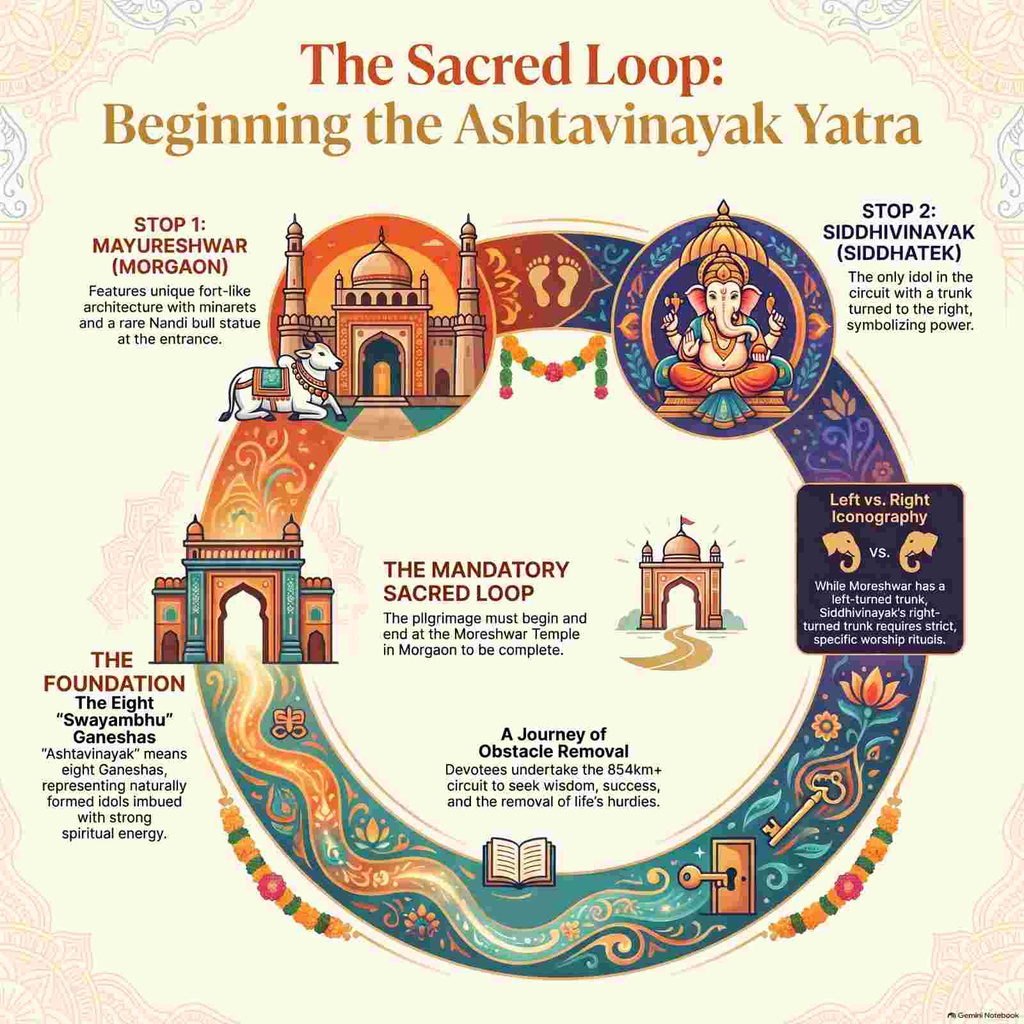
The Rule of the Sacred Loop: Why Sequence Matters
Before you visit even a single temple, you must understand the most sacred rule of the Ashtavinayak circuit: The pilgrimage is a closed loop.
- The Golden Rule: The Yatra must traditionally always begin at the Mayureshwar Temple in Morgaon and must always conclude back at Morgaon after visiting all eight temples.
- Failing to return to Morgaon to offer final prayers is traditionally believed to leave the pilgrimage incomplete.
- The entire circuit covers roughly 600 to 700 kilometers, typically taking 2 to 3 days by car when starting from Pune or Mumbai.
Let’s dive into the first two abodes that set the foundation of this divine journey.
1. Mayureshwar Temple (Morgaon) — The Starting Point
Located about 74 kilometers from Pune in the Baramati taluka, the Mayureshwar Temple (also known as Moreshwar) is the undisputed alpha and omega of the Ashtavinayak Yatra.
Quick Facts: Mayureshwar Temple
- Location: Morgaon, Pune District, Maharashtra
- Deity Form: Lord Ganesha as Mayureshwar (riding a peacock)
- Architecture: Bahamani-style black stone structure with four minarets and high walls resembling a fortress.
- Key Legend: Lord Ganesha defeated the demon Sindhurasura here while riding a divine peacock (Mayura).
The Legend and Architecture
The temple complex reflects a unique blend of Hindu and Islamic architectural styles, featuring four grand gateways guarded by stone Nandi bulls (a rare sight in a Ganesha temple, pointing to the deep cosmic bond between Ganesha and his father, Lord Shiva). Inside the sanctum, the idol is seated with its trunk turned to the left, flanked by brass statues of Riddhi and Siddhi (prosperity and spiritual attainment).
Pilgrim Tip: When you start your journey here, make a formal Sankalp (vow) before Lord Mayureshwar, declaring your intent to complete the entire circuit and return safely.
2. Siddhatek Temple (Siddhatek) — The Abode of Spiritual Accomplishment
From Morgaon, the traditional route heads southwest across the Bhima River to the Ahmednagar district to reach the second temple: Siddhivinayak Temple at Siddhatek. (Note: This is distinct from the famous Siddhivinayak Temple in Mumbai).
Quick Facts: Siddhatek Temple
- Location: Siddhatek, Karjat Taluka, Ahmednagar District
- Deity Form: Siddhivinayak (The Giver of Siddhi/Success)
- Distinct Feature: The idol’s trunk is turned entirely to the right.
- Key Legend: Lord Vishnu meditated here for ages to gain divine powers (siddhis) to defeat the demon twins Madhu and Kaitabha.
The Rare Right-Trunked Idol
While most home Ganesha idols feature a left-facing trunk, Siddhatek houses a rare right-trunked (Dakshinabhimukhi) form. In Vedic tradition, right-trunked Ganeshas are considered extraordinarily powerful, strict, and quick to manifest spiritual boons, requiring high devotion and disciplined ritual conduct from visiting pilgrims.
The temple is peacefully nestled on a small hillock (tekdi) on the banks of the river Bhima. Walking around the temple hill (Pradakshina) is a deeply meditative experience, though devotees must navigate a brisk climb surrounded by local wildlife and serene river views.
Planning Your Yatra? Ask Our AI Astrologer
Embarking on a sacred pilgrimage is a major life step. Choosing the right auspicious muhurat to start your journey can maximize your spiritual alignment and clear obstacles from your path.
Planning your Ashtavinayak Yatra?
Find the most auspicious date and time to begin your journey, or ask questions about temple routes and planetary alignments based on your Kundli.
Ashtavinayak Yatra Part 2: Devotion and Boons (Ballaleshwar & Varadavinayak)
Continuing our sacred journey along the Ashtavinayak circuit, Part 2 brings us deep into the lush, mountainous terrains of the Raigad district.
If Part 1 introduced you to the grand beginning and the strict rules of the sacred loop, this leg of the pilgrimage shifts the focus from raw divine power to raw human emotion—specifically, unwavering faith, unconditional surrender, and eternal protection.
Let’s explore temples 3 and 4 of the sacred circuit.
3. Ballaleshwar Temple (Pali) — The Shrine Named After a Devotee
Located about 30 kilometers southeast of Karjat in the village of Pali, the Ballaleshwar Temple holds a unique distinction: it is the only Ashtavinayak temple in the entire circuit named after a human devotee rather than an attribute of Lord Ganesha.
Quick Facts: Ballaleshwar Temple
- Location: Pali, Sudhagad Taluka, Raigad District
- Deity Form: Ballaleshwar (The Lord of Ballal)
- Distinct Feature: The idol faces east, and the morning sunrays naturally fall directly on Ganesha’s diamond-studded eyes during worship.
- Key Legend: Named after a young boy named Ballal, whose intense devotion to Ganesha withstood parental anger and severe punishment.
The Touching Legend of Young Ballal
According to the Mudgala Purana, a young boy named Ballal, son of a wealthy merchant in Pali, became so deeply absorbed in worshiping clay idols of Ganesha that he neglected his studies and worldly duties. Angered by this obsession, Ballal’s father beat him severely, tied him to a tree in a dense forest, and left him to die of hunger and thirst.
Despite his agony, Ballal kept chanting Ganesha’s name. Deeply moved by this pure, unconditional surrender, Lord Ganesha manifested in person, healed the boy’s wounds, and granted him a permanent boon. When Ballal requested that Ganesha reside there forever, the Lord took the form of a stone idol and declared that his own name would forever be prefixed to Ballal’s—hence, Ballaleshwar.
Unique Architecture at Pali
The temple itself is a marvel of architecture. Built entirely of stone with a massive bell brought back as a war trophy by the Peshwas from the Portuguese in Vasai, the temple is strategically designed so that the morning sun illuminates the sanctum directly.
Pilgrim Tip: When visiting Pali, notice the two distinct shrines within the complex: one houses the primary self-manifested Ganesha idol, while the other houses a smaller “Dhundi Vinayak” idol that is traditionally worshipped first before entering the main sanctum.
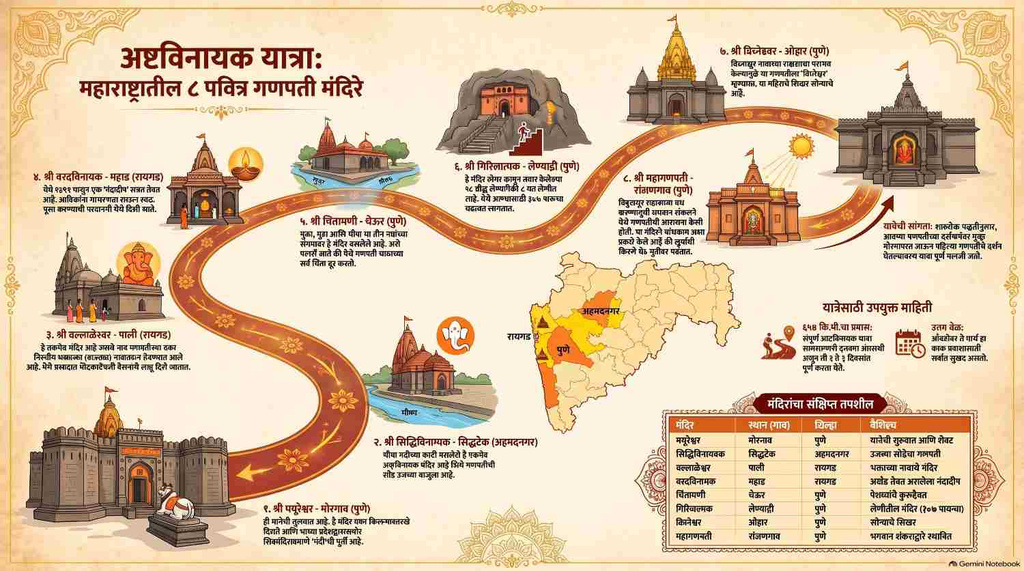
4. Varadavinayak Temple (Mahad) — The Home of the Eternal Flame
From Pali, the journey moves northwest toward the village of Mahad in the Khalapur taluka, nestled quietly amidst scenic groves and hills. Here lies the Varadavinayak Temple, renowned as the giver of boons (Varada) and success.
Quick Facts: Varadavinayak Temple
- Location: Mahad village, Khalapur Taluka, Raigad District
- Deity Form: Varadavinayak (Fulfiller of Desires and Boons)
- Distinct Feature: Home to the *Nandadeep*—an oil lamp that has burned continuously without interruption since 1892.
- Key Legend: Associated with the tragic curse of King Gritsamada and the divine granting of the kingdom of Brahmaloka.
The Legend of King Gritsamada
Legend states that Sage Gritsamada, through intense penance, realized his divine potential. However, a jealous demon cursed him, creating a demon son named Vichitrasura. After a fierce battle where Vichitrasura was defeated, Gritsamada prayed to Lord Ganesha for absolute peace and liberation from negative karma. Pleased by his prayers, Ganesha blessed the land, making it a sacred spot where anyone who worships Varadavinayak with a pure heart has all their legitimate wishes fulfilled.
The Sacred Nandadeep Experience
Unlike many heavily commercialized temples, Varadavinayak retains a peaceful, village-like serenity. The most striking element inside the sanctum is the Nandadeep—a brass oil lamp that has remained lit 24 hours a day, 365 days a year, since 1892. Sitting in front of this flame for a few moments of silent meditation is a deeply grounding experience for tired pilgrims.
Have Questions About Your Yatra or Personal Doshas?
Planning a pilgrimage across rough mountain terrains requires mental and physical clarity. If you are facing obstacles in your personal life or career and want to know how planetary alignments affect your spiritual pursuits:
Seeking wish fulfillment or clarity?
Ask our AI Astrologer about remedial rituals, obstacle removal, or the ideal astrological muhurat for your next major life step.
Ashtavinayak Yatra Part 3: Tranquility and Rock-Cut Wonders (Chintamani & Girijatmaj)
Crossing the halfway mark of the Ashtavinayak Yatra, Part 3 brings a distinct shift in both landscape and spiritual energy. Having witnessed the raw devotion at Pali and the eternal flame at Mahad, you now step into regions defined by deep mental peace, river confluences, and ancient rock-cut architecture.
Let’s explore temples 5 and 6 of the sacred circuit.
5. Chintamani Temple (Theur) — The Reliever of Mental Anxiety
Located about 25 kilometers from Pune at the confluence (Sangam) of the Mutha, Mula, and Indrayani rivers, the Chintamani Temple in Theur is one of the most revered and heavily visited shrines in the entire circuit.
Quick Facts: Chintamani Temple
- Location: Theur, Haveli Taluka, Pune District
- Deity Form: Chintamani (The Dispeller of Worries and Material Attachments)
- Distinct Feature: The idol faces east, with diamond eyes that catch the morning light. It is deeply associated with the Peshwa dynasty of the Maratha Empire.
- Key Legend: Lord Ganesha recovered the wish-fulfilling jewel (*Chintamani*) from the greedy sage Kapila here.
The Legend of the Chintamani Jewel
According to mythology, a sage named Kapila possessed the divine Chintamani jewel, which could grant any wish. A greedy king named Gana stole it. When Kapila prayed to Lord Ganesha for help, Ganesha defeated the king and restored the jewel. However, Kapila offered the jewel back to Ganesha, placing it around his neck—giving the deity the name Chintamani, the one who removes all worries (Chinta) from the minds of his devotees.
Deep Historical Ties to the Peshwas
Theur is also famous for its deep historical ties to Madhavrao Peshwa, one of the greatest rulers of the Maratha Empire. During his final days of failing health, Madhavrao Peshwa spent considerable time in prayer and meditation at this very temple. Today, the peaceful riverbank setting makes it an ideal spot for pilgrims to sit quietly, meditate, and unburden their minds of daily stress.
6. Girijatmaj Temple (Lenyadri) — The Cave Temple on the Hill
From Theur, the pilgrimage heads north toward Junnar in the Pune district, leading to one of the most visually stunning and physically unique shrines in the circuit: Girijatmaj Temple at Lenyadri.
Quick Facts: Girijatmaj Temple
- Location: Lenyadri, Junnar Taluka, Pune District
- Deity Form: Girijatmaj (The Son of Parvati / Girija)
- Distinct Feature: The only Ashtavinayak temple carved entirely out of a single rock inside an ancient Buddhist cave mountain.
- Access: Pilgrims must climb approximately 307 rock-cut steps carved into the hillside.
The Architectural Marvel of Lenyadri
Lenyadri translates to “Mountain Cave.” This temple is part of a cluster of nearly 30 rock-cut Buddhist caves dating back to the 1st to 3rd centuries CE. Long before it became a Hindu pilgrimage site, ascetics meditated in these hills.
To reach the sanctum, you must climb 307 stone steps up the hill. Once inside, you enter a massive, pillarless hall (Sabhamandapa) carved directly out of solid basalt rock. Because the inner sanctum has no windows, the entire hall is lit entirely by natural sunlight pouring through the large front entrance, creating a deeply mystical, echoing acoustic environment where even a quiet chant reverberates powerfully.
The Legend of Goddess Parvati’s Penance
According to the Mudgala Purana, Goddess Parvati (Girija) performed severe penance on this hill for 12 years to beget Lord Ganesha as her son. Pleased by her devotion, Ganesha promised to be born as her child here. Sitting inside this cave temple offers a humbling reminder of ancient Indian engineering, rock-cut artistry, and deep spiritual resolve.
Seeking Inner Peace or Clarity? Ask Our AI Astrologer
Whether you are carrying the mental weight of career stress, financial uncertainty, or navigating major life transitions, tuning your energy can help clear obstacles.
Looking to clear mental stress or life roadblocks?
Ask our AI Astrologer how planetary transits affect your peace of mind, and discover personalized Vedic remedies for obstacle removal.
shtavinayak Yatra Part 4: Overcoming Obstacles & Concluding the Loop (Vighneshwar & Mahaganapati)
Welcome to the grand finale of the Ashtavinayak Yatra. In Part 4, we complete the final two abodes of the sacred circuit, master the vital rule of closing the loop, and provide practical travel tips to ensure your pilgrimage is smooth, spiritually fulfilling, and properly completed.
Let’s explore temples 7 and 8 of the circuit.
7. Vighneshwar Temple (Ozar) — The Remover of Major Obstacles
Located on the banks of the Kukadi River in the Junnar taluka of Pune district, the Vighneshwar Temple in Ozar is renowned as the ultimate remover of deep-seated, formidable life obstacles (Vighna).
Quick Facts: Vighneshwar Temple
- Location: Ozar, Junnar Taluka, Pune District
- Deity Form: Vighneshwar (The Lord of Obstacles)
- Distinct Feature: Features a striking golden summit (*kalash*) and wide stone fortifications that give it a grand, royal appearance.
- Key Legend: Built to celebrate Ganesha’s defeat of the arrogant demon Vighnasura, who created chaos in the universe.
The Legend of Vighnasura
According to ancient lore, the demon Vighnasura was created by King Abhinandana to disrupt a sacrificial ritual. However, Vighnasura went rogue, actively destroying all religious ceremonies and creating obstacles for sages and gods alike. When the deities prayed for deliverance, Lord Ganesha intervened and defeated the demon. Pleading for mercy, Vighnasura requested that Ganesha take his name as well—hence, the Lord became Vighneshwar, with the strict condition that the demon’s name would only be invoked alongside Ganesha’s to neutralize all negative forces.
8. Mahaganapati Temple (Ranjangaon) — The Powerhouse of Spiritual Energy
The final stop on the primary temple visits is the Mahaganapati Temple at Ranjangaon, located in the Shirur taluka of Pune district. This temple represents supreme cosmic power, strength, and spiritual cleansing.
Quick Facts: Mahaganapati Temple
- Location: Ranjangaon, Shirur Taluka, Pune District
- Deity Form: Mahaganapati (The Ten-Armed, Fiercely Powerful Form of Ganesha)
- Distinct Feature: Built in the classic 9th-to-10th-century Maratha architectural style, designed so that the equinox sunrays fall directly onto the idol.
- Key Legend: Associated with Lord Shiva worshipping Ganesha before defeating the demon Tripurasura.
The Legend of Tripuraharana Ganpati
Before Lord Shiva set out to destroy the three flying citadels of the demon Tripurasura (Tripurapura), he inadvertently forgot to pray to Ganesha. His chariot wheel promptly stuck in the mud, rendering him helpless. Realizing his omission, Shiva prayed to Ganesha as Mahaganapati, instantly clearing the obstacle and securing his victory.
The idol here is depicted in a fierce, majestic posture with ten arms, radiating intense spiritual authority.
The Most Critical Step: Closing the Sacred Loop
Visiting Ozar and Ranjangaon completes your tour of all eight distinct abodes, but your Yatra is not officially finished yet.
- The Final Requirement: To properly close the karmic loop of the circuit, tradition dictates that you must travel back to the Mayureshwar Temple in Morgaon (where you started in Part 1) to offer a final prayer of gratitude, surrender your journey results, and seek completion (Purnahuti).
- Skipping this return visit is traditionally believed to leave the spiritual circuit incomplete.
Practical Travel Tips for Modern Pilgrims
To ensure your multi-day road trip runs smoothly across Maharashtra’s rural and hilly terrains, keep these tips in mind:
- Best Time to Visit: Plan your trip between November and March, when the weather across Pune, Ahmednagar, and Raigad is cool and pleasant. Avoid peak summer afternoons when climbing hill shrines like Lenyadri becomes exhausting.
- Vehicle Preparation: Ensure your car is serviced, as some remote stretches between Pali, Mahad, and Lenyadri involve narrow winding ghat roads.
- Dress Code: Traditional attire is preferred inside the inner sanctums. Men should wear a dhoti or kurta-pyjama at certain strict shrines, and women should wear sarees or modest salwar kameez.
- Cash is King: While digital payments are growing, many smaller rural temple stalls, shoe-keeping counters, and prasad vendors still rely heavily on cash.
Need Guidance on Your Spiritual Journey or Life Decisions?
Completing a sacred pilgrimage cleanses the spirit, but navigating life’s everyday hurdles requires continuous clarity.
Looking for lifetime obstacle removal or personalized guidance?
Ask our AI Astrologer for tailored remedies, planetary insights, or the best auspicious timing for your next major milestone.
Lesser-Known Ganesha Temples in India
1. Trinetra Ganesh Temple, Ranthambore, Rajasthan
Nestled within the UNESCO heritage Ranthambore Fort, this rare temple features a unique three-eyed Ganesha idol. It is one of the few that also houses statues of his parents, Shiva and Parvati, along with his mouse vehicle. The temple holds special significance as part of the Ashtavinayak pilgrimage and is said to be the place where Parvati performed penance to beget Ganesha.
2. Girijatmaj Temple, Lenyadri, Maharashtra
Set in ancient rock-cut Buddhist caves near Junnar, this temple is unique in being the only cave temple dedicated to Ganesha. The idol is carved from a single rock and the temple faces south, which is uncommon. It is part of the Ashtavinayak circuit and holds deep spiritual importance as a place of divine birth and penance.
3. Dholkal Ganesha, Dantewada, Chhattisgarh
Located on a hilltop amidst dense forests at 3,000 feet elevation, this granite idol is over a millennium old. The idol is known for its distinctive adornment of chains instead of the usual sacred thread. Local legends link this temple to fierce battles involving Ganesha, marking it as a site rich with mythology and natural beauty.
4. Titwala Siddhivinayak Temple, Maharashtra
Known for its self-manifested idol, this temple offers a peaceful atmosphere for spiritual reflection away from Mumbai’s urban rush. Legend speaks of the idol emerging naturally from the earth, casting a mystical aura over the temple surroundings. Its rural and hill-surrounded setting provides devotees an authentic experience.
5. Ballaleshwar Temple, Pali, Maharashtra
Devotees uniquely name this Ashtavinayak temple after the young devotee Ballala rather than Lord Ganesha himself, honoring Ballala’s unwavering faith and devotion. It celebrates the touching story of unwavering devotion and humility, symbolizing the power of faith over status.
6. Vinayagar Temple, Pillaiyarpatti, Tamil Nadu
Carved from a single rock about 1,600 years ago, this ancient temple houses a massive six-foot-tall Ganesha idol. The rock-cut architecture and ritual traditions here are notable examples of South India’s rich religious heritage and artistic excellence.
7. Ganesh Tok Temple, Gangtok, Sikkim
Perched atop a hill in Sikkim’s serene landscape, this temple offers spectacular views of the Kanchenjunga mountains. It is a less frequented spiritual site where devotees enjoy natural beauty alongside their worship, blending Himalayan tranquility with devotion.
Unique Features of Lesser-Known Ganesha Temples
Pilgrims find many temples situated in remote or hilly locations, which spiritually cleanse them during their pilgrimage. Many devotees revere idols that self-manifest (Swayambhu), enhancing these temples’ mystical appeal.
- Temples integrate natural rock formations and caves as sanctums, reflecting ancient Indian rock-cut architectural traditions.
- Rich local myths augment the temples’ spiritual significance, adding layers of cultural heritage.
- Rituals tend to be more traditional and intimate compared to larger temples, allowing for personal reflection.
Conclusion
Ganesha temples in India, from the widely visited Siddhivinayak in Mumbai to the sacred Ashtavinayak circuit in Maharashtra, stand testament to the god’s appeal and spiritual significance. These temples not only symbolize divine blessings for removing obstacles but also embody India’s rich tapestry of architecture, mythology, and cultural traditions.
For devotees, each visit is more than just worship; it is a pilgrimage of faith, community, and self-realization. Through these temples, Lord Ganesha continues to inspire millions with his qualities of wisdom, courage, and benevolent grace.
Conclusion: The Transformative Power of the Ashtavinayak Yatra
The Ashtavinayak pilgrimage is far more than a simple road trip across Maharashtra; it is a profound journey of surrender, spiritual cleansing, and divine connection. From the fortress-like walls of Morgaon to the ancient rock-cut caves of Lenyadri and the fierce majesty of Ranjangaon, each of the eight abodes reveals a different facet of Lord Ganesha—the Vighnaharta who removes obstacles and guides us toward wisdom.
By respecting the sacred order, closing the loop back where you started, and maintaining a humble heart, this Yatra leaves an indelible mark on every devotee. Whether you complete the circuit in a single weekend or take your time across multiple visits, the blessings of Bappa remain for a lifetime.
Explore More Festival & Pilgrimage Guides
Frequently Asked Questions (Ashtavinayak Yatra)
Planning your pilgrimage? Here are the answers to the most common questions asked by devotees embarking on the Ashtavinayak circuit.
1. What is the correct sequence to visit the Ashtavinayak temples?
The traditional and mandatory sequence is: 1. Mayureshwar (Morgaon) -> 2. Siddhatek (Siddhatek) -> 3. Ballaleshwar (Pali) -> 4. Varadavinayak (Mahad) -> 5. Chintamani (Theur) -> 6. Girijatmaj (Lenyadri) -> 7. Vighneshwar (Ozar) -> 8. Mahaganapati (Ranjangaon). After visiting Ranjangaon, you must return to Morgaon to officially complete the circuit.
2. Why must we return to Morgaon at the end of the Yatra?
Returning to the Mayureshwar Temple in Morgaon closes the karmic loop of the pilgrimage. Offering final prayers where you started signifies the successful completion (Purnahuti) of your vow (Sankalp).
3. How many days does it take to complete the Ashtavinayak Yatra?
Most pilgrims complete the entire circuit in 2 to 3 days by car when starting from Pune or Mumbai. However, some devotees prefer a relaxed 4-to-5-day pace to spend more time in meditation at each temple.
4. What is the total distance covered during the Ashtavinayak circuit?
The total driving distance covers approximately 600 to 700 kilometers, depending on your starting point in Pune or Mumbai and the exact routes taken through the rural and hill roads of Maharashtra.
5. Which is the best time of the year to visit the Ashtavinayak temples?
The winter months between November and March offer the most pleasant weather for travel and climbing hill shrines like Lenyadri. Summers in Maharashtra can be intensely hot.
6. Are all the Ashtavinayak idols Swayambhu (self-manifested)?
Yes, all eight idols across the Ashtavinayak circuit are naturally occurring (Swayambhu) formations shaped like Ganesha, often found underground, in water bodies, or inside rock caves.
7. Which temple is located inside a cave?
The Girijatmaj Temple at Lenyadri is the only Ashtavinayak shrine carved entirely out of a single rock inside an ancient Buddhist cave complex on a hillside requiring a climb of 307 steps.
8. Which temple is named after a human devotee?
The Ballaleshwar Temple at Pali is named after a young devotee named Ballal, whose intense, unwavering devotion moved Lord Ganesha to permanently attach his name to the shrine.
9. Is there a dress code for visiting the Ashtavinayak temples?
Yes, traditional and modest attire is strongly recommended. Men are often required to wear a dhoti or kurta-pyjama for entering the inner sanctum at certain temples, and women should wear traditional sarees or salwar kameez.
10. Can senior citizens easily visit all eight temples?
Most temples are easily accessible by vehicle. However, Girijatmaj (Lenyadri) requires climbing over 300 rock-cut steps, which can be strenuous for elderly or physically challenged devotees (though palanquin/doli services are sometimes available locally).
11. What is the significance of the Nandadeep at Varadavinayak Mahad?
The Nandadeep is a sacred oil lamp that has burned continuously without interruption since 1892, symbolizing eternal divine presence and wish fulfillment.
12. Do any temples feature a right-facing trunk?
Yes, the Siddhatek Temple features a rare right-trunked (Dakshinabhimukhi) idol, which is traditionally considered exceptionally powerful and strict in its spiritual discipline.
13. Are electronic payments accepted at the temples?
While digital donations and major trusts accept online payments, it is strongly advised to carry sufficient cash for small prasad stalls, shoe-keeping counters, and rural toll roads along the route.
14. Can the Ashtavinayak Yatra be completed via public transport?
Yes, Maharashtra State Transport (ST) buses and private tour operators run dedicated Ashtavinayak packages from Mumbai and Pune, though hiring a private cab offers much greater flexibility and time management.
15. What offerings are traditionally made to Lord Ganesha during the Yatra?
Devotees traditionally offer Modaks, Laddoos, fresh red hibiscus flowers, coconut, and Durva grass (21 blades) at each temple shrine.
📚 References & Recommended Reading
To deepen your spiritual practice, plan your festival rituals, or explore further sacred journeys dedicated to Lord Ganesha, explore our complete library of guides:
- Ganesh Chaturthi 2026 Date, Exact Sthapana Muhurat & City-Wise Timings — Learn the precise Panchang dates, Madhyahna Sthapana windows, and Mithya Dosha remedies.
- Ganesh Chaturthi 2026 Puja Vidhi, Samagri List & Visarjan Choghadiya Dates — Step-by-step home worship instructions and day-wise festival immersion schedules.
- Puranic Texts & Scriptures: Traditional legends of the Ashtavinayak circuit are referenced from the Mudgala Purana and Ganesha Purana.


1 Comment