Your zodiac sign might tell you that you are a Leo, a Virgo, or a Pisces. But have you ever wondered why your personality does not always match your horoscope?
Perhaps you are a confident Aries who needs plenty of alone time. Maybe you are a practical Capricorn who feels everything deeply. Or perhaps people see you as outgoing, even though you are much more reserved once they get to know you.
In astrology, your Sun sign is only one part of your birth chart. Your Moon sign and Rising sign add two more perspectives on your identity, emotional nature, and approach to life. Together, these three placements are known as your Big Three in astrology.
If you have been searching for “sun moon and rising sign” or wondering “what are my Big Three?”, this guide explains what each placement means, how they differ, and what you need to discover yours.
Explore Your Zodiac Profile
Start exploring astrology with Shloka. Learn about zodiac signs, relationships, and the traditional interpretations astrologers use to understand connections between signs.
Explore Zodiac CompatibilityWhat Are the Big Three in Astrology?
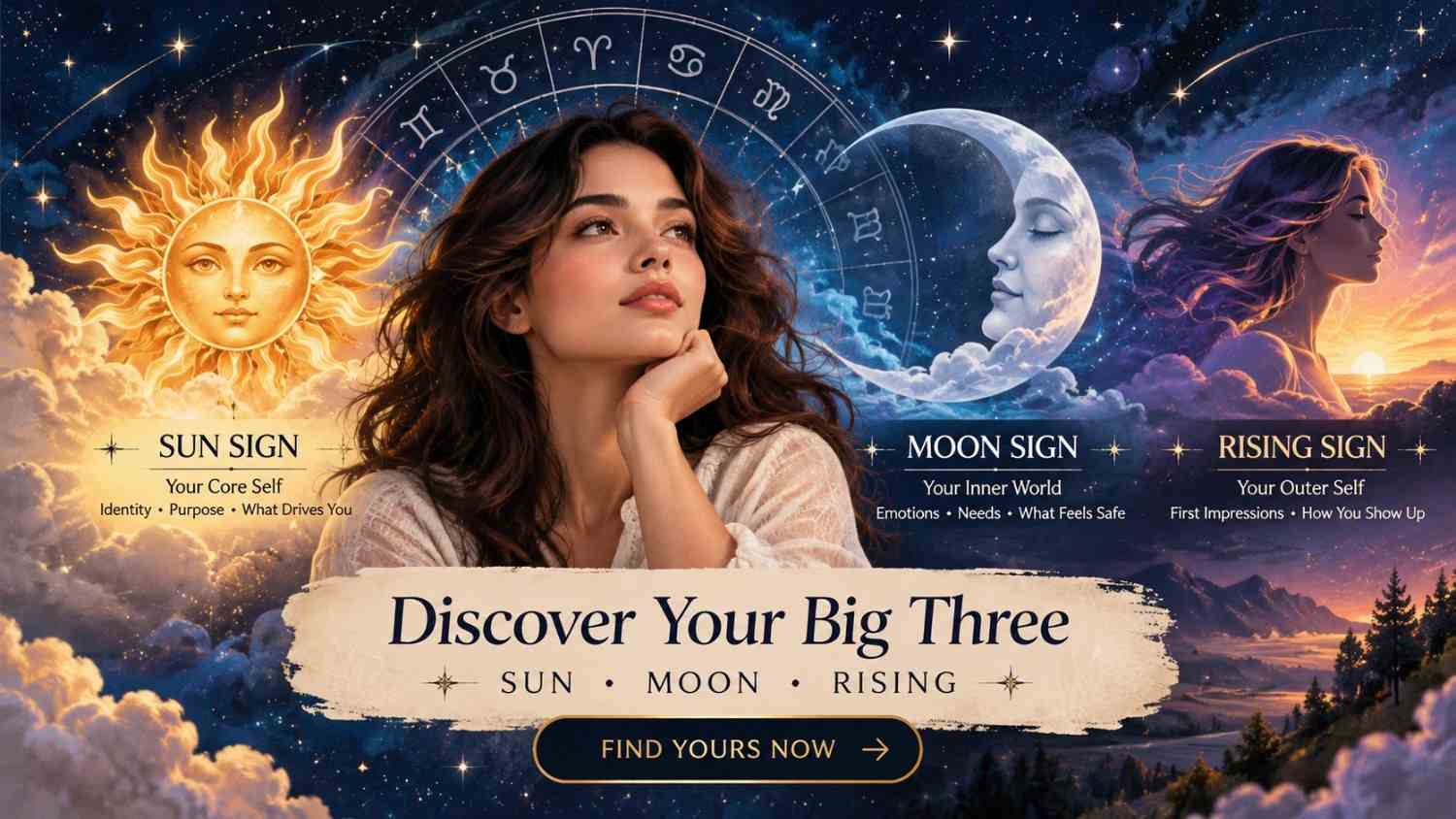
The Big Three refers to three placements in your astrological birth chart: your Sun sign, Moon sign, and Rising sign. Astrologers interpret each placement as representing a different dimension of your life and personality.
- Sun sign: Your core identity, individuality, and sense of purpose.
- Moon sign: Your emotions, instincts, and inner needs.
- Rising sign: Your approach to new situations, outward presentation, and the beginning of your astrological houses in many chart systems.
Consider someone with a Leo Sun, Pisces Moon, and Capricorn Rising. In traditional astrology, their Leo Sun might suggest expressive qualities, their Pisces Moon might be associated with emotional sensitivity, and their Capricorn Rising might suggest a more measured first impression.
These placements do not cancel one another out. Instead, astrologers interpret them together as parts of a larger chart. Your Big Three are a useful starting point, although the rest of your chart adds further detail.
1. What Is My Sun Sign?
Your Sun sign is the zodiac sign most people mean when they ask, “What’s your sign?” It is based primarily on the position of the Sun at the time of your birth.
In astrology, the Sun is associated with your core identity, vitality, individuality, and the qualities you may consciously develop throughout your life.
What Does Your Sun Sign Mean?
Astrologers use the Sun sign to explore themes such as your personal motivations, sense of self, ambitions, and preferred ways of expressing your individuality.
For example, Aries is traditionally associated with initiative and courage, while Taurus is associated with persistence and stability. Gemini is linked with curiosity and communication, while Cancer is associated with emotional awareness and nurturing.
These are traditional astrological interpretations, not fixed personality rules. Your Sun sign alone cannot describe every aspect of who you are.
How Do I Find My Sun Sign?
Your date of birth will usually identify your Sun sign. However, if you were born near the date when the Sun changes signs, the exact year and time of birth may matter.
| Zodiac Sign | Approximate Dates |
|---|---|
| Aries | March 21 – April 19 |
| Taurus | April 20 – May 20 |
| Gemini | May 21 – June 20 |
| Cancer | June 21 – July 22 |
| Leo | July 23 – August 22 |
| Virgo | August 23 – September 22 |
| Libra | September 23 – October 22 |
| Scorpio | October 23 – November 21 |
| Sagittarius | November 22 – December 21 |
| Capricorn | December 22 – January 19 |
| Aquarius | January 20 – February 18 |
| Pisces | February 19 – March 20 |
These dates are approximate and refer to the commonly used tropical zodiac. Exact sign boundaries vary from year to year.
Your Sun sign is a good place to begin, but understanding your Moon and Rising signs can give you more context within an astrological reading.
2. What Is My Moon Sign?
Your Moon sign is the zodiac sign occupied by the Moon at your birth. In astrology, the Moon is associated with emotions, instinctive reactions, comfort, and your inner world.
Unlike the Sun, which spends roughly a month in each zodiac sign, the Moon changes signs approximately every two to three days. This means people born under the same Sun sign can have very different Moon signs.
What Does Your Moon Sign Tell You?
Traditionally, the Moon sign is interpreted through themes such as emotional needs, personal comfort, reactions to stress, and the ways you seek security.
For example, Cancer Moon is often associated with sensitivity and a desire for emotional security. Aquarius Moon is commonly associated with independence and an intellectual approach to feelings.
Neither placement is better than the other. They represent different symbolic themes within astrology.
How Do I Find My Moon Sign?
You generally need your date of birth, birthplace, and birth time to calculate your Moon sign accurately. If the Moon changed signs around your birth, the exact time can determine which sign applies.
Once you know your Moon sign, you can explore its traditional meaning alongside your Sun sign rather than interpreting either placement in isolation.
3. What Is My Rising Sign?
Your Rising sign, also called your Ascendant, is the zodiac sign rising over the eastern horizon at the time and place of your birth.
Because the Earth rotates, the Rising sign changes throughout the day. It typically changes signs approximately every two hours, although the timing varies by location and sign. This makes your birth time especially important.
What Does Your Rising Sign Mean?
Astrologers associate the Rising sign with how you approach unfamiliar situations, the impression you make, and your initial way of engaging with the world.
For example, Libra Rising is traditionally associated with diplomacy and an appreciation for harmony. Scorpio Rising is often associated with intensity, privacy, and observation.
These interpretations are not guarantees of how you look, behave, or interact with others.
Why Your Rising Sign Can Feel Different From Your Sun Sign
Imagine someone with a Sagittarius Sun and Virgo Rising. Sagittarius is traditionally associated with exploration and enthusiasm, while Virgo is associated with observation, organisation, and attention to detail.
Astrologers might interpret this combination as a blend of exploratory motivations and a more methodical approach to new experiences.
Your Ascendant also establishes the starting point for the twelve houses in many astrological systems, making it important to a broader birth chart interpretation.
How Do I Find My Rising Sign?
You need your date of birth, exact birth time, and birthplace. An inaccurate birth time can produce an incorrect Ascendant, especially when the calculated Rising sign is near a boundary.
If your birth time is unknown, check your birth certificate or ask family members who may remember it. Avoid treating a default time entered by a calculator as your actual birth time.
Sun vs. Moon vs. Rising: What’s the Difference?
The easiest way to remember the Big Three is to think of them as three different perspectives within an astrological chart.
| Placement | Traditional Meaning | A Useful Question |
|---|---|---|
| Sun | Core identity and individuality | What qualities define my sense of self? |
| Moon | Emotions and inner needs | What helps me feel emotionally secure? |
| Rising | Approach to life and outward presentation | How do I approach new situations? |
These questions are simple memory aids, not formal astrological rules. All three placements are interpreted within the context of the complete chart.
You do not need to decide which sign is the “real you.” In astrology, the Big Three are intended to complement one another rather than compete.
How to Find Your Big Three in Astrology
Finding your Big Three starts with collecting accurate birth information. Follow these steps to get started.
Step 1: Gather Your Birth Details
- Date of birth: Day, month, and year.
- Time of birth: The most accurate time available.
- Place of birth: Your birth city and country.
Step 2: Use a Birth Chart Calculator
A birth chart calculator uses your birth details to calculate planetary placements and the Ascendant according to its astrological system.
Make sure the tool you use actually calculates the Sun, Moon, and Ascendant. A zodiac compatibility tool serves a different purpose and should not be treated as a substitute for a birth chart calculator.
Step 3: Locate Your Sun Sign
Find the Sun symbol or the word “Sun” in your chart results. The zodiac sign listed alongside it is your Sun sign.
Step 4: Locate Your Moon Sign
Look for the Moon symbol or the word “Moon.” The associated zodiac sign is your Moon sign.
Step 5: Find Your Ascendant
Look for “Ascendant,” “ASC,” or “Rising” in your results. The sign shown there is your Rising sign.
Step 6: Interpret the Three Placements Together
Once you have your Big Three, explore how astrologers traditionally interpret each placement and how their themes might complement or contrast with one another.
Explore Your Zodiac Connections
Curious about how zodiac signs are traditionally interpreted in relationships? Explore the compatibility of different zodiac sign pairings on Shloka.
Explore Zodiac CompatibilityWhat If You Don’t Know Your Birth Time?
Not everyone knows their exact birth time, but you may still be able to identify some of your Big Three placements.
- Sun sign: Usually identifiable from your date of birth, except when additional precision is needed near a sign transition.
- Moon sign: May be identifiable from your birth date, but the birth time can matter if the Moon changed signs that day.
- Rising sign: Requires an accurate birth time and birthplace for a reliable result.
Start by checking your birth records or asking family members whether they remember the time. If you cannot establish it, avoid relying on a randomly assigned time to determine your Ascendant.
Some astrologers offer birth-time rectification, but its reliability is disputed and it is not a scientifically verified method of establishing birth time.
What If Your Big Three Share the Same Element?
In Western astrology, the twelve zodiac signs are grouped into four elements: fire, earth, air, and water. Each element has traditional associations used when interpreting a chart.
| Element | Signs | Traditional Associations |
|---|---|---|
| Fire | Aries, Leo, Sagittarius | Energy, enthusiasm, initiative |
| Earth | Taurus, Virgo, Capricorn | Practicality, stability, persistence |
| Air | Gemini, Libra, Aquarius | Ideas, communication, social interaction |
| Water | Cancer, Scorpio, Pisces | Emotions, sensitivity, intuition |
If your Sun, Moon, and Rising signs all belong to the same element, astrologers may interpret that element as a prominent theme in your chart.
For example, a Taurus Sun, Virgo Moon, and Capricorn Rising combine three earth signs. Traditional interpretations might emphasise practicality, persistence, and structure.
An Aries Sun, Leo Moon, and Sagittarius Rising combine three fire signs. These placements might be interpreted through themes of enthusiasm, initiative, and exploration.
Sharing an element does not make the three placements interchangeable. Each sign has its own traditional meanings, and the rest of your chart adds further context.
Can Your Big Three Tell You About Relationship Compatibility?
Astrology is often used to explore relationship dynamics, attraction, and compatibility. Within this tradition, the Big Three can offer different perspectives on how people approach relationships.
- Sun signs are often considered when discussing identity and shared values.
- Moon signs are used to explore emotional needs and responses.
- Rising signs can be considered when interpreting first impressions and approaches to new people.
However, the Big Three alone do not provide a complete compatibility reading. Different astrological traditions also use other planetary placements and chart factors.
Explore zodiac compatibility on Shloka to learn about the traditional interpretations of different zodiac sign pairings.
Astrology is not a scientifically established way to predict relationship success. Communication, respect, trust, and shared effort remain important in real relationships.
Why People With the Same Sun Sign Can Be Different
Two people can share the same Sun sign and still have very different personalities, interests, and life experiences. Astrologers point to several chart factors when interpreting these differences.
Different Moon Signs
People with the same Sun sign may have different Moon signs, which astrologers associate with different emotional themes.
Different Rising Signs
The Rising sign changes throughout the day, so people born on the same date can have different Ascendants.
Other Planetary Placements
Mercury, Venus, Mars, and other planetary placements add further detail to an astrological chart.
Individual Experiences
Your upbringing, relationships, culture, environment, and personal choices all influence who you become.
Astrology provides a symbolic framework for exploring personality, but it has not been scientifically established as a reliable method of predicting personality or life events.
Frequently Asked Questions About the Big Three
1. What are my Big Three in astrology?
Your Big Three are your Sun sign, Moon sign, and Rising sign. The Sun is traditionally associated with core identity, the Moon with emotions and inner needs, and the Rising sign with your approach to the world. You generally need your birth date, time, and location to calculate all three accurately.
2. How do I find my Sun, Moon, and Rising signs for free?
Use an online birth chart calculator that supports all three placements. Enter your date of birth, birth time, and birthplace, then look for the Sun, Moon, and Ascendant in the results. A zodiac compatibility calculator is a different tool and may not provide your Big Three.
3. Can I find my Big Three using only my date of birth?
Your date of birth is generally enough to identify your Sun sign, but it may not be enough to determine your Moon and Rising signs accurately. Your birth time can matter if the Moon changed signs around your birth, and it is essential for calculating a reliable Rising sign.
4. Which is more important: Sun, Moon, or Rising?
There is no universally agreed-upon ranking of the Big Three. Modern Western astrologers commonly interpret all three together, with each placement representing a different dimension of the chart.
5. Can my Rising sign change during my life?
Your natal Rising sign does not change. It is calculated from your birth date, time, and location. The Ascendant changes throughout the day, which is why people born at different times can have different Rising signs.
6. Why doesn’t my zodiac sign match my personality?
Your zodiac sign usually refers to your Sun sign, which is only one placement in your birth chart. Astrologers also interpret the Moon, Rising sign, and other placements. Personal experiences and individual characteristics also influence personality, and astrology is not a scientifically validated personality assessment.
7. Is my Moon sign the same as my zodiac sign?
Not necessarily. When people ask for your zodiac sign, they usually mean your Sun sign. Your Moon sign is calculated separately, so you could have an Aries Sun and a Cancer Moon, for example.
8. What is the difference between a Rising sign and an Ascendant?
They are two names for the same placement. Your Rising sign, or Ascendant, is the zodiac sign rising over the eastern horizon at your birth time and location.
9. Can two people have the same Big Three?
Yes. Two people can share the same Sun, Moon, and Rising signs. Their complete birth charts may still differ because of other planetary positions, degrees, houses, and aspects. Their individual personalities and experiences will also differ.
10. Are the Big Three scientifically proven?
No. Astrology has cultural and historical significance, but there is no robust scientific evidence establishing that Sun, Moon, and Rising signs reliably determine personality or predict life outcomes. They can be explored as a symbolic or reflective framework.
11. What if I don’t know my exact birth time?
You can usually identify your Sun sign from your birth date. Your Moon sign may also be identifiable if the Moon did not change signs that day. However, your Rising sign cannot be determined reliably without an accurate birth time and birthplace. Check your birth records or ask family members if possible.
12. Do the Big Three determine zodiac compatibility?
In astrology, the Big Three are sometimes considered when discussing relationship compatibility, but they are not the only placements astrologers examine. Zodiac compatibility is a traditional astrological practice, not a scientifically established predictor of relationship success. Explore zodiac compatibility on Shloka .
Discover Your Big Three and Explore Astrology
Your Sun, Moon, and Rising signs offer three different starting points for exploring your astrological birth chart. The Sun is associated with identity, the Moon with emotions, and the Rising sign with your approach to the world.
You do not need to memorise every zodiac sign or understand every planetary placement to get started. Begin with the Big Three, explore their traditional meanings, and reflect on which interpretations resonate with your experiences.
Interested in how zodiac signs are traditionally interpreted in relationships? Explore zodiac compatibility on Shloka and learn about the different connections astrologers associate with zodiac sign pairings.
Astrology is best approached as a tool for cultural exploration and personal reflection, rather than a fixed definition of who you are.