
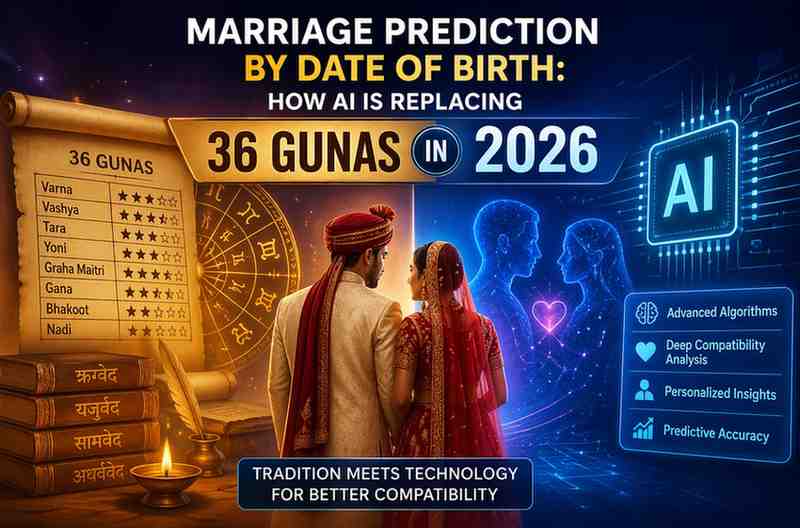
Marriage Prediction by Date of Birth: The Evolution Beyond 36 Gunas
For centuries, the practice of analyzing compatibility through birth details has remained a central pillar of Vedic astrology. Families have traditionally depended on structured systems like the 36 Gunas, or Ashta-Koota matching, to assess whether two individuals are suitable for marriage. This method provided a clear and simple framework: a score above 18 was generally considered favorable, while a lower score often raised doubts and hesitation. In many cultures, this numerical result played a decisive role in whether a match moved forward or was rejected, making it one of the most trusted tools in arranged marriage traditions.
However, as we move into 2026, this long-standing approach is gradually evolving to meet the needs of a more complex and modern world. Relationships today are influenced by far more than just birth-based compatibility. Factors such as emotional intelligence, communication styles, personal values, and life goals now play a crucial role in determining long-term success. As a result, relying solely on a fixed scoring system may not provide a complete picture of a relationship’s potential.
This shift has opened the door for technological advancements, particularly Artificial Intelligence, to enhance traditional methods. AI brings the ability to analyze multiple layers of information simultaneously, going beyond basic astrological matching. It can evaluate entire birth charts, identify subtle patterns, and even integrate behavioral and psychological insights. This creates a more dynamic and personalized approach to understanding compatibility.
Instead of offering a rigid yes-or-no outcome, modern tools provide deeper guidance, highlighting strengths, potential challenges, and areas that may require effort. This transformation makes compatibility analysis more adaptable and relevant to contemporary relationships. By blending ancient wisdom with modern innovation, the process becomes more precise, insightful, and aligned with the realities of today’s evolving partnerships.
Also Read :- Life Not Settling After Moving to Canada – Astrology Explanation
The Traditional Foundation: Understanding the 36 Gunas
The 36 Gunas system, also known as Ashta-Koota matching, is deeply rooted in Vedic astrology. It evaluates compatibility based on the Moon sign of both individuals.
The Eight Kootas Include:
- Varna – Spiritual compatibility
- Vashya – Mutual control or dominance
- Tara – Star alignment
- Yoni – Sexual compatibility
- Graha Maitri – Planetary friendship
- Gana – Nature and temperament
- Bhakoot – Emotional bonding
- Nadi – Health and genetic factors
This system formed the backbone of marriage prediction by date of birth for generations.
Also Read :- How can astrology help identify my life purpose
Limitations of the 36 Gunas System
While valuable, the traditional system has limitations.
❌ Static Analysis
It only considers birth data and ignores life changes.
❌ Limited Scope
Focuses mainly on Moon signs rather than the full chart.
❌ No Psychological Insight
It does not consider personality, trauma, or communication style.
Because of these gaps, marriage prediction by date of birth is now expanding beyond traditional frameworks.
How AI is Transforming Marriage Compatibility
Artificial Intelligence is revolutionizing how compatibility is analyzed. Instead of replacing astrology, it enhances it.
1. Multidimensional Chart Analysis
Traditional astrology focuses heavily on the Moon. AI systems analyze:
- 7th house (marriage)
- Venus (love and attraction)
- Mars (energy and conflict)
- Mercury (communication)
This creates a deeper level of marriage prediction by date of birth.
2. Big Data & Pattern Recognition
AI models analyze thousands—even millions—of relationship datasets.
They identify:
- patterns of successful marriages
- common causes of separation
- long-term compatibility markers
This allows marriage prediction by date of birth to become more accurate.
3. Psychological Integration
Modern AI combines astrology with psychology.
It considers:
- personality traits
- emotional intelligence
- communication styles
This creates a more realistic version of marriage prediction by date of birth.
4. Real-Time Behavioural Inputs
Unlike static astrology, AI adapts.
Users can input:
- behavior patterns
- relationship preferences
- lifestyle choices
This makes marriage prediction by date of birth dynamic and evolving.
The Shift: From Fate to Workability
Traditional systems label compatibility as:
- good ✔
- bad ❌
AI changes the approach.
Instead of final judgments, it offers guidance.
Example:
👉 “Strong attraction exists, but communication may need effort.”
This transforms marriage prediction by date of birth into a tool for growth.
Astrology + AI: The Hybrid Model
The future lies in combining both systems.
Astrology Provides:
- karmic patterns
- planetary influence
- spiritual insights
AI Provides:
- data-driven analysis
- behavioral predictions
- adaptability
Together, they redefine marriage prediction by date of birth.
Key Astrological Factors Still Relevant
Even with AI, astrology remains essential.
🔹 7th House
Represents marriage and partnerships.
🔹 Venus
Indicates love and attraction.
🔹 Mars
Shows passion and conflict.
🔹 Mercury
Controls communication.
These elements remain central to marriage prediction by date of birth.
Comparing 36 Gunas vs AI
| Factor | 36 Gunas | AI-Based |
|---|---|---|
| Data | Limited | Massive |
| Flexibility | Static | Dynamic |
| Accuracy | Moderate | High |
| Personalization | Low | High |
This comparison shows how marriage prediction by date of birth is evolving.
Emotional Compatibility Matters More Today
Modern relationships require:
- emotional maturity
- communication skills
- adaptability
AI helps measure these aspects, making compatibility analysis more relevant.
Astrology shows potential—not destiny.
Even the best match can fail without effort.
AI emphasizes:
- effort
- communication
- awareness
Thus, compatibility analysis serves as a guide rather than a strict rule.
Benefits of AI in Marriage Matching
- deeper insights
- real-time adaptability
- better compatibility analysis
- reduced divorce risk
These benefits make compatibility analysis more practical.
Challenges of AI-Based Matching
- over-reliance on technology
- data privacy concerns
- lack of spiritual depth
Balance is key.
The Future of Marriage Prediction
The future is hybrid.
- astrology + AI
- tradition + technology
- intuition + data
This evolution ensures that compatibility analysis becomes more accurate than ever.
Final Thoughts
The Timeless Value of the 36 Gunas System
The 36 Gunas system has long been a cornerstone of traditional Vedic astrology, especially in the context of marriage compatibility. It offers a structured and time-tested approach to understanding how two individuals align on emotional, physical, and spiritual levels.
Even today, it continues to hold immense cultural and spiritual value, particularly in societies where arranged marriages and astrological guidance play an important role. Therefore, many families still rely on this system as an initial step to assess harmony and reduce potential conflicts in a relationship.
Changing Relationship Expectations in the Modern World
However, as relationships evolve in the modern world, expectations have also changed significantly. Today’s partnerships are no longer based solely on traditional roles or birth-based compatibility. Instead, they increasingly depend on communication, emotional intelligence, shared values, and personal growth.
Moreover, people now seek deeper understanding, mutual respect, and adaptability in their relationships. As a result, relying only on a fixed astrological system may not fully capture real-life dynamics and individual evolution.
The Role of AI in Modern Compatibility Analysis
This is where modern intelligence, particularly Artificial Intelligence, begins to complement traditional wisdom. By combining ancient astrological principles with advanced analytical tools, compatibility analysis becomes more comprehensive and insightful.
Instead of offering a simple yes-or-no answer, this approach provides a deeper understanding of strengths, challenges, and areas that require effort. Consequently, individuals can not only assess compatibility but also actively work on improving their relationships.
A Balanced Approach for Stronger Relationships
Ultimately, the fusion of ancient wisdom and modern intelligence transforms compatibility analysis into a powerful and practical tool. In other words, it helps individuals build stronger, more resilient relationships that can adapt to real-life complexities.
Rather than replacing tradition, this evolution enhances it. Therefore, timeless knowledge remains relevant, practical, and valuable in a rapidly changing world.
Marriage prediction by date of birth is done using astrology by analyzing planetary positions, birth charts, and compatibility factors like the 36 Gunas system.
The 36 Gunas are points used in traditional Vedic astrology to assess compatibility between two individuals based on their birth charts.
While not mandatory, 36 Gunas matching is considered important in Vedic astrology to evaluate harmony, emotional compatibility, and long-term stability.
AI can analyze large datasets and patterns quickly; however, its accuracy depends on data quality and algorithms, and it may lack the depth of traditional astrological interpretation.
Both have advantages. AI offers speed and data-driven insights, while 36 Gunas provides traditional, spiritually rooted compatibility analysis.
A score above 18 out of 36 is generally considered acceptable, while higher scores indicate better compatibility.
Yes, predictions can vary depending on the astrologer, method, and interpretation. Free will and personal choices also play a significant role.
No, while it provides insights, successful relationships also depend on communication, understanding, and effort from both partners.
AI compares kundli data using algorithms to quickly calculate compatibility, identify doshas, and generate predictions based on patterns.
Online kundli matching tools can be helpful for basic analysis, but for accurate results, expert interpretation is recommended.
Conclusion
We are entering a new era where compatibility is no longer defined only by the alignment of stars or traditional astrological calculations. While planetary positions still offer valuable insights into personality traits and relationship dynamics, modern relationships require a much deeper and more practical understanding. Today, compatibility is shaped by how well two individuals understand each other, how they grow together over time, and how effectively they adapt to life’s challenges.
Understanding forms the foundation of any strong relationship. It goes beyond surface-level attraction and focuses on emotional awareness, communication, and the ability to truly listen and support one another. Growth is equally important, as relationships are not static. Individuals evolve, priorities shift, and circumstances change. A successful partnership is one where both people are willing to grow together rather than drift apart. Adaptability, therefore, becomes the key to sustaining long-term harmony. Life is unpredictable, and couples who can adjust to change with patience and resilience are more likely to build lasting bonds.
At the same time, technology is playing a transformative role in how compatibility is evaluated. Artificial Intelligence is enhancing astrological analysis by adding layers of depth and precision that were previously difficult to achieve. By combining traditional astrological knowledge with data-driven insights and behavioral patterns, compatibility analysis is becoming more refined and personalized. It can highlight potential strengths, identify areas of conflict, and even suggest ways to improve communication and understanding.
As a result, compatibility is no longer seen as a fixed outcome but as a dynamic process. With the support of both ancient wisdom and modern intelligence, individuals now have access to more meaningful guidance, allowing them to build relationships that are not only aligned but also resilient, evolving, and deeply fulfilling.
References
This article on Marriage Prediction by Date of Birth: AI vs 36 Gunas is based on traditional Vedic astrology principles and modern technological insights.
- Astro.com – Birth charts and planetary data
- Astro-Seek – Kundli matching and compatibility tools
- Cafe Astrology – Relationship astrology insights
- Encyclopaedia Britannica – Overview of astrology concepts
- Gurucool.life – Vedic astrology and relationship guidance
- Shloka.life – Spiritual knowledge and compatibility insights
Disclaimer: Marriage predictions are based on astrological interpretations and AI analysis. Results may vary depending on individual charts and personal choices.
13 Comments