
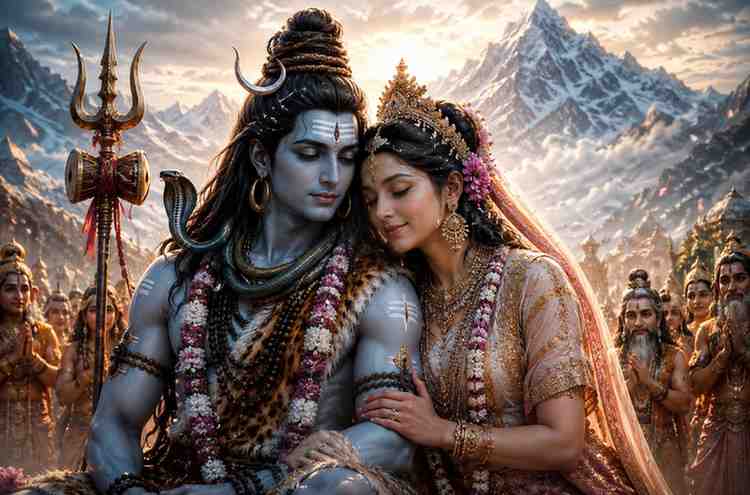
Shiva and Parvati’s Union: Embracing Authentic Life Beyond Social Expectations
The Shiva and Parvati union is one of the most profound and symbolic stories in Hindu mythology. More than a divine marriage, it is a spiritual revelation about human identity, authenticity, and liberation from societal conditioning. Beneath the grandeur of celestial celebrations lies a timeless teaching that challenges the way we define success, respectability, and self-worth.
In a world where people are constantly pressured to conform, achieve approval, and maintain carefully curated identities, the story of Shiva and Parvati stands as a powerful reminder that true fulfillment comes only through authenticity. Shiva, the ascetic yogi who defies every social expectation, represents the raw essence of existence itself. Parvati, the royal princess who chooses him despite social resistance, symbolizes spiritual wisdom and unconditional devotion.
Together, their union becomes a sacred metaphor for transcending superficiality and reconnecting with truth.
Also Read :- How to Read Your Own Kundli (Birth Chart) in 5 Easy Steps
The Spiritual Significance of Shiva and Parvati
Also Read :- Astrology Career Guidance: Find Your Purpose Through Your Birth Chart
The relationship between Shiva and Parvati is deeply symbolic in Vedic philosophy. Shiva represents pure consciousness—formless, limitless, and detached from worldly illusions. Parvati represents Shakti, the dynamic creative energy that sustains existence. Their union symbolizes the balance between stillness and movement, consciousness and creation, masculine and feminine energies.
However, the story is not presented as a polished fairy tale. Instead, it deliberately contrasts social expectations with spiritual reality. The Shiva and Parvati union forces us to question whether cultural refinement and social status truly define greatness.
Parvati was born into royalty as the daughter of Himavan, the King of the Himalayas. She embodied grace, beauty, discipline, and noble upbringing. Her marriage was expected to strengthen royal prestige and fulfill societal ideals.
Shiva, on the other hand, appeared as the complete opposite of a socially acceptable groom.
Also Read :- Marriage Prediction by Date of Birth: How AI is Replacing 36 Gunas in 2026
Shiva: The Untamed Force of Existence
Also Read :- Why Do I Feel Lost in Life? Astrology Explains Your True Purpose
Shiva’s appearance at the wedding shocked everyone present. He arrived riding Nandi, the bull, accompanied not by noblemen or kings but by ghosts, spirits, ascetics, and wild beings. His body was smeared with ash from cremation grounds. Snakes adorned his neck, and animal skins covered his body.
To the royal guests, Shiva appeared terrifying and uncivilized.
This imagery was intentional. Shiva’s appearance symbolizes freedom from human pretension. He does not attempt to fit into society’s expectations because he exists beyond them. He is untouched by the need for validation, approval, or status.
Modern society often rewards people who conform to accepted standards of success. Individuals are taught to build impressive identities through wealth, education, lineage, and social image. Yet beneath these identities often lies anxiety, fear, and emotional exhaustion.
Shiva destroys this illusion.
The Shiva and Parvati union teaches that spiritual truth cannot be measured through social polish. Real wisdom often appears unconventional because it does not seek approval.
The Fear of the Untamed
Also Read :- Kundli Matching for Marriage: Step-by-Step Guide to Guna Milan
The wedding guests’ reaction to Shiva reflects humanity’s fear of unpredictability. Society creates systems, rules, and expectations to make life controllable. Anything untamed threatens that sense of security.
Shiva represents the aspect of life that cannot be controlled.
Nature itself operates through cycles of creation and destruction. Storms, death, transformation, and rebirth are beyond human authority. Shiva embodies this raw cosmic reality. He reminds us that life is not always neat, predictable, or socially refined.
Many people spend years suppressing their authentic selves in order to gain acceptance. They hide emotions, desires, creativity, and individuality behind socially acceptable masks. Over time, this creates inner conflict and spiritual emptiness.
The story of Shiva challenges us to ask difficult questions:
- Are we living authentically?
- Are we performing roles designed by society?
- Do we define ourselves through external approval?
- Have we lost touch with our true nature?
The Shiva and Parvati union encourages us to reconnect with the untamed part of ourselves that exists beneath conditioning.
Shiva’s Silence on Lineage
One of the most powerful moments in the wedding narrative occurs during the traditional Vedic rituals. Priests ask Shiva to declare his lineage and ancestry. In ancient society, lineage established identity, social status, and legitimacy.
But Shiva remains silent.
This silence carries immense philosophical depth.
Shiva is Swayambhu—self-created. He has no father, grandfather, or inherited identity. He exists beyond historical definitions. By refusing to define himself through ancestry, Shiva reveals that true existence transcends accumulated memory and social categorization.
Human beings often define themselves through past experiences, family background, achievements, or inherited identities. While these elements shape personality, they do not define the essence of consciousness.
The Shiva and Parvati union teaches that spiritual liberation begins when individuals stop identifying entirely with social labels and historical conditioning.
Shiva’s silence becomes a meditation on freedom.
Parvati’s Role: Seeing Beyond Appearance
Parvati’s role in this story is equally important. While everyone else judged Shiva based on appearance and social standards, Parvati recognized his divine essence. Her devotion was not based on status, comfort, or approval from society.
She saw beyond the external form.
Parvati’s spiritual maturity teaches an important lesson: wisdom involves perceiving truth beneath appearances. Modern culture often encourages superficial judgments based on wealth, image, beauty, or influence. Yet these external qualities are temporary and incomplete.
Parvati understood that Shiva represented ultimate consciousness itself.
Her acceptance of Shiva symbolizes the soul’s willingness to embrace truth, even when it challenges societal conditioning. In many ways, Parvati represents the inner seeker within every human being—the part that longs for authenticity rather than performance.
The Shiva and Parvati union becomes the meeting point between spiritual awareness and pure existence.
The Destruction of Ego and Social Masks
Shiva is often called the destroyer, but destruction in spirituality does not mean negativity. Shiva destroys illusion, ego, ignorance, and false identity.
The ego thrives on comparison, validation, and social recognition. It constantly seeks approval from others. Many people spend their entire lives building identities designed to impress society while neglecting inner fulfillment.
Shiva’s presence at the royal wedding exposes the fragility of these identities.
His ash-covered body reminds us that all physical forms eventually return to dust. His association with cremation grounds symbolizes awareness of mortality. When people truly understand the impermanence of life, superficial ambitions lose their grip.
The Shiva and Parvati union therefore represents the dissolution of egoic barriers. It invites individuals to live truthfully rather than performatively.
Authentic living requires courage because society often resists those who refuse conformity.
The Symbolism of Nandi the Bull
Shiva’s vehicle, Nandi the bull, also carries profound symbolism. The bull represents strength, patience, stability, and devotion. Unlike royal chariots that symbolize power and status, Nandi symbolizes grounded consciousness.
Shiva arriving on a bull instead of a luxurious carriage reflects detachment from material display. His value is not dependent on external symbols of prestige.
In modern society, people frequently use possessions and achievements to establish identity. Social media culture intensifies this tendency by encouraging constant self-presentation and comparison.
The Shiva and Parvati union reminds us that genuine power comes from inner stability rather than external display.
Nandi’s calm presence also symbolizes disciplined devotion. Despite Shiva’s wild appearance, there is immense inner stillness and balance within him.
Shiva and the Cremation Grounds
One of the most misunderstood aspects of Shiva is his connection to cremation grounds. To ordinary people, cremation grounds symbolize death and fear. Yet Shiva meditates there peacefully.
Spiritually, cremation grounds represent impermanence. They are places where all social distinctions disappear. Wealth, titles, beauty, and status ultimately lose meaning before death.
By living among cremation grounds, Shiva demonstrates complete freedom from attachment to worldly illusions.
The Shiva and Parvati union teaches that authentic life begins when individuals confront impermanence honestly. Many fears arise because people cling desperately to temporary identities and possessions.
Shiva invites humanity to transcend this fear through awareness and acceptance.
The Balance Between Civilization and Authenticity
The story does not reject civilization entirely. Parvati herself represents culture, grace, devotion, and refinement. The union works because both Shiva and Parvati bring complementary energies together.
This balance is essential.
Spiritual wisdom does not require abandoning society completely. Instead, it involves participating in life without becoming imprisoned by social conditioning. One can fulfill responsibilities while remaining inwardly free.
The Shiva and Parvati union demonstrates that authentic living involves harmony between structure and freedom, discipline and spontaneity, civilization and nature.
When either side dominates completely, imbalance occurs. Excessive conformity suppresses individuality, while total chaos creates instability. Shiva and Parvati together symbolize integrated existence.
Lessons for Modern Life
The teachings embedded in this ancient story remain deeply relevant today. Modern society places enormous pressure on individuals to succeed according to predefined standards. Careers, relationships, appearance, and lifestyle choices are often shaped more by external expectations than inner truth.
As a result, many people experience anxiety, burnout, and disconnection from themselves.
The Shiva and Parvati union offers several timeless lessons:
1. Authenticity Is More Valuable Than Approval
Living truthfully may not always earn social acceptance, but it creates inner peace. Shiva does not compromise his essence to impress others.
2. Identity Is Not Limited by the Past
Shiva’s silence regarding lineage reminds us that consciousness is greater than inherited labels and conditioning.
3. Spiritual Wisdom Requires Seeing Beyond Appearances
Parvati recognized Shiva’s divine essence despite his unconventional appearance. True understanding goes deeper than surface impressions.
4. Fear of Judgment Limits Freedom
Many people avoid authenticity because they fear criticism. Shiva teaches fearless self-expression.
5. Impermanence Reveals What Truly Matters
Awareness of mortality helps individuals prioritize truth, love, and spiritual growth over superficial achievement.
Shiva and Parvati as Inner Archetypes
Spiritually, Shiva and Parvati can also be understood as inner archetypes rather than external figures alone.
Shiva represents the silent, conscious dimension within every person—the witness beyond thoughts, emotions, and social identity. Parvati represents the active energy of life, emotion, creativity, and devotion.
The Shiva and Parvati union symbolizes the integration of these inner forces. When consciousness and energy operate harmoniously, individuals experience wholeness.
Meditative traditions often emphasize balancing stillness with action. Excessive mental activity creates restlessness, while excessive detachment can disconnect people from life. Shiva and Parvati together embody complete balance.
Why This Story Still Resonates
The enduring power of this myth lies in its psychological and spiritual depth. Across generations, human beings continue struggling with the tension between authenticity and conformity.
People want acceptance, yet they also long for freedom.
The Shiva and Parvati union resonates because it speaks directly to this conflict. It reminds humanity that spiritual fulfillment cannot emerge from pretending to be someone else.
In every era, society creates new forms of pressure and performance. Yet the fundamental human search for truth remains unchanged.
Shiva’s fearless authenticity and Parvati’s unwavering devotion continue inspiring seekers to look beyond appearances and reconnect with their essential nature.
Shiva and Parvati’s union symbolizes the balance between consciousness and energy, representing harmony between spiritual awareness and worldly life.
Shiva is portrayed as an ascetic who rejects social norms, material wealth, and external appearances, symbolizing ultimate freedom and authenticity.
Parvati represents divine feminine energy, devotion, strength, compassion, and spiritual wisdom.
The guests feared Shiva because of his unconventional appearance, ash-covered body, serpents, and association with cremation grounds, which challenged societal expectations.
Shiva’s silence symbolizes freedom from social identity, ancestry, and ego-based definitions of self.
The story encourages people to live authentically instead of constantly seeking social approval and external validation.
Shiva symbolizes pure consciousness, transformation, destruction of ego, and liberation from illusion.
Their union represents the cosmic balance between masculine and feminine energies, consciousness and creation.
Conclusion: Living Beyond Social Pretension
The Shiva and Parvati union is far more than a mythological wedding story. It is a spiritual blueprint for authentic living. Shiva represents the untamed truth of existence that refuses to be limited by social expectations, while Parvati represents the wisdom to recognize and embrace that truth.
Together, they teach humanity that real freedom begins when individuals stop living entirely for external approval.
Modern life often encourages performance over authenticity, image over substance, and conformity over individuality. Yet beneath these social layers exists a deeper reality waiting to be rediscovered.
By embracing the lessons of Shiva and Parvati, people can begin releasing false identities and reconnecting with their essential selves. The path may challenge societal expectations, but it leads toward genuine peace, inner strength, and spiritual awakening.
Ultimately, the union of Shiva and Parvati reminds us that the divine is not found in perfection or social polish. It is found in fearless authenticity, unconditional acceptance, and the courage to live truthfully.



3 Comments