
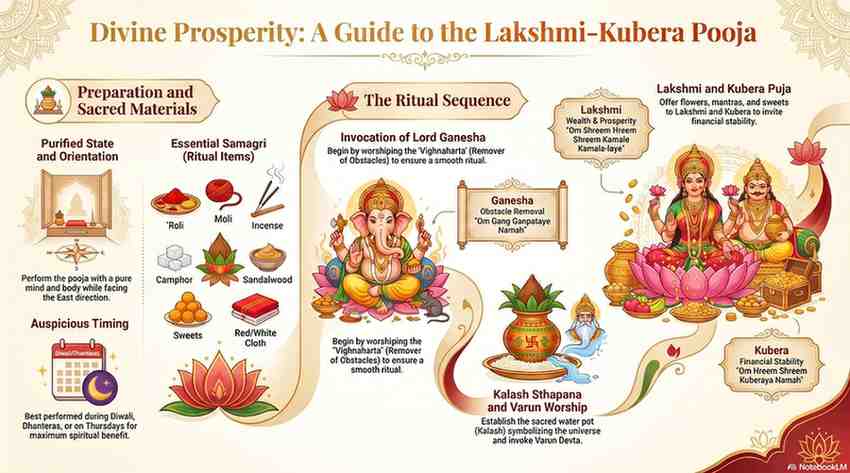
The Lakshmi Kubera Pooja is a profoundly sacred Hindu ceremony designed to invite abundance into your life. It is strictly dedicated to Goddess Mahalakshmi, the supreme goddess of fortune, and Lord Kubera, the celestial treasurer. Together, they form a powerful divine force that grants and protects material wealth.
In Part 1 of this comprehensive guide, we will explore the deep spiritual significance of this pooja, its incredible financial benefits, and the most auspicious times to perform it.
Also Read :- The Spiritual Mindset of the Entrepreneur
The True Spiritual Purpose and Virtues
Also Read :- How to Find Your True Calling Through Astrology
What is the ultimate spiritual purpose of the Lakshmi Kubera Pooja? It is not merely about accumulating money. Instead, it serves to harmonize the attraction of material wealth with essential spiritual virtues. Specifically, practitioners must balance their pursuit of wealth with deep generosity and sincere gratitude.
When devotees genuinely worship Mahalakshmi, their flaws and past sins are destroyed. According to the sacred texts, the Supreme Lord took incarnations in both male and female forms to perfectly maintain this cosmic balance of power, wealth, and spiritual liberation. Therefore, true worship requires much more than just reciting words. It demands a pure heart, unwavering faith, and righteous daily actions.
The Financial Benefits of Worship
Also Read :- Feeling Stuck Financially? Astrology Explains
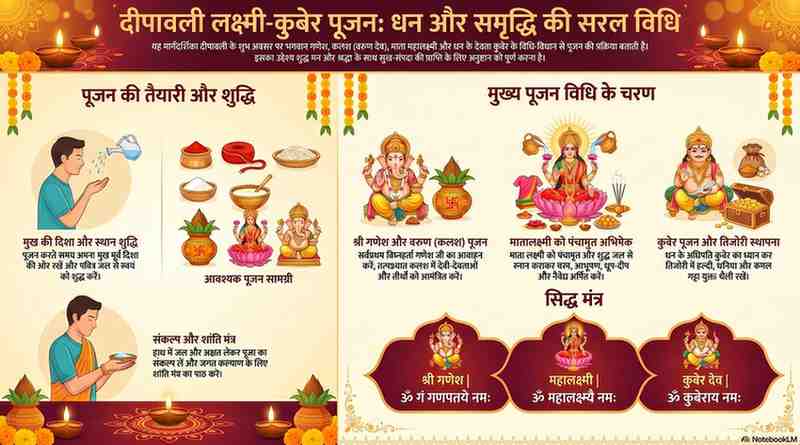
The primary financial benefits of worshiping Goddess Mahalakshmi are vast. She clears financial blockages, attracts new avenues of income, and brings overall prosperity. However, making money is only half the battle. Because Lord Kubera is the celestial treasurer, he is invoked to ensure that the wealth Mahalakshmi brings is safely retained, protected, and multiplied.
To maximize these financial benefits, practitioners highly rely on ancient Vedic hymns. Reciting or listening to the Shri Suktam yields incredible results. The specific benefits of the Shri Lakshmi Suktam include shattering poverty, destroying sorrow, and granting immense wealth and unshakeable prosperity to the household.
Auspicious Timings and Modern Practices
Also Read :- Marriage Prediction by Date of Birth: How AI is Replacing 36 Gunas in 2026
To fully harness the cosmic energies, timing is crucial. The absolute best annual festivals to perform the Lakshmi Kubera Pooja are Diwali (Amavasya) and Dhanteras. For those wanting to incorporate this powerful pooja into a regular routine, Thursdays and Fridays are highly recommended days of the week.
Today, many people wonder how modern practitioners can conveniently perform these intricate rites at home. Fortunately, it is easier than ever. You can perform the rituals smoothly using specialized, pre-assembled pooja kits that contain all necessary items. Furthermore, if someone wants expert guidance, excellent alternative options exist. You can easily hire online services or expert pandits to conduct personalized, virtual pooja sessions.
Finally, setting up your space correctly is vital. Whether performing the pooja alone or with a guide, the practitioner should always sit facing the East or North direction to attract the most auspicious energies.
Also Read :- Astrology of 2026: How Planetary Shifts Will Reshape Your Life
Essential Samagri and Initial Purification for the Lakshmi Kubera Pooja
Also Read :- Sun, Moon, and Rising Sign: What Does Your Birth Chart Actually Mean?
Successfully performing the Lakshmi Kubera Pooja requires careful preparation. Gathering the correct ritual materials, known as samagri, is just as important as the mantras you chant. Once your space is set, the initial purification rituals lay a divine foundation for the ceremony.
In Part 2 of our complete guide, we detail the exact physical items required for the pooja and outline the vital first steps of spiritual cleansing.
Required Ritual Materials(Poojan Samagri)
To invite ultimate prosperity, practitioners must prepare a variety of offerings. These specific items please the deities and help manifest positive spiritual energy.
Sacred Powders, Aromatics, and Botanicals
Vedic rituals heavily utilize natural elements to engage the senses. First, you will need sacred powders, specifically abir (white colored powder), gulal (pink or red powder), and sindoor. Next, gather highly aromatic items to purify the air. These include pure camphor (kapoor), incense sticks (dhoop), saffron, and fragrant sandalwood paste.
Additionally, specific leaves and nuts are mandatory. You must procure fresh betel leaves (paan) and betel nuts (supari). For the offerings, the specific grass used is durva (also known as dhoob grass). Furthermore, you need to include aromatic spices like cloves and cardamom in your setup.
Divine Food Offerings (Prasad)
The deities are offered pure, sweet foods during the Lakshmi Kubera Pooja. Practitioners must provide fresh seasonal fruits, sweets of their choice, and sugar drops (batashe).
You will also need to prepare Panchamrit, a highly sacred nectar used for bathing the deities. The five exact ingredients used to make Panchamrit are raw cow’s milk, fresh curd, desi ghee, sugar, and pure honey. Finally, ensure you have a specific grain offering ready: puffed rice, commonly known as kheel.
Physical Setup and Decor
To physically host the deities, you need specific idols (murtis) of Goddess Lakshmi, Lord Ganesh, and Lord Kubera. Place these idols upon a chowki, which is a small wooden throne or raised seat.
To dress the altar, you need exactly half a meter of white cloth and half a meter of red cloth. You must also prepare a Kalash (sacred pot), which should strictly be made of either copper or earthen clay. Lastly, have plenty of moli (also known as kalawa), the sacred red thread used for tying and offering.
Initial Setup and Spiritual Purification
Before making any material offerings, the practitioner must undergo a spiritual reset to ensure the space and their mind are perfectly clean.
The Achaman Ritual
The ceremony begins with the Achaman ritual. This is a profound purification process of cleansing oneself internally by sipping small drops of water. During this physical cleansing, practitioners chant specific names of Lord Vishnu to purify the soul: Narayan, Keshav, and Madhav.
The Shanti Path
Following the personal purification, the very first overarching mantra recited is the Shanti Path. This beautiful chant does not ask for personal wealth. Instead, the purpose of the Shanti Path is to invoke universal peace, harmony, and well-being for the entire world.
Taking the Sankalp (The Sacred Vow)
With a pure body and peaceful environment, the practitioner moves to the Sankalp, which is the formal resolution or vow.
During the Sankalp, the practitioner holds three specific items in their right hand: pure water, unbroken rice, and a fresh flower. While holding these items, you must state highly specific details to the universe. You mention your own name, your family lineage (gotra), the current date, and your exact geographic location. Finally, you declare the specific purpose of the ritual. In the context of the Lakshmi Kubera Pooja, this declared purpose is to attain wealth, completely remove debt, and formally seek the divine blessings of Goddess Lakshmi and Lord Kubera.
Lord Ganesh Worship and Kalash Sthapana Rituals
No auspicious Hindu ceremony can commence without clearing the path of spiritual and physical obstacles. In the Lakshmi Kubera Pooja, this requires the devoted worship of Lord Ganesh, followed immediately by the establishment of cosmic energies through the Kalash Sthapana.
In Part 3 of our comprehensive guide, we cover the exact step-by-step procedures for invoking these vital divine forces before calling upon the Goddess of Wealth.
The Worship of Lord Ganesh (Vighnaharta)
Why is Lord Ganesh worshipped first in the ceremony? As the Vighnaharta (remover of obstacles), he ensures that your pooja proceeds without disruption and clears the energetic path for wealth to flow.
Invocation and the Divine Bath
The ritual begins with Pran Pratishtha, the profound process of establishing the life force within the Ganesh idol by chanting specific mantras. Once invoked, the deity is given a sequential divine bath.
First, Lord Ganesh is bathed with Panchamrit (the sacred mixture of milk, curd, ghee, honey, and sugar). Immediately after the Panchamrit, he is bathed with pure water. During this pure water bath (Shuddhodak snan), practitioners invoke the spiritual essence of sacred rivers like the Ganga, Yamuna, Godavari, and Narmada to completely purify the deity.
Offerings and Adornment
After bathing, the practitioner dresses the idol. Appropriate clothing and the Yagyopaveet (sacred thread) are formally offered to Lord Ganesh. Following this, he is adorned with highly fragrant pastes and powders, specifically sandalwood paste and sindoor.
Next, the practitioner offers durva grass. Interestingly, Goddess Ambika is always worshipped alongside Lord Ganesh during the vital offering of this sacred grass.
The Ganesh Aarti
The Ganesh worship concludes with a joyous Aarti. During this musical prayer, Lord Ganesh is honored with specific titles praising his immense power and compassion. The Aarti proudly identifies Lord Shiva and Goddess Parvati as the parents of Lord Ganesh. Furthermore, the chant details exactly what his divine grace grants to humanity: he provides eyes to the blind, bodies to the leper, children to the barren, and wealth to the poor.
Kalash Sthapana and Varun Pooja
Following the Ganesh worship, the practitioner must set up the Kalash. In Vedic rituals, the Kalash represents the entire universe and the divine, life-giving presence of water.
Establishing the Kalash
The very first thing done before placing the Kalash on the ground or the chowki is spreading a small, neat mound of unbroken rice. The pot is placed directly upon this rice.
Once placed, several sacred items are dropped inside the water of the Kalash. You must include sandalwood, durva grass, five sacred leaves (Panch Pallav), a betel nut, and a coin. To crown the setup, a whole coconut perfectly wrapped in red cloth is placed directly on top of the Kalash.
Invoking Lord Varun
With the physical pot established, the spiritual invocation begins. The specific deity invoked into the Kalash is Lord Varun, the supreme god of water. However, he does not reside there alone; all the sacred rivers of India are invoked into the Kalash alongside him.
During his specific pooja, Lord Varun is respectfully bathed with pure water. The practitioner then presents various offerings to Lord Varun, including fresh water for sipping, clothing, fragrant sandalwood, fresh flowers, and incense. Finally, at the conclusion of his worship, a special prayer is offered to seek his continuous blessings and to ensure that the environment remains eternally pure for the remainder of the ritual.
Goddess Mahalakshmi, Lord Kubera Rituals, and Concluding Mantras
After purifying the space and honoring Lord Ganesh and the Kalash, the ceremony reaches its most vital stage. The heart of the Lakshmi Kubera Pooja lies in the grand worship of the Goddess of Wealth and the Celestial Treasurer.
In this final part of our comprehensive guide, we will walk you through the intricate Mahalakshmi Snan, the creation of the Kubera treasure pouch, essential wealth-drawing mantras, and the concluding prayers of surrender.
The Grand Goddess Mahalakshmi Pooja
According to ancient texts, Goddess Mahalakshmi physically resides in the heart of Lord Vishnu. To physically invite her presence into your space, practitioners visualize her physical characteristics: she is a radiant, golden-hued deity, gracefully holding beautiful lotus flowers in her hands.
The Divine Bath (Snan) and Adornment
To begin, the practitioner offers Mahalakshmi a sacred lotus seat (Asan). Following this, she is given a detailed sequence of divine baths. First, she is bathed with milk, followed immediately by an offering of pure water to cleanse her. This pattern continues: she is bathed with curd, followed by water; then bathed with ghee, followed by water; bathed with honey, followed by water; and finally bathed with sugar, followed by pure water. During this elaborate ritual, a special sweet mixture called Madhupark is also offered.
Once thoroughly purified, the deity is adorned. Practitioners offer fragrant sandalwood paste and vibrant red sandalwood. She is then dressed in divine garments and intricate jewelry, and beautifully decorated with kumkum and sindoor. After she is dressed and adorned, the exact sequence of offerings includes fragrant incense, light from a ghee lamp, seasonal fruits, and sweets. Finally, she is offered a betel leaf (Tambool) to cleanse her mouth, followed by a final gesture of physical surrender and respect known as Pradakshina (circumambulation).
The Forms of Lakshmi and Her Aarti
During the worship, it is crucial to recognize her multifaceted nature. Goddess Lakshmi manifests in various forms depending on where she resides. In heaven, she resides as the supreme goddess of fortune. In the homes of humans, she resides as the bringer of domestic harmony. With merchants, she resides as trade and commerce, and in battle alongside victors, she resides as the embodiment of victory.
To honor all these forms, devotees sing her dedicated Aarti, with the lyrics “Om Jai Lakshmi Mata.” This beautiful hymn repeatedly identifies Lord Vishnu as her husband. Furthermore, the Aarti explicitly claims that she provides immense happiness and wealth to those who sing it, while completely removing their worldly sorrows and sins.
Lord Kubera Pooja and Sacred Mantras
Following the goddess, practitioners must worship Lord Kubera. Known as the King of the Yakshas, Lord Kubera holds the esteemed title of the celestial treasurer. The primary purpose of worshiping him immediately after Lakshmi is to ensure that the newly attracted wealth is safely retained and to permanently remove heavy debt.
The Kubera Treasure Pouch Ritual
To secure this financial protection, practitioners create a Kubera treasure pouch. Specific ingredients are placed inside this sacred bundle: whole turmeric, coriander seeds, kamal gatta (lotus seeds), durva grass, and a monetary offering (Dravya). Once energized during the Lakshmi Kubera Pooja, this sacred Kuber pouch must be permanently placed in a safe or treasury (Tijori) to ensure uninterrupted prosperity.
Essential Wealth Mantras
Throughout the ceremony, specific mantras are chanted to activate cosmic energies. The pooja utilizes “Om Gam Ganapataye Namaha” to honor Lord Ganesh’s initial presence. To invoke the ultimate divine couple, a combined mantra invokes both Goddess Mahalakshmi and Lord Vishnu together. To draw immense wealth, a specific Kuber mantra is chanted to explicitly grant gold and gems, while another powerful verse, “Suvarna Ratna Sampadam,” is invoked to manifest tangible treasures. Finally, a dedicated mantra is chanted to ask Lord Kubera to remove all debt and sorrow from the household.
Concluding Rituals: The Purusha Suktam and Forgiveness Prayer
Vedic rituals are intricate, and human beings are inherently prone to making mistakes. Therefore, a forgiveness prayer (Kshama Prarthana) is absolutely necessary at the end of the pooja.
During the Kshama Prarthana, the practitioner makes a humble admission regarding their lack of knowledge of the exact mantras and ritual actions. In a state of total surrender, the practitioner asks Goddess Lakshmi to lovingly accept their imperfect devotion as perfect and to forgive any procedural mistakes made during the worship.
Alongside these prayers, ancient hymns like the Purusha Suktam are often recited. This Vedic hymn describes the Virat Purusha, the magnificent cosmic being who is said to possess thousands of heads, thousands of eyes, and thousands of feet, representing the omnipresence of the divine.
The Final Jagdish Aarti
The grand ceremony concludes with the final Aarti, “Om Jai Jagdish Hare,” sung at the very end. In this hymn, Lord Vishnu is praised as the supreme “Lord of the Universe.” Through the Jagdish Aarti, the practitioner asks the Lord to remove deep suffering and worldly sorrows, and ultimately asks for their devotion and faith to be infinitely increased.

1 Comment