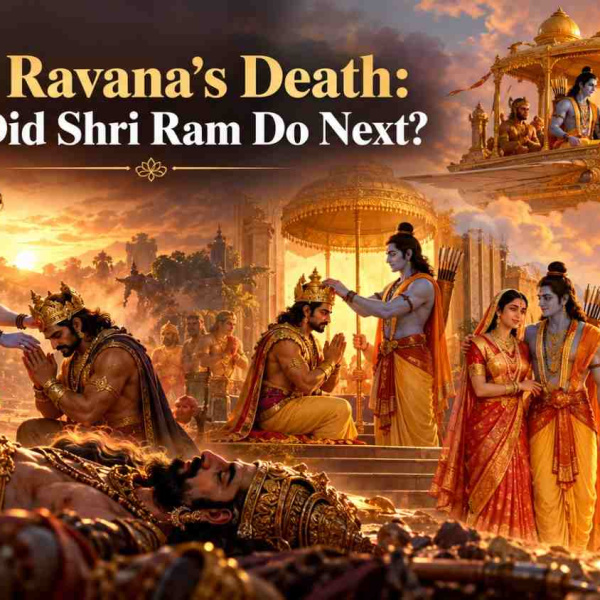
Ravana had fallen, but Lanka still needed a future. Why did Shri Ram choose Vibhishana? Could someone else have ruled? And what happened to Shurpanakha and the rest of Ravana’s family after the war?
The fall of Ravana is one of the most remembered moments in the Ramayana. But defeating Ravana did not automatically answer the next question: who would rule Lanka?
Shri Ram’s decision to make Vibhishana king is more than a change of ruler. It is a turning point in the story, connecting dharma, responsibility, promises, and the difficult task of moving forward after a war.
In this episode, we look at the coronation through the Valmiki Ramayana and explore related questions readers often have: whether another royal family member could have ruled, what happened to Shurpanakha, and how much the epic actually tells us about Lanka’s future.
Who Was Vibhishana in the Ramayana?
Vibhishana was Ravana’s younger brother and a member of Lanka’s royal family. Unlike Ravana, he opposed the decision to abduct Sita and urged his brother to choose a more righteous course.
Ravana refused to listen. Vibhishana eventually left Lanka and approached Shri Ram, seeking refuge. He offered knowledge about Lanka and Ravana’s forces and expressed his willingness to support Shri Ram.
From Ravana’s point of view, his brother’s departure could be seen as disloyalty. From the perspective of dharma, the story raises a difficult question: should loyalty to family mean supporting every action a family member takes?
Why Did Shri Ram Trust Vibhishana?
When Vibhishana arrived, some members of Shri Ram’s camp were suspicious. Someone leaving Ravana’s side could potentially be a threat. Shri Ram considered the question and accepted Vibhishana.
1. Vibhishana spoke against wrongdoing
Vibhishana had urged Ravana to return Sita rather than continue a conflict rooted in Ravana’s own actions. He did not approve of his brother’s decisions simply because Ravana was king.
2. He was willing to help
Vibhishana shared knowledge about Lanka and its forces. He was not only seeking protection; he was prepared to contribute to Shri Ram’s cause.
3. Shri Ram made a promise
In Yuddha Kanda, Sarga 19, Shri Ram promises that Vibhishana will be made king after Ravana is defeated. After the battle, Shri Ram follows through on that commitment.
Why Did Shri Ram Make Vibhishana King of Lanka?
The coronation passage in Yuddha Kanda, Sarga 112 gives the direct explanation. Shri Ram tells Lakshmana to consecrate Vibhishana on Lanka’s throne, describing him as loyal and as someone who had previously helped them.
Lanka needed a ruler
Ravana’s defeat did not settle the future of Lanka. The coronation establishes a new ruler and marks the transition from war to a new political order.
Vibhishana had demonstrated his position
Vibhishana’s royal birth alone does not explain Shri Ram’s choice. The coronation account highlights his loyalty and previous assistance.
Shri Ram honoured his word
The sequence matters: Shri Ram promises Vibhishana the kingship before the final victory, Ravana is defeated, and the coronation follows. The story connects a promise with action.
Victory had to lead somewhere
The end of a battle does not erase its consequences. Installing a ruler gave Lanka a path forward, although the epic does not provide a detailed modern reconstruction plan for the kingdom.
How Was Vibhishana Crowned King?
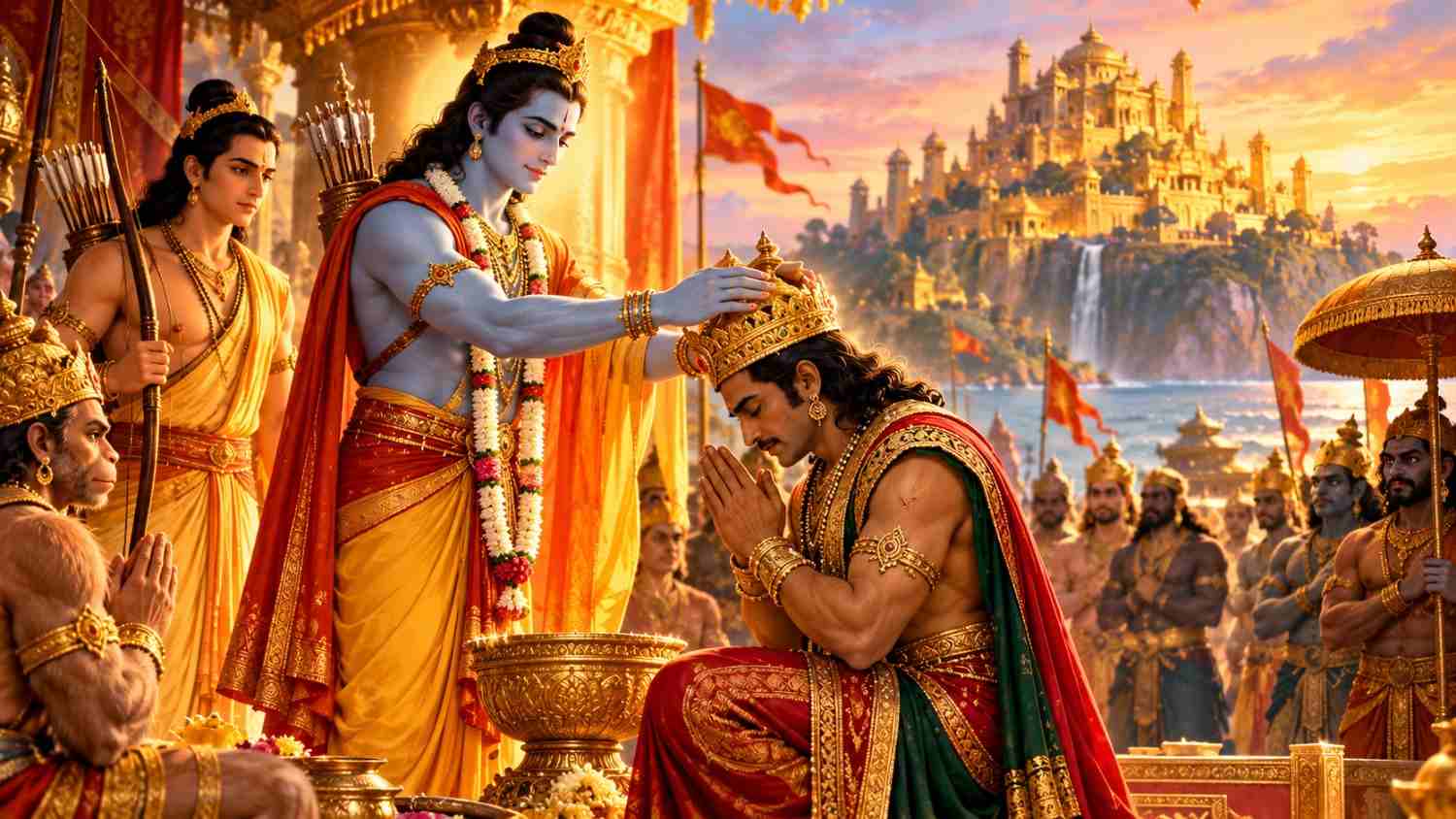
In Yuddha Kanda, Sarga 112, Shri Ram asks Lakshmana to arrange Vibhishana’s consecration. Lakshmana obtains a golden vessel, and monkey leaders bring water from the sea.
Lakshmana seats Vibhishana for the ceremony and consecrates him with the sea water, following the ritual described in the text. The rakshasas witness the ceremony, and the narrative describes the rakshasas and vanaras rejoicing.
If Vibhishana Had Not Become King, Who Could Have Ruled Lanka?
The Valmiki Ramayana does not name a definite alternative ruler who would have taken Lanka’s throne if Vibhishana had not been chosen. Ravana had a royal family, but the coronation narrative does not describe a formal contest between Vibhishana and another relative.
Indrajit, Ravana’s prominent son, had been killed during the war. It would be speculation to state that Mandodari, another relative, or a particular descendant would certainly have ruled instead.
What the text does establish is that Shri Ram had already promised the kingship to Vibhishana and later instructed Lakshmana to carry out the coronation. That is the succession the narrative records.
What Happened to Lanka After Ravana’s Death?
Vibhishana was consecrated king, marking the transition to a new ruler. The epic then continues with events following Ravana’s defeat and Shri Ram’s return journey.
The coronation is not the same as a detailed account of reconstruction. The cited passage does not describe every administrative decision, public project, or social change that may have followed. We can interpret the coronation as a step toward a new chapter for Lanka without inventing details the text does not provide.
What Happened to Shurpanakha After Ravana’s Death?
Shurpanakha plays an important role earlier in the Ramayana. Her encounter with Shri Ram and Lakshmana, followed by her approach to Ravana, becomes a major turning point in the events leading to Sita’s abduction and the war.
However, the main Valmiki Ramayana narrative does not give a clear, detailed account of Shurpanakha’s life after Ravana’s death and Vibhishana’s coronation. Her later fate should not be presented as settled fact on the basis of this text alone.
Other Ramayana retellings may give different details. Any specific account of her later life should be attributed to the tradition that tells it, rather than presented as a universal version.
Did Shurpanakha Cause the Entire Ramayana War?
Shurpanakha’s encounter with Shri Ram and Lakshmana is a crucial turning point. She eventually tells Ravana about Sita, and Ravana chooses to abduct her.
But it is too simple to place the entire responsibility for the war on Shurpanakha. The conflict develops through a chain of decisions, especially Ravana’s choice to abduct and refuse to return Sita. An event may set consequences in motion, but people remain responsible for the choices they make.
What Happened to Mandodari After Ravana’s Death?
Mandodari is remembered as Ravana’s principal queen in many familiar Ramayana traditions. Her later life is not described identically in every telling.
Some later traditions describe her subsequent relationship with Vibhishana. Details vary, so claims about her later life should be linked to a specific Ramayana tradition rather than treated as though every version tells the story in the same way.
Did Vibhishana Betray His Brother Ravana?
Vibhishana did leave Ravana’s side during the conflict. From the perspective of family allegiance, this can look like betrayal. But the story also shows Vibhishana opposing Ravana’s decisions and seeking refuge with Shri Ram.
His choice raises a lasting moral question: does loyalty require supporting every action of a loved one or a leader? The episode invites readers to reflect on the difference between standing by a person and standing by a principle.
What Does Vibhishana’s Coronation Teach Us About Dharma?
Choose principles over blind loyalty
Family loyalty does not require approval of every action.
Recognise conduct and service
The coronation passage highlights Vibhishana’s loyalty and help.
Honour your commitments
Shri Ram’s earlier promise is followed by the coronation.
Look beyond victory
The end of a conflict brings new responsibilities for the future.
The Deeper Lesson: What Happens After the War?
It is easy to focus on the moment an enemy falls. The more difficult question is what happens next. Who accepts responsibility? Who establishes order? How does a community move toward a different future?
Vibhishana’s coronation moves the Ramayana from Ravana’s defeat toward the establishment of a new ruler in Lanka. The episode does not answer every question about the kingdom’s future, but it shows that the story does not end with victory alone.
Frequently Asked Questions
1. Why did Shri Ram make Vibhishana king of Lanka?
In the Valmiki Ramayana, Shri Ram describes Vibhishana as loyal and as someone who had previously helped them. Shri Ram had also promised him the kingship before Ravana’s defeat.
2. Who ruled Lanka before Ravana?
Ravana’s rise to power is described differently across traditional accounts and should be discussed with reference to a particular Ramayana version. In the Valmiki narrative, Ravana is the ruler whose defeat leads to Vibhishana’s coronation.
3. If Vibhishana had not become king, who would have ruled Lanka?
The cited Valmiki Ramayana coronation passage does not name an alternative ruler. Naming a particular relative as the definite successor would be speculation.
4. Did Shri Ram want to rule Lanka himself?
The cited coronation passage describes Shri Ram directing Lakshmana to consecrate Vibhishana. It does not present Shri Ram as claiming Lanka’s throne for himself.
5. Was Vibhishana a traitor or a righteous man?
Vibhishana left Ravana’s side because he opposed Ravana’s decisions. The episode invites readers to consider whether loyalty to family should outweigh a commitment to dharma.
6. What happened to Shurpanakha after Ravana’s death?
The main Valmiki Ramayana narrative does not provide a clear, detailed account of Shurpanakha’s life after Ravana’s death. Later retellings may differ.
7. Did Shurpanakha cause the war between Shri Ram and Ravana?
Her encounter with Shri Ram and Lakshmana is an important turning point, and she eventually tells Ravana about Sita. However, Ravana’s decision to abduct and refuse to return Sita is central to the conflict that follows.
8. What happened to Mandodari after Ravana died?
Mandodari’s later life differs across Ramayana traditions. Some later accounts describe her subsequent relationship with Vibhishana. Such details should be attributed to a specific tradition.
9. What happened to Ravana’s son Indrajit?
Indrajit, also known as Meghanada, was killed during the war before Ravana’s final defeat. His death is one of the major losses suffered by Ravana’s side in the conflict.
10. What happened to Kumbhakarna?
Kumbhakarna fought on Ravana’s side and was killed during the war. His death occurs before Ravana’s final defeat in the Ramayana’s war narrative.
11. Who performed Vibhishana’s coronation?
Shri Ram instructed Lakshmana to perform Vibhishana’s consecration. The account describes sea water being used in the ceremony.
12. Did Shri Ram promise Vibhishana the throne before Ravana died?
Yes. In Yuddha Kanda, Sarga 19, Shri Ram says he will make Vibhishana king after Ravana is defeated. The coronation follows the victory.
13. What happened to Lanka after Ravana’s death?
Vibhishana was consecrated king. The coronation establishes a new ruler, although the cited passage does not provide a detailed account of Lanka’s long-term reconstruction.
14. Did Vibhishana help Shri Ram during the war?
Yes. Vibhishana joined Shri Ram’s side and provided assistance. The coronation passage itself refers to his previous service as one reason for Shri Ram’s decision.
15. What is the main lesson of Vibhishana becoming king?
The story connects dharma with responsible action, loyalty, service, and honouring commitments. It also marks the transition from Ravana’s defeat to a new ruler for Lanka.
Continue the Ramayana Journey
Episode 1 — After Ravana’s Death: What Did Shri Ram Do Next?
Continue the story with Shri Ram’s next steps after Ravana’s defeat.
Read Episode 1 on the Shloka Blog
.
Explore spiritual guidance: Talk to astrologers for a personal consultation, or explore free AI astrologers for an accessible way to explore astrology questions.
For daily astrological guidance, visit the daily horoscope .
References and Further Reading
The story of Vibhishana’s coronation is drawn from the Valmiki Ramayana. The following references provide translations and textual context for the main claims in this article.
- Valmiki Ramayana, Yuddha Kanda, Sarga 19. Shri Ram’s promise to make Vibhishana king after Ravana’s defeat. Read the passage .
- Valmiki Ramayana, Yuddha Kanda, Sarga 112. Shri Ram instructs Lakshmana to consecrate Vibhishana; the passage describes the sea water and the coronation. Read the English translation .
- Valmiki Ramayana, Yuddha Kanda, Sarga 112 — prose translation. An additional translation of the coronation sequence. Read the prose version .
Note: Ramayana traditions and translations may differ in chapter numbering and later narrative details. Claims about Shurpanakha’s or Mandodari’s later lives should be tied to a specific tradition. Where the cited Valmiki Ramayana passage does not provide an answer, this article states that limitation rather than presenting speculation as established fact.
What Happened to Shurpanakha and Mandodari After Ravana’s Death?
Ravana’s death changed the future of Lanka, but what happened to the people closest to him? Readers often wonder whether Shurpanakha returned to Lanka, what became of Mandodari, and whether Vibhishana married Ravana’s widow. The answers require care because different Ramayana traditions do not always tell later events in the same way.
What happened to Shurpanakha after Ravana’s death?
In the main narrative of the Valmiki Ramayana, Shurpanakha plays an important role in the events leading to Sita’s abduction. However, the text does not provide a clear, detailed account of her life after Ravana’s death. It is therefore more accurate to say that her later fate is not established by this narrative than to claim a specific ending without identifying another source.
What happened to Mandodari after Ravana died?
Mandodari, Ravana’s queen, is an important figure in Ramayana traditions. Accounts of her later life vary. Some later retellings describe her relationship with Vibhishana after Ravana’s death, but readers should check which version is being discussed rather than assuming every detail appears identically in the Valmiki Ramayana.
Why do different Ramayana versions tell the story differently?
The Ramayana has been retold across regions, languages, religious traditions, and literary forms. The Valmiki Ramayana, the Ramcharitmanas, and regional or folk retellings can differ in emphasis and narrative detail. A story found in one version should not automatically be attributed to every version.
This distinction does not make one question less meaningful than another. It helps readers understand what a particular text actually says and where a later tradition adds its own interpretation.
Frequently Asked Questions About Shurpanakha and Mandodari
1. Did Shurpanakha die after Ravana’s death?
The main Valmiki Ramayana narrative does not clearly establish Shurpanakha’s fate after Ravana’s death. A definite claim about her death would need a specific supporting source from another Ramayana tradition.
2. Did Shurpanakha return to Lanka after the war?
The cited Valmiki Ramayana narrative does not provide a clear account confirming that she returned to Lanka after the war. Her later movements should not be stated as fact without identifying a source.
3. Did Vibhishana marry Mandodari?
This claim appears in some later tellings and popular accounts, but details vary between Ramayana traditions. It should be attributed to the particular version that describes it rather than presented as a universal account.
4. Was Mandodari punished after Ravana’s defeat?
The question assumes a particular outcome that should not be taken for granted. The account of Ravana’s defeat and Vibhishana’s coronation does not establish a universal story in which Mandodari is punished. Later accounts should be checked individually.
5. Is the Valmiki Ramayana different from the Ramcharitmanas?
Yes. They are distinct works composed in different languages and literary contexts. Their presentation, emphasis, and some narrative details differ, so a claim from one text should be checked before being attributed to the other.
6. Why do people disagree about what happened after Ravana died?
Not every Ramayana tradition narrates the characters’ later lives in the same way. Some popular stories come from later retellings, regional traditions, or modern interpretations. Identifying the source helps distinguish a textual account from a later interpretation.
In short: when asking what happened to Shurpanakha or Mandodari after Ravana’s death, the most responsible approach is to identify the Ramayana tradition being discussed. Where the cited text does not provide an answer, uncertainty is more accurate than an invented ending.